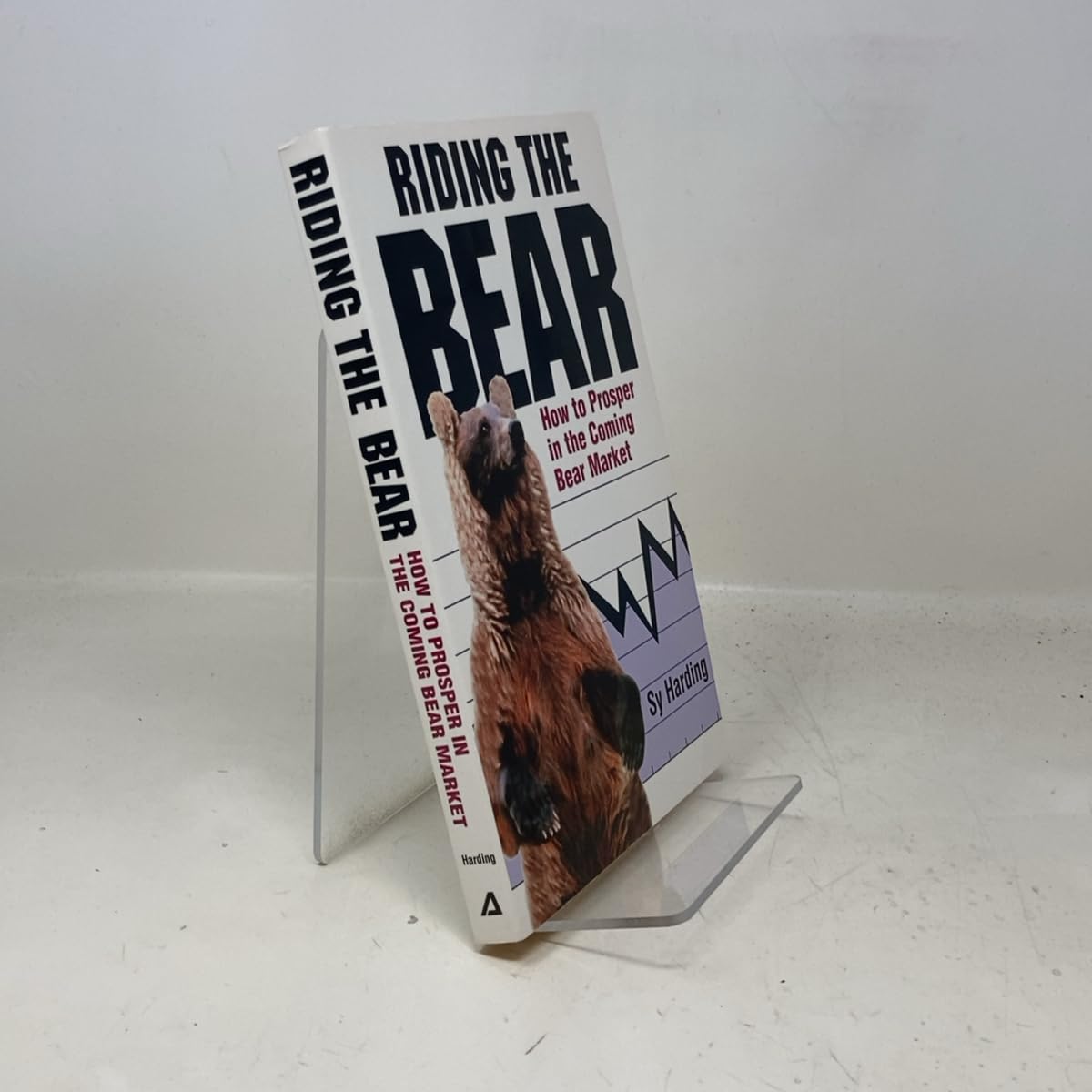



Over the last 100 years there have been 29 serious stock market corrections, with declines averaging 31.6%. There were ten in which the declines averaged 49.4%. In those, investors lost half of their invested assets. Yet, in the upside of every cycle, the endurance of the bull market transports investors into a state of confidence where they believe this time will be different. The record-breaking bull market of the 1990s certainly has had that effect, the excitement enticing investors into the market as never before, carrying them away on a euphoric wave of confidence that they've discovered something new, a risk-free money machine. History shows otherwise. Eighty percent of public investors wind up losing money in the stock market over the long term, because few emerge financially intact from the periodic bear markets. Riding the Bear is aimed at ending that vicious cycle for its readers. It explains clearly why bear markets are inevitable, why the next one is just around the corner, and will be the longest and most severe since 1929. But Riding the Bear is not just about bear markets. Readers learn how to maximize profits in a bull market, and unlike buy and hold investors, keep those profits, and go on to make more in bear markets. It introduces a simple, mechanical system, discovered during the research, that over the last 35 years would have almost tripled the gain of a buy and hold strategy, and with half the risk. It should work for the next 35 years. Riding the Bear also reveals the truth about Wall Street, its misleading propaganda and deceptions, and teaches its readers to be street smart. As subscribers to Sy Harding's Street Smart Report have come to expect, Riding the Bear tells it like it is, in plain English. Just two chapters "Public Investors versus Wall Street" and "What Causes Bear Markets" are more than worth the price. Thanks to the exciting bull market of the 1990s, there are now more than 40 million investors in the U.S., and they have far and away more money, and a higher percentage of their net worth at risk in the market than ever before in history. Unfortunately, 85% of that money flowed into the market in just the last five years, and so has never experienced a bear market or anything like a bear market. Most of those new investors are not only unprepared, but are unaware of what they will inevitably face at some point, sooner rather than later. I fear for them. And I despair in the knowledge that a book by an unknown author will reach so relatively few of them. I hope readers will help spread the word of its value. Shakespeare or a John Grisham novel it is not. But honest, outspoken, and unafraid to tromp on Wall Street's self-serving propaganda it is. Riding the Bear will be a virtual life jacket for those it reaches. Sy Harding is the founder and president of Asset Management Research Corp., which has been providing stock market research to institutions and serious investors for 12 years. He publishes Sy Harding's Street Smart Report , an investment advisory newsletter. Mr. Harding has been consistently ranked in the "Top 10 Market Timers in the U.S.", compiled by Timer Digest, and is frequently quoted in the financial media. A new investor once wrote me to ask what I meant by the term 'market correction'. What is it that the market is correcting when it declines, she wanted to know. The answer, of course, is that it's correcting the excesses created by the previous bull market. The almost uncontrolled frenzy to own stocks at any price, which takes place as a bull market matures, boosts stock prices to unreasonable levels related to the value of the company the stock represents. The euphoria causes investors to lose touch with reality and commit an excessive portion of their assets and future security to the vagaries of the market. Those overvalued and overbought extremes eventually become unsustainable and have to be "corrected". Who says so? Why can't people just keep buying? Why can't the market just keep rising? Why does it have to become unsustainable? For one thing, because the higher the market rises, the more new money it requires to keep it rising, while the more money investors put in the market, the closer they come to running out of money. Think back to our analogy of the stock market being like a flowing river. As the river, being flooded by melting snows and torrential rains, continues to rise, it must have an increasingly larger volume of water flowing in to keep it rising. It takes twice as much additional water to raise a 50 foot wide river 2 inches as it took when it was only 25 feet wide. If the inflow of water does not continue to grow, the river will stop rising. If the inflow of water decreases to any degree at all, the high water conditions will begin to recede. From years of experience, everyone knows the rising river cannot continue rising forever. There is only so much snow to melt. So it is with the stock market. The higher the ma