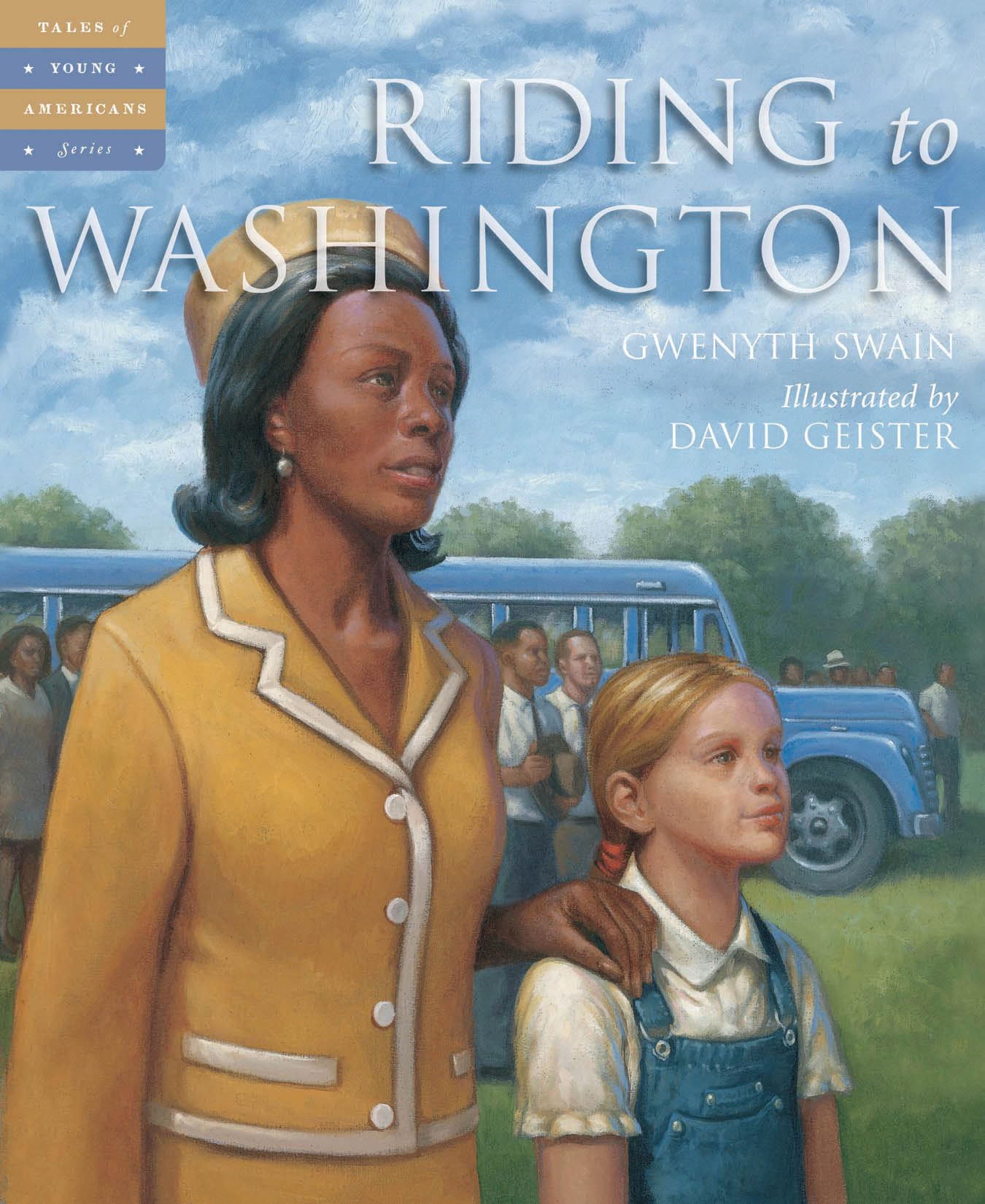



Janie is not exactly sure why her daddy is riding a bus from Indianapolis to Washington, D.C. She knows why she has to go-to stay out of her mother's way, especially with the twins now teething. But Daddy wants to hear a man named Dr. Martin Luther King Jr. speak and, to keep out of trouble, Janie is sent along. Riding the bus with them is a mishmash of people, black and white, young and old. They seem very different from Janie. As the bus travels across cities and farm fields to its historic destination, Janie sees firsthand the injustices that many others are made to endure. She begins to realize that she's not so different from the other riders and that, as young as she is, her actions can affect change.Though fiction, Riding to Washington is a very personal story for Gwenyth Swain as both her father and grandfather rode to Washington, D.C., to participate in the 1963 civil rights march on the nation's capital. Ms. Swain's other books include Chig and the Second Spread and I Wonder As I Wander. She lives in St. Paul, Minnesota. Artist David Geister has entertained audiences for years with his costumed portrayals of historic characters from the nineteenth century, and his artwork reflects his interest in history and dramatic storytelling. Riding to Washington is his third title with Sleeping Bear Press. David lives in Minneapolis, Minnesota. Grade 1–4—Swain bases this story on her father's remembrances of attending the August 1963 March on Washington, DC. Fed up with Janie's impulsive behavior, Mama sends the girl on a bus trip with her father to hear Martin Luther King, Jr., speak at the Lincoln Memorial. Not many "black folks" live in Janie's part of Indianapolis, but she's seen TV news reports of "coloreds" being sprayed with fire hoses and chased by police dogs in the South. While boarding the bus, she meets the wife of one of her father's employees. Mrs. Taylor is an elegant black woman who wears a matching suit and "hat like Mrs. Kennedy." During the journey, the driver can't locate a restaurant that will serve a "mixed crowd." When they stop at a gas station, Mrs. Taylor decides to ignore the "No Coloreds" sign over the restroom door. Inspired by her determination, Janie accompanies the woman and helps teach the young attendant a quiet lesson in compassion. Listening to Dr. King speak, Janie realizes that his dream is important for everyone, not just African Americans. The text effectively describes Janie's experiences, and readers can easily imagine how they would respond in similar situations. The illustrations provide a strong sense of the period. The soft earth tones and rounded forms create a mood of safety and stability. This heartfelt tale provides an unusual and compelling perspective on a historical event.— Lucinda Snyder Whitehurst, St. Christopher's School, Richmond, VA Copyright © Reed Business Information, a division of Reed Elsevier Inc. All rights reserved. Traveling by bus with her dad to Washington, D.C., in August 1963, a young girl from an all-white neighborhood isn’t sure what awaits her. But on the journey, she encounters discrimination when restaurants refuse to serve mixed crowds, and she’s made aware of a No Coloreds sign at a gas-station restroom, which she helps a passenger challenge. Then, as part of the huge gathering in Washington, she hears a speech by Dr. King, and she understands that the dream he speaks of belongs to everyone. Geister’s unframed, period paintings give a strong sense of the times, from the large picture of the bus on the road to the close-up portraits of the girl and the African American friend she makes during their travels. The child’s viewpoint personalizes those archival images of the great March on Washington in this entry in the Tales of Young Americans series. Grades K-3. --Hazel Rochman Gwenyth Swain is the youngest of five sisters and the only one to live outside her native state of Indiana. She writes partly to let folks back home know that shes keeping busy through the long Minnesota winters and partly because writing is the best job she can imagine having. She enjoys weaving family stories and historical events together in fiction. Ms. Swain is the author of two middle-grade novels— Shady Grove (Indiana Historical Society Press) and Chig and the Second Spread (Delacorte)—and the historical picture book I Wonder As I Wander (W.B. Eerdmans), illustrated by Ronald Himler. She lives in St. Paul, Minnesota, with her husband, Vinnie, and their two children. Artist Dave Geister tells stories through his historical paintings and costumed storytelling. He enjoys doing school visits almost as much as painting children’s book illustrations. Teachers and librarians often comment on the rapport that Dave establishes with children and staff and how he encourages them to do their art. Dave is married to Pat Bauer, author of his most recent book B is for Battle Cry: A Civil War Alphabet .