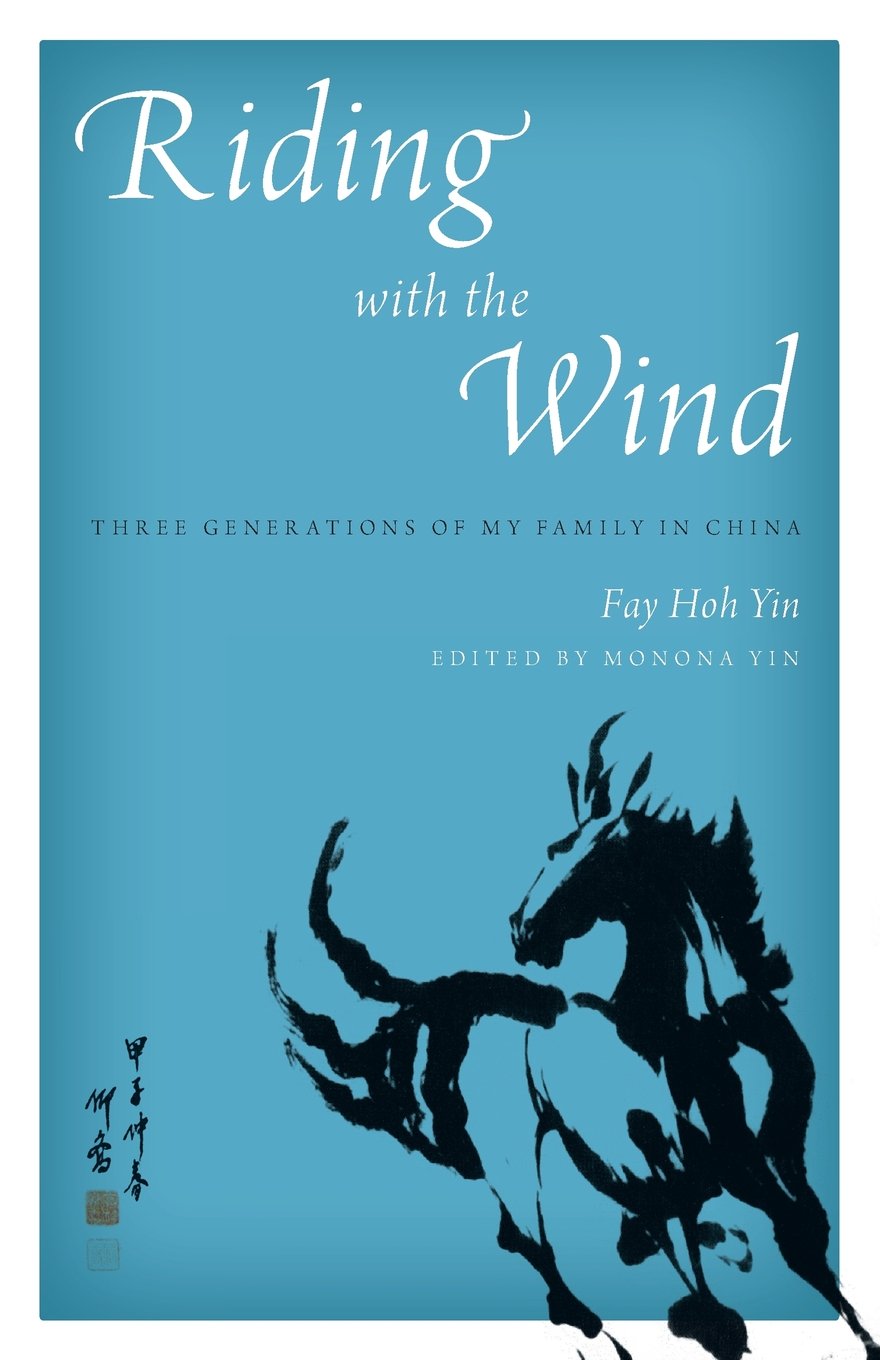



In Riding with the Wind, Fay Hoh Yin paints an indelible portrait of three generations of her family in China as the imperial era ends and war with Japan begins. Her parents are among the first young people to escape the archaic traditions of foot binding and arranged marriage, then use their newfound freedom to study in the West. They return home in the early 1920s to become pioneering educators and proponents of physical fitness and sports. In lyrical prose, the author recalls scenes from her improbably happy childhood amid bombs and atrocities.Yin later comes to the U.S. herself, marries a fellow foreign student, and starts a family. Tragically, she loses her husband at age thirty-seven, but forges a unique partnership with her widowed mother-in-law that far outlasts either of their marriages. Yin’s stories of daring, hardship, and perseverance are deeply personal, yet illuminate the changing roles of women in 20th century China and the United States. After I retired in 1991, the urge to write about my family and my childhood in China bubbled up and became irresistible. Over the next twenty-plus years, I worked on these pieces on and off whenever the mood struck me. In 1995, I began taking writing classes at the Academy of Lifelong Learning, University of Delaware. There my teachers and fellow students encouraged me to continue telling stories about "my China." Apart from my own experiences, these are the stories my parents, my aunt, and my mother-in-law told me countless times. Both my parents had illustrious careers and many articles were written about them. My father also wrote his autobiography. These became references for my writing. I couldn't help but include my parents' public lives but, more importantly, I wanted to show them as loving parents and grandparents.I wanted to share their lives, struggles, sacrifices, and survival in a tumultuous, changing time in China. I also wanted my children to learn more about their young father, whose life was cut short in an accident in 1969. It only became obvious to me after I finished writing that each generation passed on their love to the next in the best way they knew how. This love fortified their children in their own times of hardship and became the strength behind their survival. As I was writing, I realized that "my China" had ceased to exist around the early 1950s when I left; it bears no resemblance to the China that has progressed and changed relentlessly for the last sixty years. It cannot be found in today's Taiwan either, where I lived for two years. Still, I am partial to my China as a time when life was slower paced, family was at the center of everything, and honoring one's elders and keeping one's promises were revered practices.Three-quarters of the nineteen years that I lived in China took place during the war with Japan. We were refugees in our own country--constantly running, dodging, and trying to stay ahead of the invading Japanese army. We were lucky that nobody in our family was killed. In spite of that, I had a wonderful childhood and many sweet memories. Against a backdrop of chaos and terror, my parents somehow managed to make happy times.This, then, is my China with all its blemishes and beauty. Fay Hoh Yin was born in Beijing in 1932 to a family of educators. She grew up while China was wracked by almost two decades of war--first with Japan and then civil war between the Chinese Nationalists and Communists. She and her family fled thousands of miles to escape the chaos, finally settling in Taiwan in 1949. Two years later, she came to the U.S. as a foreign student and earned a Ph.D. in biochemistry from the University of Wisconsin. Fay married Ted Yin in 1958 and they had a son and daughter. After being widowed in 1970, she took up international folk dancing, which remained her passion for more than forty years. Fay retired in 1991 after working for twenty-six years as a virologist for the DuPont Company in Wilmington, Delaware.