Right and Wronged in International Relations (Cambridge Studies in International Relations)
$34.99
by Brian C. Rathbun



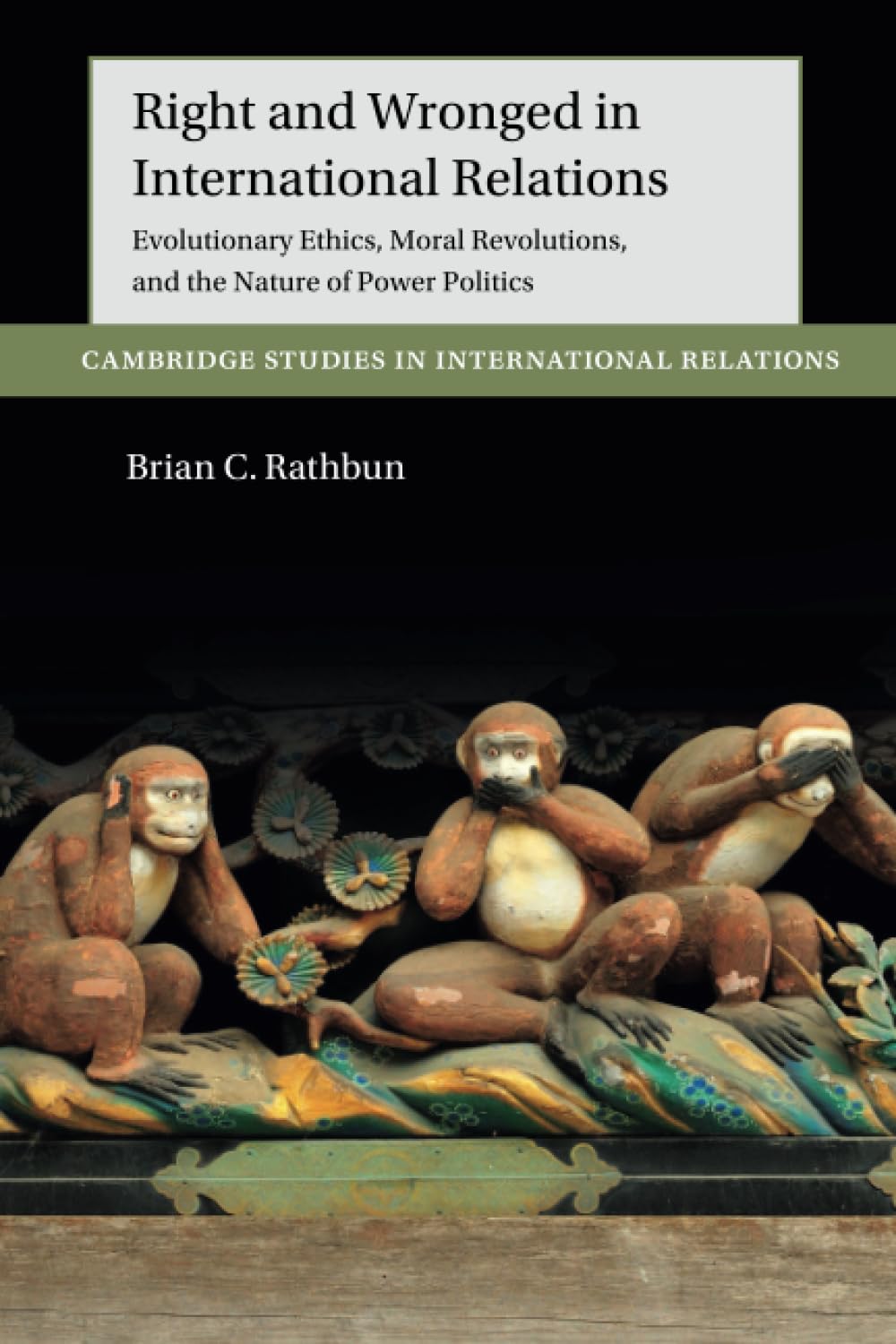
Brian Rathbun argues against the prevailing wisdom on morality in international relations, both the commonly held belief that foreign affairs is an amoral realm and the opposing concept that norms have gradually civilized an unethical world. By focusing on how states respond to being wronged rather than when they do right, Rathbun shows that morality is and always has been virtually everywhere in international relations – in the perception of threat, the persistence of conflict, the judgment of domestic audiences, and the articulation of expansionist goals. The inescapability of our moral impulses owes to their evolutionary origins in helping individuals solve recurrent problems in their anarchic environment. Through archival case studies of German foreign policy; the analysis of enormous corpora of text; and surveys of Russian, Chinese, and American publics, this book reorients how we think about the role of morality in international relations. ‘This exciting book rejects realist, moralist, and constructivist accounts of international ethics in favor of a biology-based conception of evolutionary ethics that, even if it does not convince readers, will fundamentally challenge them. And the extended exploration of the ‘hard case’ of Wilhelmine and Nazi Germany is of great substantive and methodological interest.’ Jack Donnelly, Josef Korbel School of International Studies, University of Denver ‘Scholars have long argued that international politics are fundamentally amoral - if not immoral. Brian Rathbun’s outstanding book should put a stop to those claims. Drawing upon evolutionary theory and psychology, he shows us how political communities act to protect their own deeply held moral beliefs and condemn the actions of others. He relies on a wealth of empirical evidence, including quantitative content analysis, contemporary surveys, and deep archival work, to back his ambitious claims. This book is likely to become a necessary reference for any serious student of morality and international politics.’ Stacie E. Goddard, Political Science Department, Wellesley College ‘Complementing deep scholarship with a healthy dollop of humor, Rathbun skillfully applies the modern interdisciplinary science of morality to international relations. The result is both surprising and profound, and will be of immense interest to readers well beyond the academic fields synthesized in these pages. This remarkable book manages to craft an understanding of international conflicts with eyes wide open to the full range of human nature, from the morally horrific to the morally sublime.’ Jesse Graham, Eccles School of Business, University of Utah ‘Brian Rathbun has produced an important book on how the spread of ethics has changed the nature of international relations. The argument is novel, clearly stated and developed, and rooted in psychological research.’ Richard Ned Lebow, Department of War Studies, King's College London ‘This new approach to morality and international relations is provocative and insightful. Rathbun's book should be widely read and debated.’ Scott D. Sagan, Freeman Spogli Institute, Stanford University ‘An interesting contribution to the literature on the role of morality in international politics, arguing that morality is everywhere, even in places where we might least expect it. This book will have wide impact, not only in international relations (IR) theory, but also in political theory, evolutionary ethics, moral psychology, philosophy, and history.’ David Traven, Department of Political Science, California State University, Fullerton Countering the opposing narratives of political amorality and moral progressivism, Rathbun provides a new approach to the place of morality in international politics. Brian C. Rathbun is the author of four other books on international affairs and is a Distinguished Scholar of the International Studies Association. His latest book with Cambridge University Press, Reasoning of State (2019), won the 2020 award for best book on foreign policy from the American Political Science Association.