Rightlessness: Testimony and Redress in U.S. Prison Camps since World War II (Studies in United States Culture)
$14.99
by A. Naomi Paik



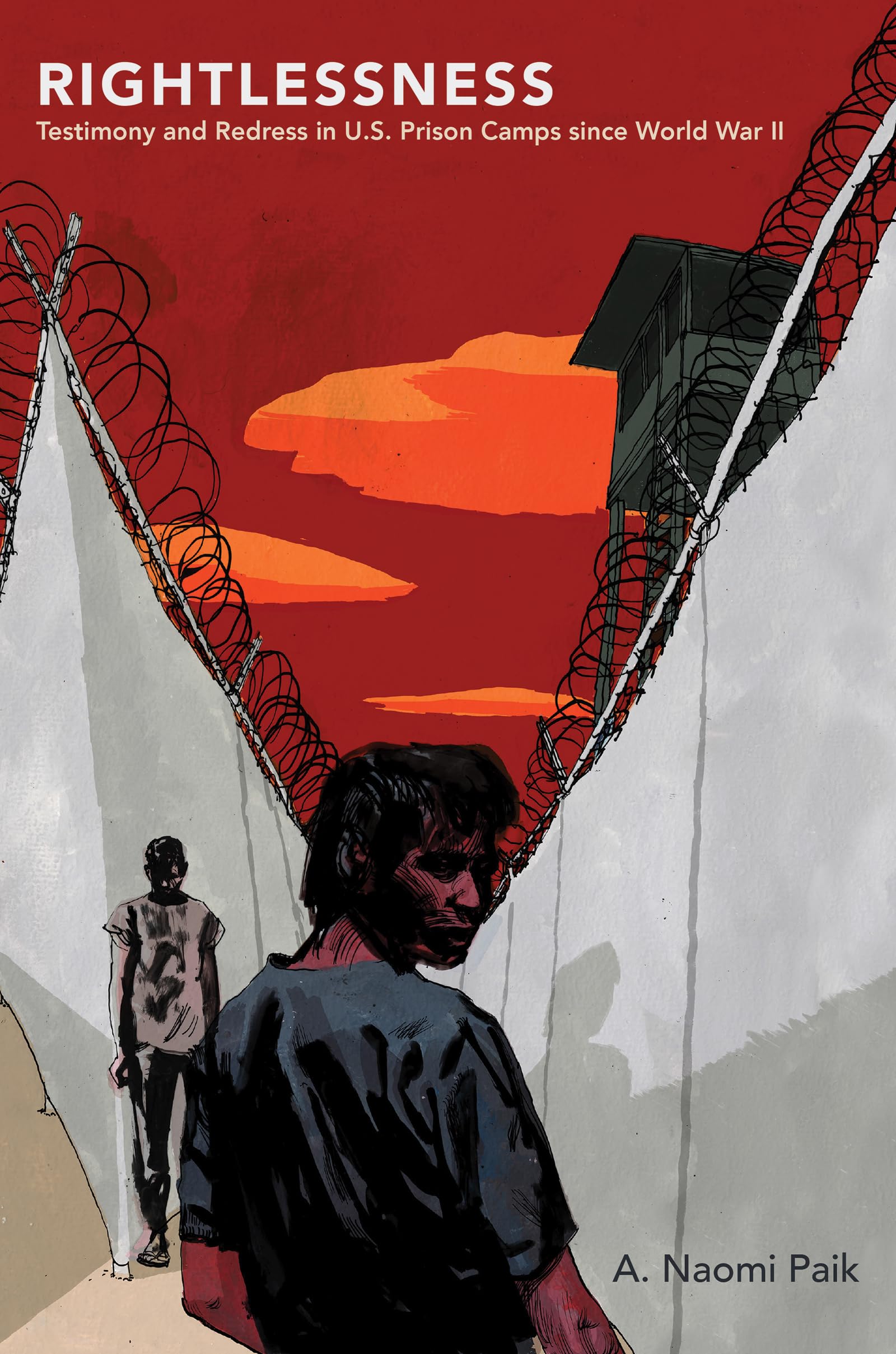
In this bold book, A. Naomi Paik grapples with the history of U.S. prison camps that have confined people outside the boundaries of legal and civil rights. Removed from the social and political communities that would guarantee fundamental legal protections, these detainees are effectively rightless, stripped of the right even to have rights. Rightless people thus expose an essential paradox: while the United States purports to champion inalienable rights at home and internationally, it has built its global power in part by creating a regime of imprisonment that places certain populations perceived as threats beyond rights. The United States' status as the guardian of rights coincides with, indeed depends on, its creation of rightlessness. Yet rightless people are not silent. Drawing from an expansive testimonial archive of legal proceedings, truth commission records, poetry, and experimental video, Paik shows how rightless people use their imprisonment to protest U.S. state violence. She examines demands for redress by Japanese Americans interned during World War II, testimonies of HIV-positive Haitian refugees detained at Guantánamo in the early 1990s, and appeals by Guantánamo’s enemy combatants from the War on Terror. In doing so, she reveals a powerful ongoing contest over the nature and meaning of the law, over civil liberties and global human rights, and over the power of the state in people’s lives. “With its interdisciplinary methodology and incisive critical analysis, Paik’s powerful book documents an important chapter in the history of rights and stands as a challenge to further expansions in rightlessness.”— Law and History Review “An astute assault . . . Paik’s careful and innovative construction balances her intellectual framing with the voices of those who—in the process of being incarcerated, tortured, or simply studied by those possessed of rights—refuse to be silenced.”— Journal of American History “An excellent book . . . Paik demonstrates that the production of . . . so-called outsides to rights are not new nor are they specific to any particular presidential administration.”— Society and Space “Paik facilitates a contextualized rethinking of the theoretical and historical technologies of racism.”— Public Books “A useful and necessary tool for thinking about how discourse on rights is continuously unchallenged and marked by U.S. global dominance. Rightlessness is an indispensable text that must be used to understand how other populations are rendered rightless, particularly during this moment in time where discourse on rights is privileged political discourse entangled with the expansion of the imprisonment regime.”— Hemispheric Institute “Paik’s comparative analysis of three camps used by the US government to hold people in a state of rightlessness is provocative and raises many crucial issues in understanding state authority within a rights-based framework.”— American Historical Review “A provocative critique of the state that is accessible and relevant to all readers, in and outside of academia. Paik excavates the testimonies of those made politically voiceless and re-presents US prison camps since World War II as xenophobic, interrelated, and directly indicative of neoliberal US politics, not the exception to them.”— Ethnic and Third World LIteratures “Useful for comparative history of political captivity. Recommended.”— CHOICE “The book is a valuable resource for researchers in the fields of law and various social sciences as it shows how rightlessness is increasingly becoming a way for states to assert authority and how the above paradox has become a feature of globalized governance.”— Border Criminologies “A. Naomi Paik’s meticulous book opens new interpretative approaches to fundamental problems of U.S. sovereignty and democracy. A challenging historical survey of the relationship between normal styles of government and states of emergency has been artfully combined with a bold defense of the value of rights in the struggles of the excluded, racialized, and incarcerated.” — Paul Gilroy, Professor of American and English Literature, King’s College London Powerful testimonies from those denied the fundamental right to even have rights A. Naomi Paik is associate professor of criminology, law, and justice and global Asian studies at the University of Illinois, Chicago.