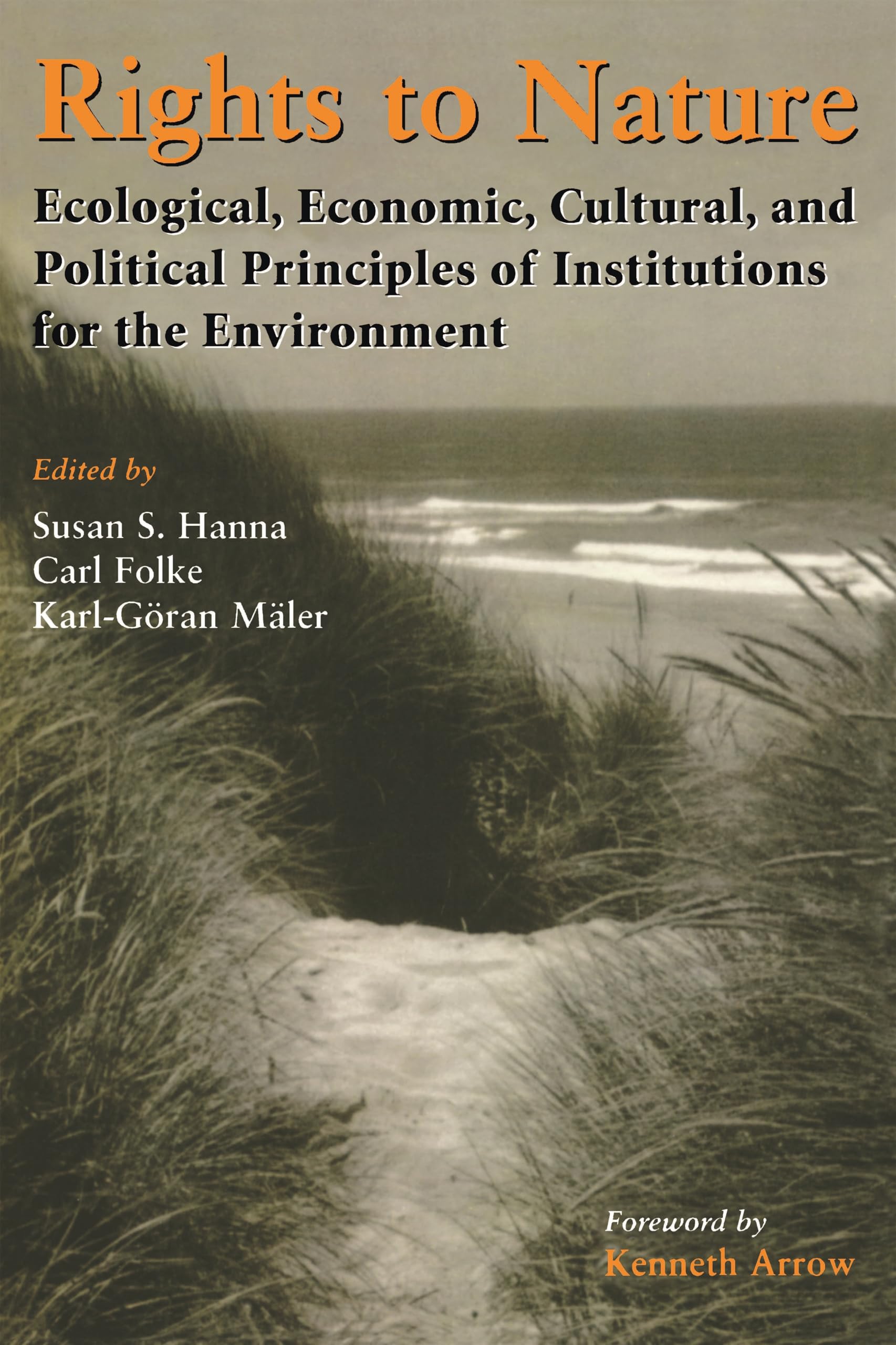
Rights to Nature: Ecological, Economic, Cultural, and Political Principles of Institutions for the Environment
$58.00
by Susan Hanna



Property rights are a tool humans use in regulating their use of natural resources. Understanding how rights to resources are assigned and how they are controlled is critical to designing and implementing effective strategies for environmental management and conservation. Rights to Nature is a nontechnical, interdisciplinary introduction to the systems of rights, rules, and responsibilities that guide and control human use of the environment. Following a brief overview of the relationship between property rights and the natural environment, chapters consider: ecological systems and how they function - the effects of culture, values, and social organization on the use of natural resources - the design and development of property rights regimes and the costs of their operation - cultural factors that affect the design and implementation of property rights systems - coordination across geographic and jurisdictional boundaries The book provides a valuable synthesis of information on how property rights develop, why they develop in certain ways, and the ways in which they function. Representing a unique integration of natural and social science, it addresses the full range of ecological, economic, cultural, and political factors that affect natural resource management and use, and provides valuable insight into the role of property rights regimes in establishing societies that are equitable, efficient, and sustainable. Carl Folke works at the Beijer International Institute of Ecological Economics. As a political economist, Elinor Ostrom studied how institutions―conceptualized as sets of rules―affect the incentives of individuals interacting in repetitive and structured situations. Ostrom and her colleagues at the Workshop in Political Theory and Policy Analysis at Indiana University developed the Institutional Analysis and Development framework, which enables them to analyze diversely structured markets, hierarchies, common-property regimes and local public economies using a common set of universal components. Large-scale studies of urban public economies demonstrated that systems composed of a few large-scale producers of services, such as forensic laboratories and training academies, combined with a large number of autonomous direct service producers (such as crime and traffic patrol) perform more effectively at a metropolitan level than a few consolidated producers. More recent empirical studies in the field and in the experimental laboratory have challenged the presumption that individuals jointly using a common-pool resource would inexorably be led to overuse, if not destroy, the resource. The design principles characterizing robust self-governed resource systems have been identified. An initial theory of institutional change has been formulated and is being tested. In 2009, Elinor Ostrom became the first woman to receive the prestigious Nobel Memorial Prize in Economic Sciences. Dr. Ostrom passed away on June 12, 2012. Rights to Nature Cultural, Economic, Political, and Economic Principles of Institutions for the Environment By Susan S. Hanna, Carl Folke, Karl-Goran Maler ISLAND PRESS Copyright © 1996 Island Press All rights reserved. ISBN: 978-1-55963-490-8 Contents Title Page, Copyright Page, About the Contributors, Foreword, CHAPTER 1 - Property Rights and the Natural Environment, PART I - The Interface Between Social and Ecological Systems, CHAPTER 2 - The Structure and Function of Ecological Systems in Relation to Property-Rights Regimes, CHAPTER 3 - Human Use of the Natural Environment: An Overview of Social and Economic Dimensions, CHAPTER 4 - Dynamics of (Dis)harmony in Ecological and Social Systems, CHAPTER 5 - Social Systems, Ecological Systems, and Property Rights, PART II - The Structure and Formation of Property Rights, CHAPTER 6 - Common and Private Concerns, CHAPTER 7 - The Formation of Property Rights, CHAPTER 8 - The Economics of Control and the Cost of Property Rights, PART III - Culture, Economic Development, and Property Rights, CHAPTER 9 - Culture and Property Rights, CHAPTER 10 - Property Rights and Development, PART IV - Property Rights at Different Scales, CHAPTER 11 - Common-Property Regimes as a Solution to Problems of Scale and Linkage, CHAPTER 12 - Rights, Rules, and Resources in International Society, CHAPTER 13 - Building Property Rights for Transboundary Resources, Index, Island Press Board of Directors, CHAPTER 1 Property Rights and the Natural Environment SUSAN HANNA, CARL FOLKE, AND KARL-GÖRAN MÄLER Introduction This book is about the human use of nature. More specifically, it is about the systems of rights, rules, and responsibilities that guide and control the human use of the natural environment. As we near the end of the twentieth century, the challenge of using and sustaining the capacity of the environment to generate a continuous flow of resources and services becomes ever more difficult. The globali