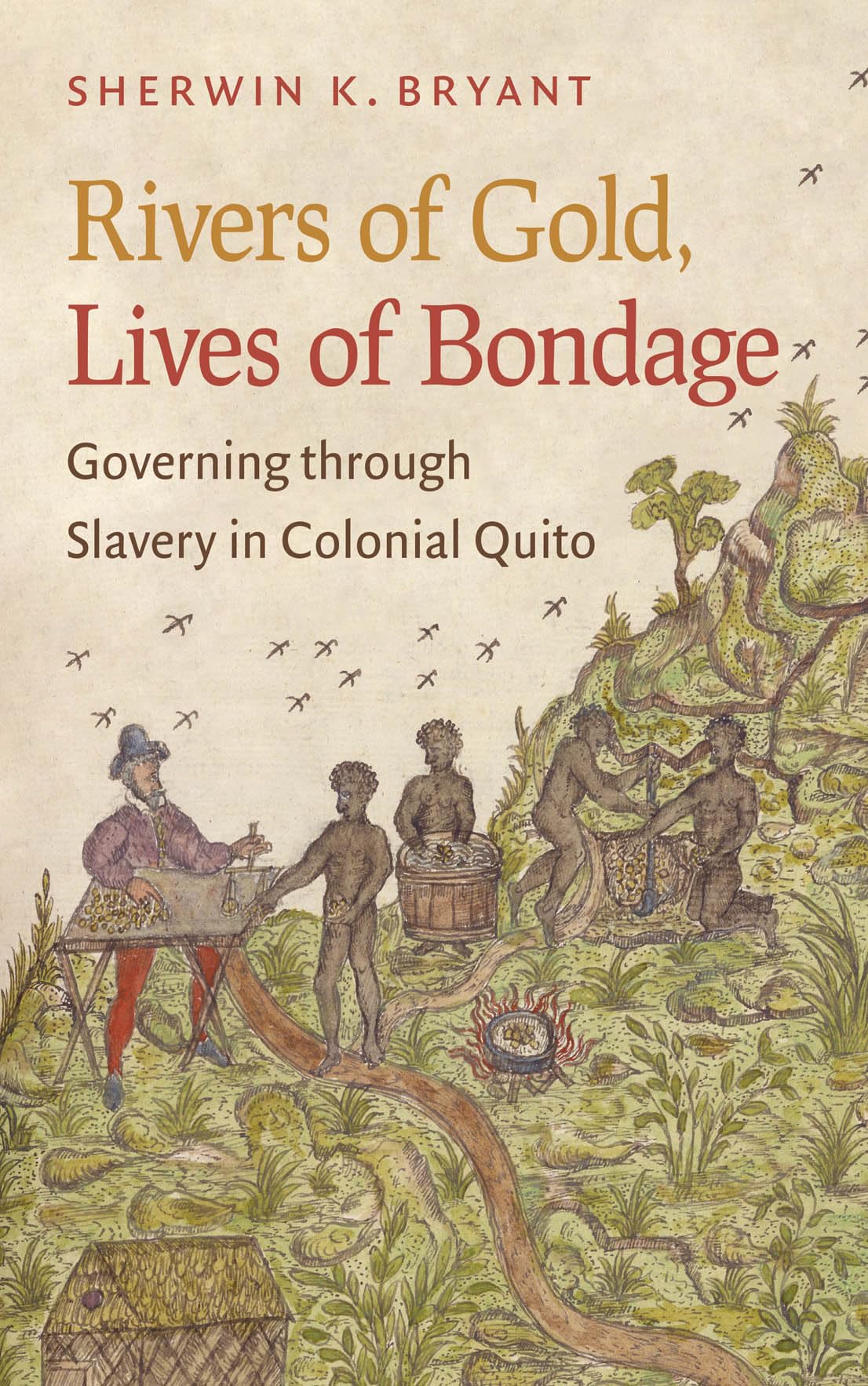
Rivers of Gold, Lives of Bondage: Governing through Slavery in Colonial Quito
$27.95
by Sherwin K. Bryant



In this pioneering study of slavery in colonial Ecuador and southern Colombia — Spain’s Kingdom of Quito — Sherwin Bryant argues that the most fundamental dimension of slavery was governance and the extension of imperial power. Bryant shows that enslaved black captives were foundational to sixteenth-century royal claims on the Americas and elemental to the process of Spanish colonization. Following enslaved Africans from their arrival at the Caribbean port of Cartagena through their journey to Quito, Bryant explores how they lived during their captivity, formed kinships and communal affinities, and pressed for justice within a slave-based Catholic sovereign community. In Cartagena, officials branded African captives with the royal insignia and gave them a Catholic baptism, marking slaves as projections of royal authority and majesty. By licensing and governing Quito’s slave trade, the crown claimed sovereignty over slavery, new territories, natural resources, and markets. By adjudicating slavery, royal authorities claimed to govern not only slaves but other colonial subjects as well. Expanding the diaspora paradigm beyond the Atlantic, Bryant’s history of the Afro-Andes in the early modern world suggests new answers to the question, what is a slave? “Offers a new perspective on early modern empire making. . . . A welcome addition that contributes to scholarship on slavery, imperial governance, and legal cultures.”— Hispanic American Historical Review “Reasserts through a varied and rich set of lenses how colonization, enslavement and race governance was enacted through royal impositions.”— Slavery & Abolition “Bryant’s exhaustive archival work yields new insights into the periodization of what he describes as the ‘black radical discourse’ of slaves”— Colonial Latin American Historical Review “Enriched by solid archival research and interdisciplinary orientation that has resulted in deeper understanding of Spanish colonial legal culture. . . . An invaluable research tool to scholars working on the history of slavery, African diaspora, Afro-Creole studies, and Colonial Latin American studies.”— Sixteenth Century Journal “Deeply researched and carefully structured.”— Journal of Historical Geography “A well-researched and eloquently written contribution to research on the Audiencia of Quito.”— American Historical Review “ Rivers of Gold takes slaves' court cases and petitions as useful strategies for challenging oppression, thereby reaching beyond individual outcomes to make a broader argument about how slaves fought their subjugation from within the system.”— Latin American Research Review “A very smart book. Bryant makes a powerful argument for slavery as integral, even indispensable, to the colonial process in Quito. His book will stand as a truly important contribution to the history of Latin America and slave studies more broadly.”—James H. Sweet, author of Domingos Álvares, African Healing, and the Intellectual History of the Atlantic World Blackness and power in the colonial Andes In this pioneering study of slavery in colonial Ecuador and southern Colombia--Spain's Kingdom of Quito--Sherwin K. Bryant argues that the most fundamental dimension of slavery was governance and the extension of imperial power. Bryant shows that enslaved black captives were foundational to sixteenth-century royal claims on the Americas and elemental to the process of Spanish colonization. Following enslaved Africans from their arrival at the Caribbean port of Cartagena through their journey to Quito, Bryant explores how they lived during their captivity, formed kinships and communal affinities, and pressed for justice within a slave-based Catholic sovereign community. Sherwin K. Bryant is associate professor of African American studies and history at Northwestern University.