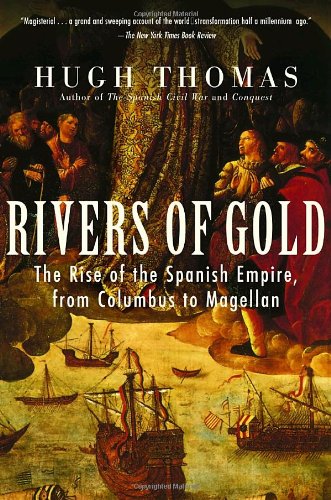
Rivers of Gold: The Rise of the Spanish Empire, from Columbus to Magellan
$25.00
by Hugh Thomas



From one of the greatest historians of the Spanish world, here is a fresh and fascinating account of Spain’s early conquests in the Americas. Hugh Thomas’s magisterial narrative of Spain in the New World has all the characteristics of great historical literature: amazing discoveries, ambition, greed, religious fanaticism, court intrigue, and a battle for the soul of humankind. Hugh Thomas shows Spain at the dawn of the sixteenth century as a world power on the brink of greatness. Her monarchs, Fernando and Isabel, had retaken Granada from Islam, thereby completing restoration of the entire Iberian peninsula to Catholic rule. Flush with success, they agreed to sponsor an obscure Genoese sailor’s plan to sail west to the Indies, where, legend purported, gold and spices flowed as if they were rivers. For Spain and for the world, this decision to send Christopher Columbus west was epochal—the dividing line between the medieval and the modern. Spain’s colonial adventures began inauspiciously: Columbus’s meagerly funded expedition cost less than a Spanish princess’s recent wedding. In spite of its small scale, it was a mission of astounding scope: to claim for Spain all the wealth of the Indies. The gold alone, thought Columbus, would fund a grand Crusade to reunite Christendom with its holy city, Jerusalem. The lofty aspirations of the first explorers died hard, as the pursuit of wealth and glory competed with the pursuit of pious impulses. The adventurers from Spain were also, of course, curious about geographical mysteries, and they had a remarkable loyalty to their country. But rather than bridging earth and heaven, Spain’s many conquests bore a bitter fruit. In their search for gold, Spaniards enslaved “Indians” from the Bahamas and the South American mainland. The eloquent protests of Bartolomé de las Casas, here much discussed, began almost immediately. Columbus and other Spanish explorers—Cortés, Ponce de León, and Magellan among them—created an empire for Spain of unsurpassed size and scope. But the door was soon open for other powers, enemies of Spain, to stake their claims. Great men and women dominate these pages: cardinals and bishops, priors and sailors, landowners and warriors, princes and priests, noblemen and their determined wives. Rivers of Gold is a great story brilliantly told. More significant, it is an engrossing history with many profound—often disturbing—echoes in the present. “ Rivers of Gold is history in the grand manner. Hugh Thomas has written a vivid, dramatic and compelling narrative of the Spanish Empire to world domination.” —ARTHUR SCHLESINGER JR., winner of the Pulitzer Prize “No one writes better than Hugh Thomas on the heartbreaking clash of civilizations that produced the Spanish Empire. This book is an event in itself, full to the brim with knowledge, colour and deep understanding.” —ANN WROE, author of The Perfect Prince and Pontius Pilate “Hugh Thomas has now retold this remarkable story—or at least the first thirty years of it—in a splendid volume, bold and strong in its outlines, rich in fascinating details, punctuated by well-chosen quotations from contemporaries and eyewitnesses, and accompanied by many maps and excellent illustrations. It is an ambitious project, magnificently carried out.” —PAUL JOHNSON HUGH THOMAS is the author of numerous histories, including The Spanish Civil War , for which he won the Somerset Maugham Award, Conquest, and The Slave Trade . His A History of the World won him the Arts Council Prize for History. Made a Lord in 1981, Lord Thomas was educated at Queens’ College, Cambridge, and the Sorbonne. Chapter 1 "This city is a wife, whose husband is the hill" Stay awhile here on the terrace of the Alhambra and look about you. This city is a wife, whose husband is the hill. Girt she is by water and by flowers Which glisten at her throat, Ringed with streams; and, behold the groves of trees which are the wedding guests, Whose thirst is assuaged by the water-channels. The Alhambra sits like a garland on Granada's brow, On which the stars are entwined, And the Alhambra (may God preserve it!) Is the ruby set above that garland. Granada is the bride whose headdress is the Alhambra And whose jewels and adornments are its flowers. Ibn Zamrak, c. 14501 The Spanish army and the court lay in Andalusia, at Santa Fe, a new white-painted town that King Fernando and Queen Isabel had built to serve their siege of Granada, the last Islamic city in Spain to resist the Christians. It was the autumn of 1491. Those who know the fertile plain, the vega, in which Granada stands, at that season of the year will recall the slight chill on the fine mornings, the blue sky at noon, and the sparkle from the high sierra to the south, with its near-perpetual snow. Santa Fe had been constructed by soldiers, quickly, in eighty days, in the shape of a gridiron within a cross, four hundred paces long by three hundred broad. Coincidentally, an