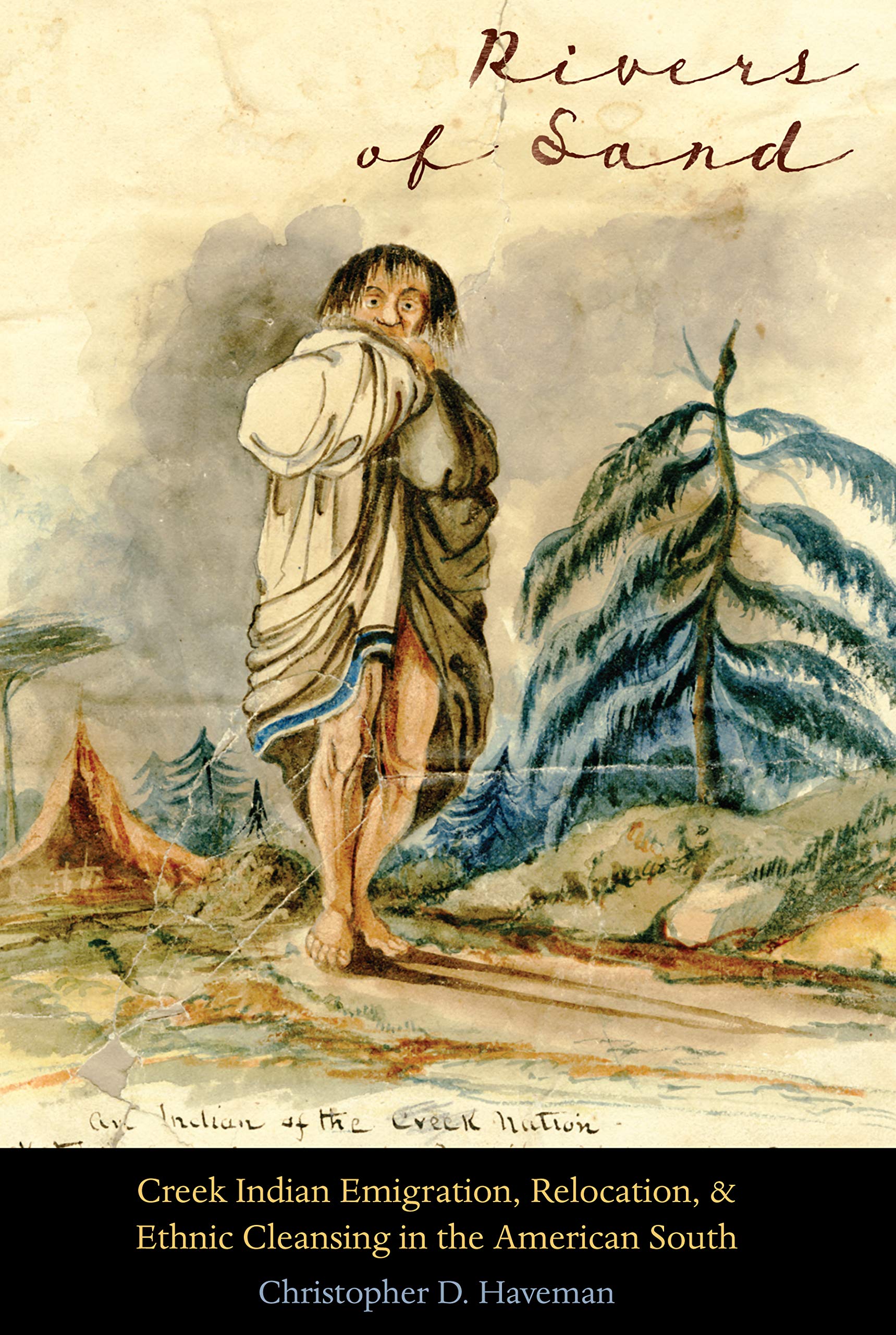
Rivers of Sand: Creek Indian Emigration, Relocation, and Ethnic Cleansing in the American South (Indians of the Southeast)
$31.31
by Christopher D. Haveman



2017 James F. Sulzby Book Award from the Alabama Historical Association At its height the Creek Nation comprised a collection of multiethnic towns and villages with a domain stretching across large parts of Alabama, Georgia, and Florida. By the 1830s, however, the Creeks had lost almost all this territory through treaties and by the unchecked intrusion of white settlers who illegally expropriated Native soil. With the Jackson administration unwilling to aid the Creeks, while at the same time demanding their emigration to Indian territory, the Creek people suffered from dispossession, starvation, and indebtedness. Between the 1825 Treaty of Indian Springs and the arrival of detachment six in the West in late 1837, nearly twenty-three thousand Creek Indians were moved—voluntarily or involuntarily—to Indian territory. Rivers of Sand fills a substantial gap in scholarship by capturing the full breadth and depth of the Creeks’ collective tragedy during the marches westward, on the Creek home front, and during the first years of resettlement. Unlike the Cherokee Trail of Tears, which was conducted largely at the end of a bayonet, most Creeks were relocated through a combination of coercion and negotiation. Hopelessly outnumbered military personnel were forced to make concessions in order to gain the compliance of the headmen and their people. Christopher D. Haveman’s meticulous study uses previously unexamined documents to weave narratives of resistance and survival, making Rivers of Sand an essential addition to the ethnohistory of American Indian removal. “One will have to look hard to find a work based on research as thorough as that which informs this book. While past studies of Creek removal have rarely risen above policy history, Haveman’s work places the emphasis on the Creeks’ experiences during their ordeal. Creeks speak for themselves throughout. Students of Indian removal will find it a good read. Arkansas readers will be pleased with Haveman’s presentation of Creek experiences during their travels through the state. Writers of other histories of tribal removal would do well to read Haveman’s work and take a cue from it.”—Daniel Littlefield Jr., Arkansas Historical Quarterly Published On: 2020-03-16 “ Rivers of Sand explores how American citizens used various levers to pry the Creek nation out of its ancestral homeland in Georgia and Alabama. The result, Haveman argues in the book’s most important conclusion, was the ethnic cleansing of the antebellum South. Whether or not scholars accept the argument remains to be seen, but the book forces us to reconsider the basic language and periodization of the field. . . . Haveman’s interpretation derives great force from the spadework he undertook to uncover exactly how the [ethnic] cleansing happened.”—James Taylor Carson, Journal of American History Published On: 2019-09-26 “Christopher Haveman presents a much-needed and compelling narrative of the forced removal of the Creek Indians. In Haveman’s hands, the inexorable weight of American expansion is felt as it played out on the ground in rampant and illegal land speculations, the forced signing of treaties, the invasion of Americans into Creek country, corrupt contractors, bitter intra-Creek disputes, and the subsequent suffering and grief of thousands of Creek men and women forced into exile from their homelands.”—Robbie Ethridge, author of Creek Country: The Creek Indians and Their World Published On: 2015-03-04 “Haveman offers an unflinching look at America’s own ethnic cleansing in this carefully researched study of Indian removal. A powerful book that exposes the brutality of U.S. policy while never losing sight of the perseverance of Indian people.”—Christina Snyder, author of Slavery in Indian Country: The Changing Face of Captivity in Early America Published On: 2015-03-04 "Through this comprehensive assessment of nineteenth-century Creek removal policy, Haveman exposes various methods of ethnic cleansing ranging from explicit laws, through manipulative treaties, to the push and pull of economic factors, enacted through various agents all the while retaining a focus on the plight of Creeks and their continued survival and pride despite the tragic events endured."—Melanie Vasselin, Native American and Indigenous Studies "Scholars interested in knowing more about not only the Creek experience but also the logistics that shaped the removal process on the ground should read Rivers of Sand ."—John P. Bowes, Journal of Southern History "A fascinating work."—J.R. Burch Jr., CHOICE "Haveman's narrative of Creek removal during the early to mid-nineteenth century is a testament to exhaustive research and judicious analysis."—Bryan Rindfleisch, H-AmIndian "Deeply researched and clearly written, Rivers of Sand gives readers a lot to contemplate."—Robert M. Owens, Tribal College Journal "Haveman has produced a sensitive, readable, and comprehensive account of t