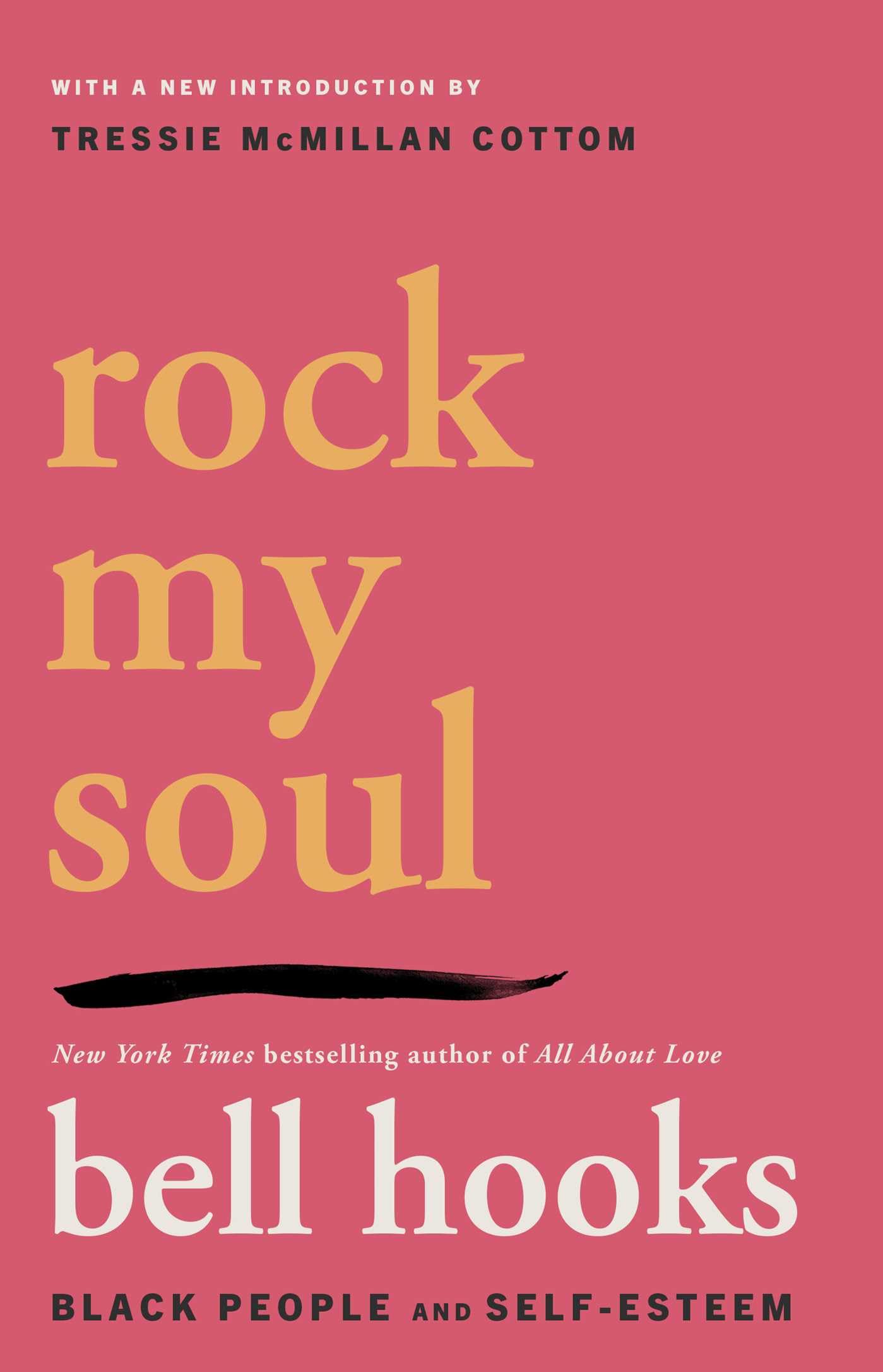



From the late feminist icon and New York Times bestselling author of All About Love , an in-depth look at one of the most critical issues facing Black Americans: a collective wounded self-esteem that has prevailed from slavery to the present day, with a new introduction by Tressie McMillan Cottom, author of Thick. Why do so many Black Americans—whether privileged or poor, urban or suburban, young or old—live in a state of chronic anxiety, fear, and shame? Rock My Soul: Black People and Self-Esteem breaks through collective denial and dares to imagine a more liberatory framework for understanding “self and identity in a world where loss is commonplace.” With visionary insight, hooks exposes the underlying reality that it has been difficult—if not impossible—for our nation to create a culture that promotes and sustains healthy self-esteem. Without self-esteem people begin to lose their sense of agency. They feel powerless. But it is never too late for any of us to acquire the healthy self-esteem that is needed for a fulfilling life. While originally written in 2002, hooks’ insights into the heart and soul of the Black American identity crisis continue to ring true. Through history, pop culture criticism, and hard-won wisdom, hooks writes about what it takes to heal the scars of the past, promote and maintain self-esteem, and lay down the roots for a truly grounded sense of community and collectivity. Moving beyond the ways historical racial justice movements have failed, hooks also identifies diverse psychological barriers and collective traumas keeping us from well-being. In highlighting the roles of desegregation, education, the absence of progressive parenting, spiritual crisis, or fundamental breakdowns in communication between Black women and men, bell hooks identifies mental health as a revolutionary frontier—and provides guidance for healing within the Black community. "With each new book, hooks is deeply exploring the inner terrain of the black community.... [Rock My Soul] is one of [her] best efforts in recent years." —Publishers Weekly "Each offering from bell hooks is a major event, she has so much to give us." —Maya Angelou bell hooks was a cultural critic, a feminist icon, and the renowned author of more than twenty books, including the enduring classic New York Times bestseller All About Love , Rock My Soul , The Will to Change , Sisters of the Yam , and When Angels Speak of Love . A charismatic speaker, she divided her time between teaching, writing, and lecturing around the world. She passed away in 2021. Chapter 1: Healing Wounded Hearts 1 HEALING WOUNDED HEARTS Self-esteem is not a sexy term. For many folks it conjures up images of self-help issues that were popular “back in the day.” Indeed, in our nation public talk about self-esteem was at its highest in the sixties. Then the United States, one of the most powerful and wealthy nations in the world, was producing citizens who were simply discontent with their lot in life, who saw themselves as failures. Many of these individuals had come from upper-class backgrounds, were educated at the best schools, prospered in jobs and careers, moved in elite social circles, and yet found themselves unable to feel truly successful or enjoy life. They went to psychologists seeking a way to gain health for the mind. These individuals were white Americans. Psychology of the fifties had little to say about the psyches and souls of black folks. In 1954 Nathaniel Branden had a small psychotherapy practice. His clients were all white but from diverse class backgrounds. Working with their issues, he began to focus on the issue of self-esteem. Branden recalls: “Reflecting on the stories I heard from clients, I looked for a common denominator, and I was struck by the fact that whatever the person’s particular complaint, there was always a deeper issue: a sense of inadequacy, of not being ‘enough,’ a feeling of guilt or shame or inferiority, a clear lack of self-acceptance, self-trust, and self-love. In other words, a problem of self-esteem.” He published his first articles on the psychology of self-esteem in the sixties. Racial integration was hotly debated in the early sixties. The issue of whether black people were inferior to whites and therefore would be unable to do well in an integrated work or school context was commonly discussed. Racist white folks insisted everyone did better when they stayed with their own kind. And there were black folks who agreed with them. When the issue of self-esteem was raised in relation to black people, it was just assumed that racism was the primary factor creating low self-esteem. Consequently, when black public figures, most of whom were male at the time, began to address the issue of self-esteem, they focused solely on the impact of racism as a force that crippled our self-esteem. Militant antiracist political struggles placed the issue of self-esteem for black folks on the agenda. And it