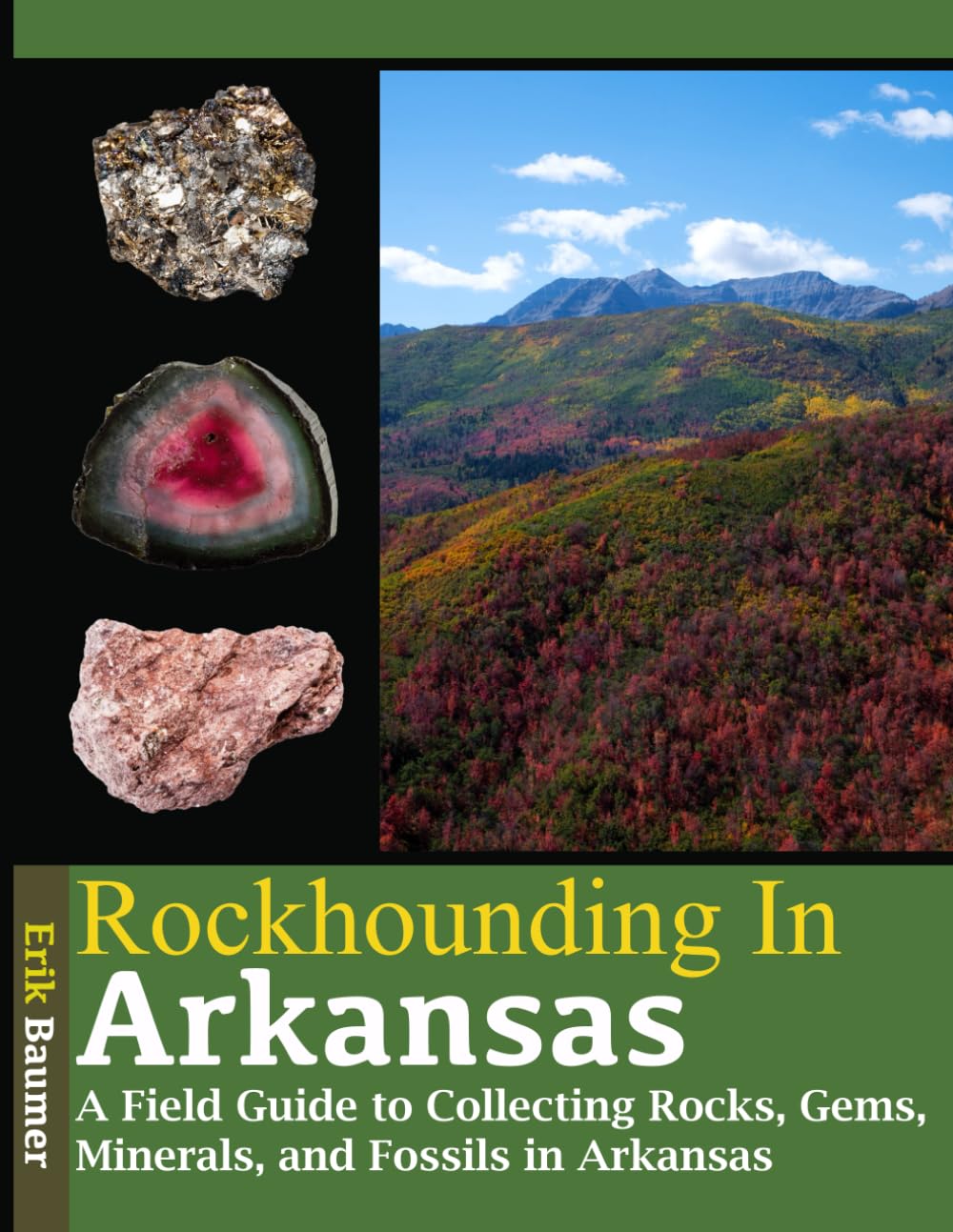
Rockhounding in Arkansas: A Field Guide to Collecting Rocks, Gems, Minerals and Fossils in Arkansas
$22.79
by Erik Baumer



A Field Guide to the Identification and Collection of Rocks Across Arkansas Arkansas occupies a geologically distinct position in the central United States, where ancient mountain systems, sedimentary basins, igneous intrusions, and fossil-bearing strata converge within a relatively small area. From the folded ridges of the Ouachita Mountains to the limestone plateaus of the Ozarks and the alluvial deposits of the Mississippi Embayment, the state preserves a complex record of marine deposition, mountain building, erosion, and volcanic activity. This guide is intended for collectors and field enthusiasts seeking a practical understanding of Arkansas’s rocks, minerals, and fossils. Inside, you’ll find: Clear, field-oriented profiles of Arkansas’s common and notable rocks, minerals, and fossils, including quartz crystals, novaculite, jasper, agate, barite, calcite, magnetite, coal, and marine fossils from Paleozoic seas. Each entry emphasizes the origin, geologic setting, and distinguishing characteristics that are useful for field identification. - Straightforward identification techniques covering color, hardness, luster, streak, fracture, crystal habit, and texture, with guidance tailored to the weathered exposures and stream-worn materials typical of Arkansas terrain. - Practical collecting guidance suited to Arkansas environments, including seasonal considerations, stream and road-cut safety, recommended tools, and clear explanations of legal and ethical collecting on state, federal, and private lands. Entries are organized by rock type—igneous, sedimentary, metamorphic, ores, native elements, and gemstones—for efficient reference. - Experienced advice for building and maintaining a collection, from locating your first quartz crystal or novaculite specimen to cleaning, labeling, cataloging, and preserving materials for long-term study or display. - 90+ collecting sites across Arkansas , ranging from the world-famous quartz fields near Mount Ida and Jessieville to novaculite ridges of the Ouachita Mountains, fossil-bearing limestones of the Ozarks, and gravel deposits along major rivers and creeks. Each site profile outlines expected materials, geologic context, access considerations, and responsible collecting practices. From deep-water marine sediments compressed into novaculite to crystal-filled veins and river-polished gravels, Arkansas’s geology reflects repeated cycles of deposition, uplift, and erosion. A Field Guide to the Identification and Collection of Rocks Across Arkansas encourages careful observation and informed collecting, offering a practical resource for understanding the geologic history recorded across the Natural State.