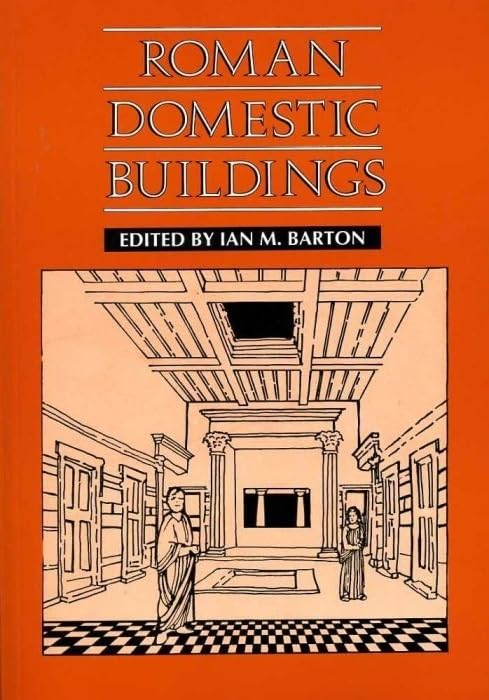



From the hovels of peasants to the palaces of monarchs, this book provides an architectural picture of Roman society through a study of domestic buildings. ... Deals with topics that are important for any teacher of Latin or Classical Civilisation, while its scale and clarity of organization make it accessible to sixth-formers. ― JACT Review, Summer A book that can serve excellently as an introduction to the studies of Roman private houses, either for undergraduate students in archaeology or for general readers with an interest in ancient culture. The authors succeed in transmitting important information concerning the way of living in countryside and town, not only in Italy but also in the remote regions of the empire. ― Mnemosyne, Vol. LII ". . . A useful starting place. Unfamiliar words are collected in a glossary, and notes to each chapter provide references to some of the more specialist works. An index of sites serves as a guide to finding discussion of them in the text and to their location on four maps. The text is amplified by black and white plates and a generous number of line drawings, the latter generally placed conveniently close to the discussion. A guide to further reading is also included . . ." ― The Classical Review, Vol. XLVIII, No. 1 In format, price, and tone the book easily succeeds (like its forerunner companion, Roman Public Buildings) in divulging a great deal of information in accessible terms. ― Greece and Rome, Vol. 44, No. 2 The rich variety of buildings across the Roman Empire is cleverly explored by the authors, the similarities and the differences being equally fascinating ... One fascinating element to emerge is the Romans' love of their gardens. How timeless seem some of the attempts to include garden space in densely populated urban areas. ― British Archaeology ... Deals with topics that are important for any teacher of Latin or Classical Civilisation, while its scale and clarity of organization make it accessible to sixth-formers. A book that can serve excellently as an introduction to the studies of Roman private houses, either for undergraduate students in archaeology or for general readers with an interest in ancient culture. The authors succeed in transmitting important information concerning the way of living in countryside and town, not only in Italy but also in the remote regions of the empire. ". . . A useful starting place. Unfamiliar words are collected in a glossary, and notes to each chapter provide references to some of the more specialist works. An index of sites serves as a guide to finding discussion of them in the text and to their location on four maps. The text is amplified by black and white plates and a generous number of line drawings, the latter generally placed conveniently close to the discussion. A guide to further reading is also included . . ." In format, price, and tone the book easily succeeds (like its forerunner companion, Roman Public Buildings) in divulging a great deal of information in accessible terms. The rich variety of buildings across the Roman Empire is cleverly explored by the authors, the similarities and the differences being equally fascinating ... One fascinating element to emerge is the Romans' love of their gardens. How timeless seem some of the attempts to include garden space in densely populated urban areas. https://global.oup.com/academic/product/9780859894159?cc=us Roman Domestic Buildings aims to provide an architectural picture of Roman society by looking at domestic buildings, from the hovels of peasants to the palaces of monarchs. The book brings out the political, social and economic significance of the buildings, as well as the technical architectural features. E. J. Owens, author of The City in the Greek and Roman World, contributes a chapter on the planning of residential areas, and A. J. Brothers writes on houses in towns. Houses in the country are dealt with by John Percival, author of The Roman Villa, and there is a chapter on palaces by the editor. Chapters on gardens, by Nicholas Purcell, and on military accommodation, by David Davidson, complete the work. The book is fully illustrated with plans and photographs; there is a glossary of architectural terms, an index of sites with reference maps, and suggestions for further reading. Roman Domestic Buildings is a companion volume to Ian Barton's Roman Public Buildings, also published in the Exeter Studies in History series. Ian Barton was until his retirement Head of Classics at University of Wales, Lampeter. Orders are despatched from our UK warehouse next working day.