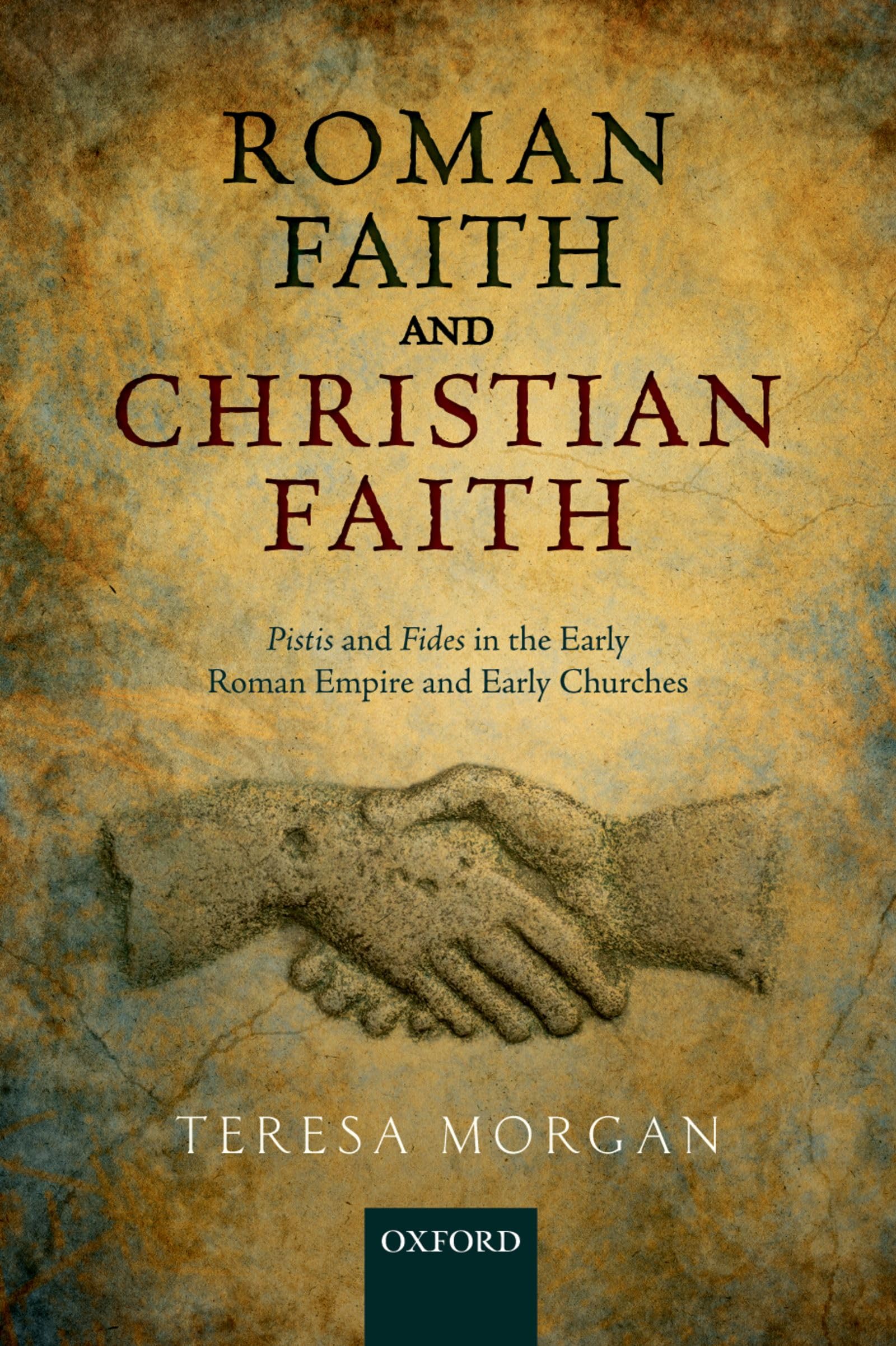
Roman Faith and Christian Faith: Pistis and Fides in the Early Roman Empire and Early Churches
$77.00
by Teresa Morgan



This study investigates why "faith" ( pistis/fides ) was so important to early Christians that the concept and praxis dominated the writings of the New Testament. It argues that such a study must be interdisciplinary, locating emerging Christianities in the social practices and mentalites of contemporary Judaism and the early Roman empire. This can, therefore, equally be read as a study of the operation of pistis/fides in the world of the early Roman principate, taking one small but relatively well-attested cult as a case study in how micro-societies within that world could treat it distinctively. Drawing on recent work in sociology and economics, the book traces the varying shapes taken by pistis/fides in Greek and Roman human and divine-human relationships: whom or what is represented as easy or difficult to trust or believe in; where pistis/fides is "deferred" and "reified" in practices such as oaths and proofs; how pistis/fides is related to fear, doubt and scepticism; and which foundations of pistis/fides are treated as more or less secure. The book then traces the evolution of representations of human and divine-human pistis in the Septuagint, before turning to pistis/pisteuein in New Testament writings and their role in the development of early Christologies (incorporating a new interpretation of pistis Christou ) and ecclesiologies. It argues for the integration of the study of pistis/pisteuein with that of New Testament ethics. It explores the interiority of Graeco-Roman and early Christian pistis/fides . Finally, it discusses eschatological pistis and the shape of the divine-human community in the eschatological kingdom. "...both classicists and New Testament scholars will appreciate what findings Roman Faith and Christian Faith does [offer]." -- Jamin Andreas Hübner, LCC International University, Journal of Greco-Roman Christianity and Judiasm "an enriching and incomparably prodigious treasure from which scholars can draw among numerous lines of inquiry. It is, quite simply, one of the most remarkable and necessary works in New Testament studies available today. I strongly recommend it for graduate studies and comprehensive exam reading lists and for the shelves of technical audiences and scholars in classics, New Testament, and systematic theology alike." -- Timothy Milinovich, Catholic Biblical Quarterly "Among studies on faith in the New Testament, Teresa Morganâs distinctive and valid approach is that we best understand in the NT by locating it in the language and culture of the early Principate." -- Ilaria L. E. Ramelli (Catholic University-Angelicum-Princeton), The Journal of Roman Studies Vol.107 "Although a long, detailed, and scholarly work, this treatise is clearly organized, accessibly written, and repays diligent study of such a seminal topic. What is more basic to Christian faith than 'faith'?"--F. Scott Spencer, Interpretation: A Journal of Bible and Theology "Morgan's work is highly recommended. It not only tackles a colossal subject, but also makes sure to nuance those interdisciplinary moments that provide the most fuel to the ongoing discussion. Morgan fills a gap that was much needed; however, her work is also positioned in such a way as to point towards new, detailed analyses that need to be done in order to move beyond the material covered. Thankfully, she is kind enough to gesture towards these avenues of interrogation in her concluding section."--Taylor Weaver, Religion "This book will be the fundamental text on this issue for a long time to come." -- Theology "It is impossible to do justice to the richness and depth of this study, let alone its many astute exegetical observations, in a single review..." -- Ecclesiology "This is a wonderful and refreshing book that offers insights for classicists, New Testament scholars, and those who bridge both fields..." -- Bryn Mawr Classical Review "This is a significant and magisterial study. One cannot read it without benefiting from the insights contained on every page..." -- Expository Times "[I]t is to be hoped that its conclusions cascade through the layers of modern Christianity to refresh more than just the thirst of professional scholars." -- Church Times Explores why "faith" ( pistis/fides ) was so important to early Christians that it dominated their earliest writings Teresa Morgan is Professor of Graeco-Roman History in the Faculty of Classics, Oxford University, and Nancy Bissell Turpin Fellow and Tutor in Ancient History at Oriel College. She is a historian of Graeco-Roman and early Christian culture and mentalite; previous books include Literate Education in the Hellenistic and Roman Worlds (1998), and Popular Morality in the Early Roman Empire (2007). She is a self-supporting priest in the Parish of Littlemore, Oxford.