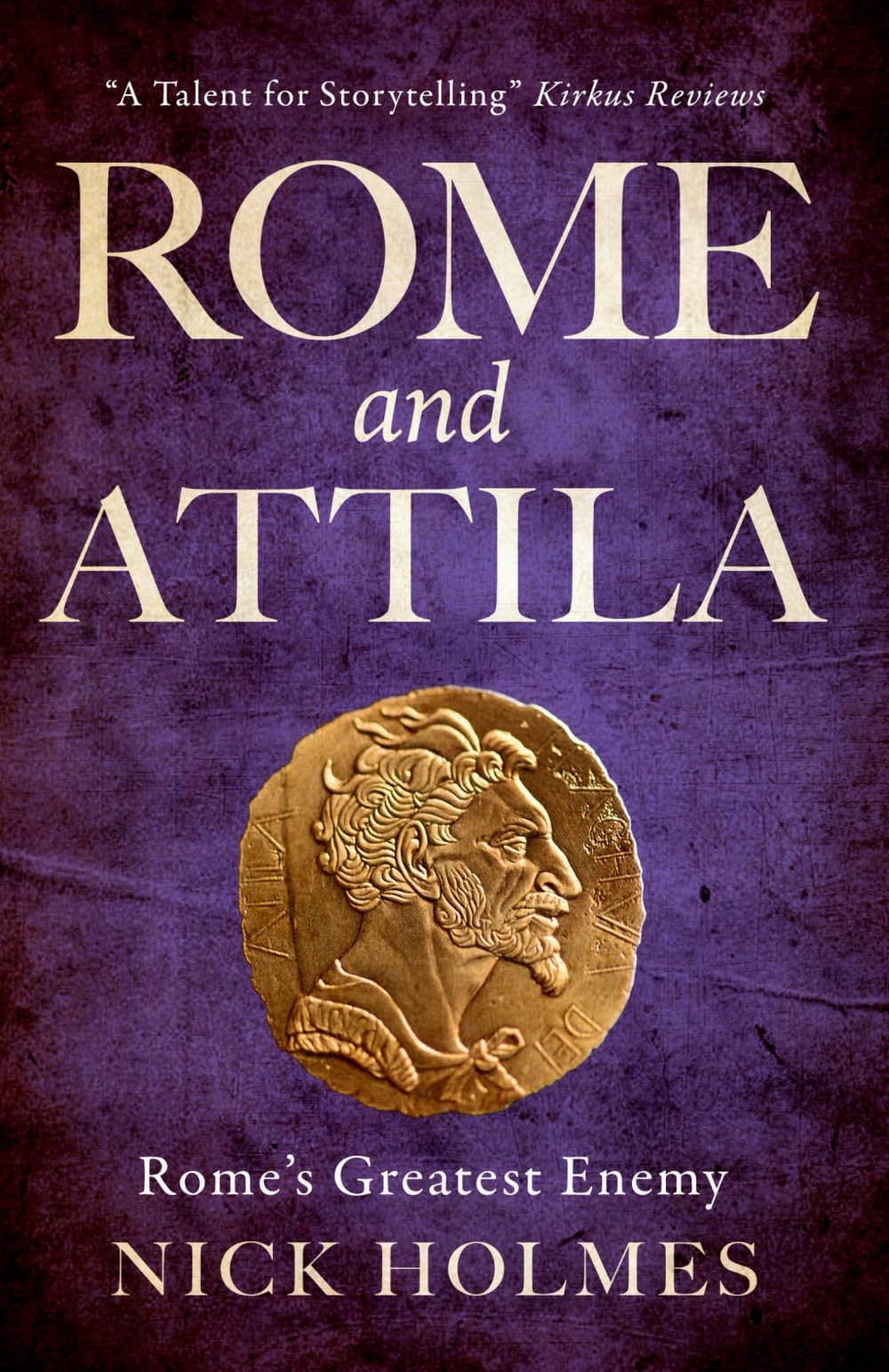
Rome and Attila: Rome's Greatest Enemy (The Fall of the Roman Empire)
$14.99
by Nick Holmes



“A skilled storyteller…Holmes presents a riveting account of Rome’s decline” Kirkus Reviews Attila is a household name. But his true character and impact on the Roman Empire have always remained elusive. Until now. In the first major work written about Attila in decades, Nick Holmes rewrites the story of Attila and Rome. Contrary to his brutal legend, Attila was a complex and captivating personality. A great warlord who despised ostentation, admired bravery and valued loyalty. He led his steppe nomads further west than Genghis Khan or Tamerlane. He nearly destroyed the Roman Empire. But his vast ambition undid him. This book is a must read for those interested in Rome, the Huns and military history. This is the third volume in Nick Holmes’ series on The Fall of the Roman Empire. The first volume, The Roman Revolution , covers the little known ‘crisis of the third century’ when barbarian invasions nearly destroyed classical Rome and led to a revolution in Roman government, the army and religion, including the extraordinary growth of Christianity. The second volume, The Fall of Rome , covers the barbarian invasions of the western half of the empire, culminating in the sack of Rome itself by the Goths in AD 410. Further volumes will continue Rome's turbulent history, from its revival under the emperor Justinian to the rise of Islam, the beginnings of Byzantium and the dawn of the Middle Ages. In this third volume of the author's history of the end of the Roman Empire, Holmes focuses on the Eastern and Western Roman Empires in the 4th and 5th centuries. The book opens with an account of the conflict between the Roman Empire and the encroaching Huns: The author depicts a rich, vivid battle scene, imagining a history told from the perspectives of the soldiers and the people on the ground, offering a vista of Romans, Franks, and Visigoths facing off, together, against the eastern nomads. ("Long dragon pennants streaming in the wind. The sun glittering off their chain-mail. Sharp spears bristling. An unstoppable phalanx of horsemen rides down the hillside.") Holmes' remit broadens to track the movement of peoples across Europe as the Huns advanced. The author argues that, while the Huns didn't directly topple the Roman Empire, they were an important factor in pushing the Goths west, and south, which led, inevitably, to the fall of Rome. He also uses paleoclimatology to make an additional argument: Desire for conquest didn't fuel the Huns' westward path exclusively—climate change drove them out of the Central Asian steppes. Looking at tree rings, Holmes identifies evidence of massive droughts that, he asserts, led the Huns west into Europe, crossing the Rhine in 451 and entering Gaul at the western frontier. Conveyed with clarity and accessibility, this history is a great primer for anyone interested in the migratory patterns of early Europeans. Kirkus Reviews