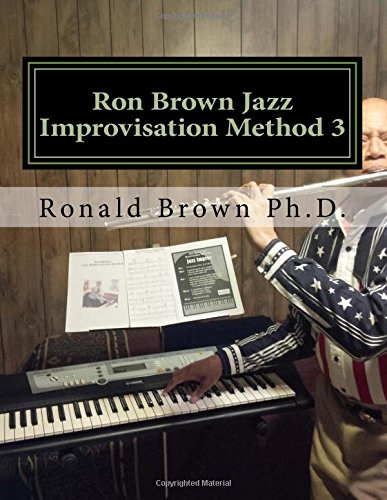
Ron Brown Jazz Improvisation Method 3: Jazz improvisation music instruction
$100.00
by Mr Ronald L Brown Ph.D



Basically, there are 8 of these super-imposed chord’s, however the Ron Brown Jazz Improvisation Method has reduced two chords for the price of one, by simply playing the distance of a (b5) in the bass, on each chord, in every key, to give the student or professional two chords in one (Brown, 2012a; Brown, 2012b). For example G7/9/13 (FABE) with the Db in the bass the chord becomes Db7/+5/+9. Now the (F) is the 3rd of Db7, the (A) is now +5 and the (E) is now +9. Thus, we are playing the same notes in the right hand with these chord tones while changing one note with a distance of (b5) tone, in the bass, and now, 25% of the eight chords, is accompanied by playing four notes, in the right hand (or a combination of instruments or voices) and changing one note a (b5) distance in the base. This basically renders the V7 as a bII7 with the variation chord name, but the four tones are exactly the same, only the base tone is changed a b5 distance. This drastically reduces learning and remembering the harmony/chords concept; and simplifies it, so easy, ‘even a Caveman can do it…’ with the cognitive domain general components presented, as a gift, in the Ron Brown Jazz Improvisation Method (Brown, 2012a). Secondly, each chord possesses a scale providing more tones, to play in addition to the chord tones. For example, in the key of ‘C’ for the G7/9/13 notes G-A-B-C-D-E-F-G represents (G-1, A-9TH, B-3rd,C-11TH-D-5th –E-13th , F- 7th ) and Db7/+5+9 chord with the same scale notes(G- +11, A- +5, B- 7th ,C- 11th , D- b9, E- +9, F- 3rd ). This is as simple as one two, three; and the same simple relationship exist between the other 3 chord types, 75 percent, covering the basic entire spectrum, of so called complex, jazz improvisation, cognitive domain general components (Brown, 2012a). Thirdly, the last major component consists of rhythms; moreover it is the amount of value given to a note, on a beat or set of beats. For example, a whole note represents holding a note for 4 beats; a half-note plays a note for 2 beats; a quarter note holds a note for one beat; an eighth note is held for a half of a beat, sixteenth note is held for fourth of a beat; and so forth with a few other variations; for example, triplets (123), triplet quarter notes in 2 beats, triplet half notes covering the entire bar with three notes contained in four beats. The Ron Brown Jazz Improvisation Method books contain a Rhythm Section with a review of literature extracted from jazz books; and all other sheet music books, accumulated with sheet music displaying rhythms, the books were stacked to the ceiling (Brown, 2012a; Brown, 2012b). And these rhythms were copied in two bar motifs, of rhythm patterns, until there was a reduction of the basic rhythm possibilities played in songs and improvisations reduced to only 5 pages. These rhythms are heard daily in almost every type of Western and other music around the world. Cognitive or mental abilities influencing music improvisation consists of the mental thinking, comprehension, of learned and remembered musical components, supplied by the “Ron Brown Jazz Improvisation Method;” a culmination of 46 years of jazz research and personal performance (Brown 2012b). Cognitive domain general skills can be taught; this type of jazz program could be offered online, with the advent of computer venues well noted with synchronous and asynchronous instruction with online universities. Jazz improvisation requires cognitive abilities affecting the possible performance by accumulating numerous cognitive tasks performed simultaneously; through the application of the Ron Brown Jazz Improvisation Method at this time designed over 46 years ago (Brown, 2012a; Brown, 2012b).