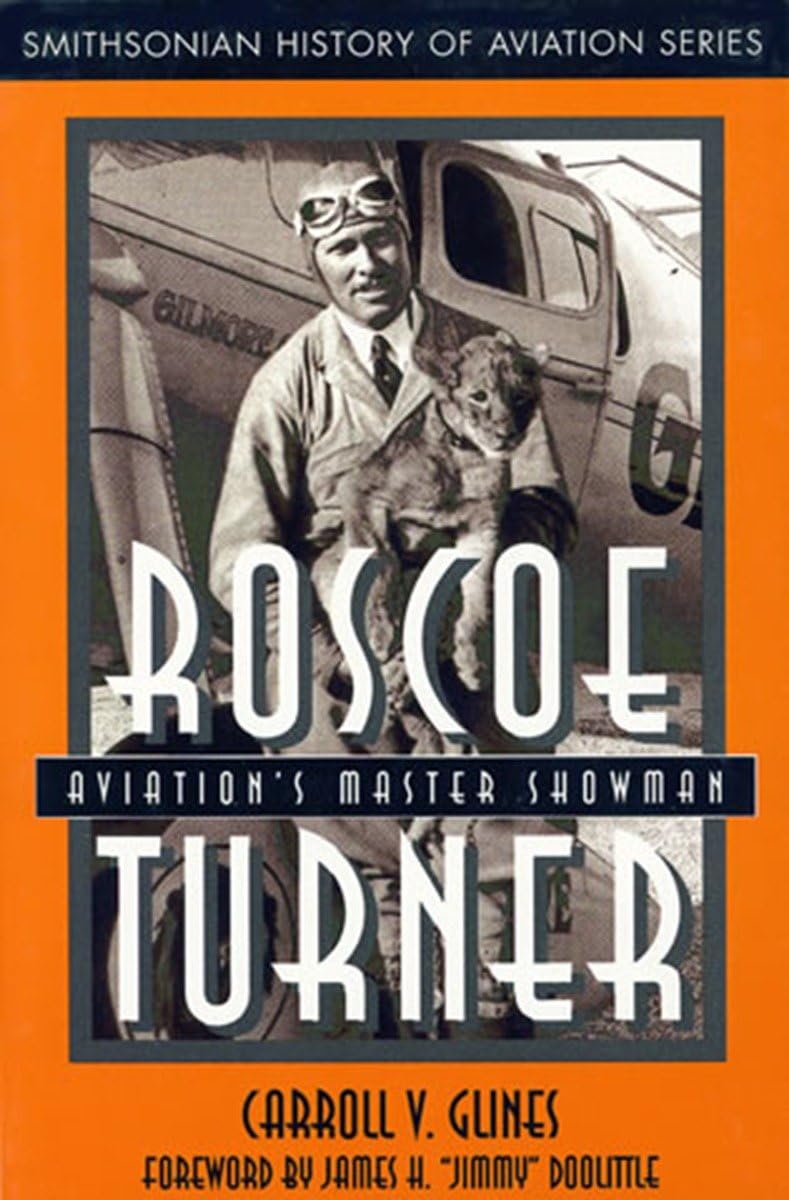
Roscoe Turner: Aviation's Master Showman (Smithsonian History of Aviation Series)
$44.31
by Carroll V. Glines



His name was synonymous with speed, his flamboyant persona as carefully crafted as that of a Hollywood star. Born in Corinth, Mississippi, in 1895, Joe Turner was an aerial showman, an audacious risk taker, and a tireless self-promoter who focused America's attention well into the 1960s on the potential of aviation for the common good. With complete access to Turner's personal papers, photographs, and memorabilia, biographer Carroll V. Glines presents the first full account of the life of this American daredevil aviator. Turner determined as a young man to make his way in the world at the forefront of the new, exciting, and risky technologies of speed in the air. After serving as a balloon pilot during World War I, Turner found his future in the 1920s as a stuntman, creator of his own flying circus, and a pilot in Howard Hughes's World War I feature, Hell's Angels, Hollywood's most expensive movie before Gone With the Wind. Turner glided smoothly into movie society, becoming good friends with fellow pilot and actor Wallace Beery and taking movie stars Clark Gable and Fred MacMurray for their first airplane rides. Turner knew how to attract attention. To create a consistent image in the public's mind--of himself and of aviation--he always dressed in a military-type uniform of blue tunic, cavalry twill riding britches, polished boots, and a pin of diamond-studded wings. He was perhaps best known as the pilot who flew with the lion cub Gilmore as an oil company promotion. His place in flight history rests on his skill as a racing pilot--he is the only person ever to win the Thompson Trophy three times and, along with Jimmy Doolittle, to win both the Thompson and Bendix trophies. In 1934 he and his two-man crew were the only Americans to finish the grueling London-to-Melbourne race. Roscoe Turner could only have happened in America. His career was a classic rags-to-riches epic, and one can only wonder how many youngsters were influenced by his example during the dark days of the Depression. With this book, Carroll Glines makes that sort of influence possible all over again. ( Air And Space ) An incisive look at one of the most colorful figures in aviation history. . . . Roscoe Turner: Aviation's Master Showman is a great book, as multidimensional as Turner was himself. ( Aviation History ) As one of America's premier aviation historians, Carroll Glines has given us a delightful and thoroughly researched biography of one of our audacious aerial risk takers. ( Jacksonville Times-Union ) This scrupulously researched work by retired Air Force colonel Glines resurrects an aerial showman who takes his rightful place in the pantheon of 20th-century daredevils. ( Publishers Weekly ) The 1920s and '30s were the Golden Age of aviation in this country. . . . No one personified that era better than Roscoe Turner. With his waxed mustache, polished boots, riding breeches, powder blue military jacket, diamond-studded aviator wings, and pet lion Gilmore, Turner (1895-1970) was just the kind of larger-than-life character aviation needed to capture the public's imaginiation. ( Richmond Times-Dispatch ) A retired Air Force colonel, Carroll V. Glines is curator of the Doolittle Military Aviation Library at the University of Texas at Dallas. He is the author of thirty-one books, including Bernt Balchen: Polar Aviator (Smithsonian Institution Press, 1999). To continue playing the air fair circuit, Roscoe needed a new stuntman to replace (Arthur) Starnes. He formed a partnership with J.W. "Bugs" Fisher, who advertised himself as a World War I ace who had served with the French Army and told reporters that his name was spelled "Fisheur." Roscoe tells what happened on their first flight together at Athens, Alabama, on August 7, 1925: Among the stunting equipment was a rope approximately 20 feet long which my former stunt man used to tie around his ankle and then hang down around the landing gear to make people think he had fallen off the airplane. We called this "The Dive of Death." The occasion was a Merchant Trade Day performance, which we had promoted around to all the merchants getting small contributions to put it on over the town's square. There were no specific acts but my man used to walk on the wings of the airplane and make a parachute jump. However, Bugs decided he wanted to put on "The Dive of Death." I told him to be sure not to get down at the end of that rope unless he was positive he could get back up to the airplane. I had no desire to be tried for manslaughter or crack up the only airplane I had, as a man hanging at the end of that rope acted just like an anchor. He would strike the ground first and slow the airplane in flight and change its direction. Bugs assured me he could perform the stunt so we got over town and after Bugs had done his walking on the wings this was his next feat. He got down on the landing gear, tied the rope around his ankle and turned loose. I flew around and around waiting for h