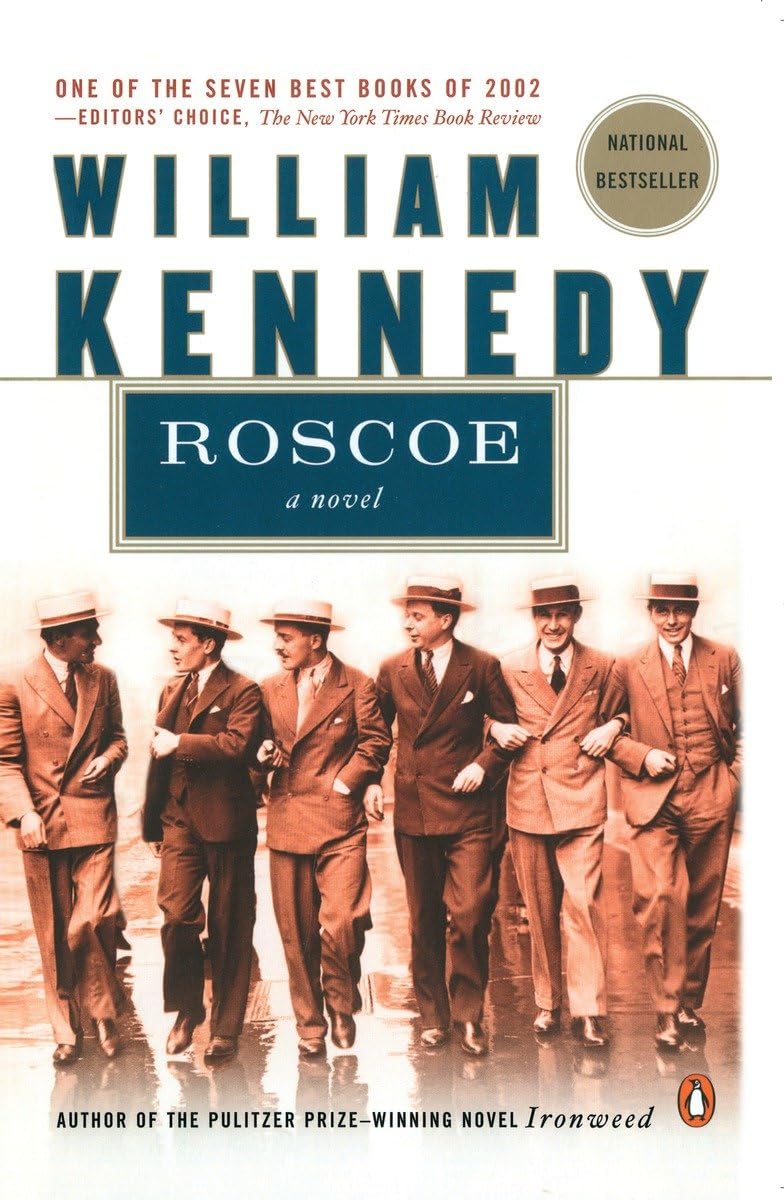



“Thick with crime, passion, and backroom banter” ( The New Yorker ), Roscoe is an odyssey of great scope and linguistic verve, a deadly, comic masterpiece from the Pulitzer Prize-winning author of Ironweed It's V-J Day, the war is over, and Roscoe Conway, after twenty-six years as the second in command of Albany's notorious political machine, decides to quit politics forever. But there's no way out, and only his Machiavellian imagination can help him cope with the erupting disasters. Every step leads back to the past—to the early loss of his true love, the takeover of city hall, the machine's fight with FDR and Al Smith to elect a governor, and the methodical assassination of gangster Jack "Legs" Diamond. William Kennedy’s Albany Cycle of novels reflect what he once described as the fusion of his imagination with a single place. A native and longtime resident of Albany, New York, his work moves from the mid-nineteenth to the mid-twentieth century, chronicling family life, the city’s netherworld, and its spheres of power—financial, ethnic, political—often among the Irish-Americans who dominated the city in this period. The novels in his cycle include, Legs , Billy Phelan’s Greatest Game , Ironweed , Quinn’s Book , Very Old Bones , The Flaming Corsage , and Roscoe . Roscoe Owen Conway, fifty-five, fat, and in failing health, is the brains who protects and preserves Albany's Democratic Party, and, as Kennedy's seventh "Albany Cycle" novel opens, Roscoe has plenty of protecting and preserving to do. It's V-J Day, 1945, and though the war in the Pacific is over, the war at home has just begun: the Democratic machine is facing a stiff challenge from the state's Republican governor, who is determined to link Albany's mayor to gambling, prostitution, and a host of other behaviors that the electorate might well frown upon. When Elisha Fitzgibbon, the city's major Democratic funder and one of Roscoe's oldest friends, commits suicide, it looks as if the city's entire political tapestry might unravel. But Roscoe empties out his bag of tricks, enlisting informants, greasing palms, and setting up secret meetings, all the while courting Veronica, Elisha's widow and his longtime love. Thick with crime, passion, and backroom banter, "Roscoe" neatly reverses the insularity of Kennedy's previous novel ("The Flaming Corsage"); the book, and its hero, is an extrovert's dream. Copyright © 2005 The New Yorker Praise for Roscoe A finalist for the PEN/Faulkner and The National Book Critics Circle Award for Fiction “Driven by a narrative electricity as alive as post-war America. Roscoe is Kennedy's finest novel since Ironweed .”— The Boston Globe “This is a novel that, as they say, has it all.... Kennedy is a writer with something to say, about matters that touch us all, and he does it with uncommon artistry.”— The Washington Post “A beaut, deadly serious high comedy propelled by soaring flights of linguistic legerdemain.”— The New York Times Book Review “This new book has a lyricism and a gusto rarely achieved in serious American novels about politics.... Roscoe may, in fact, be Kennedy's greatest.”— The Atlantic Monthly “An exuberant portrait of political and sexual intrigue. Its politics are backroom and bare-knuckle, all about power and money.”— USA Today “William Kennedy writes so melodiously about the Irish ruffians of old Albany, NY he could make Philip Roth wish he were Catholic.”— San Francisco Chronicle William Kennedy , author, screenwriter and playwright, was born and raised in Albany, New York. Kennedy brought his native city to literary life in many of his works. The Albany cycle, includes Legs , Billy Phelan's Greatest Game , and the Pulitzer Prize winning Ironweed .The versatile Kennedy wrote the screenplay for Ironweed , the play Grand View , and cowrote the screenplay for the The Cotton Club with Francis Ford Coppola. Kennedy also wrote the nonfiction O Albany! and Riding the Yellow Trolley Car . Some of the other works he is known for include Roscoe and Very Old Bones . Kennedy is the founding director of the New York State Writers Institute and, in 1993, was elected to the American Academy of Arts and Letters. He has received numerous literary awards, including the Literary Lions Award from the New York Public Library, a National Endowment for the Arts Fellowship, and a Governor’s Arts Award. Kennedy was also named Commander of the Order of Arts and Letters in France and a member of the board of directors of the New York State Council for the Humanities. THE SPHERES OF WAR AND PEACE * Roscoe Owen Conway presided at Albany Democratic Party headquarters, on the eleventh floor of the State Bank building, the main stop for Democrats on the way to heaven. Headquarters occupied three large offices: one where Roscoe, secretary and second in command of the Party, received supplicants and debtors, one where Bart Merrigan and Joey Manucci controlled the flow of visi