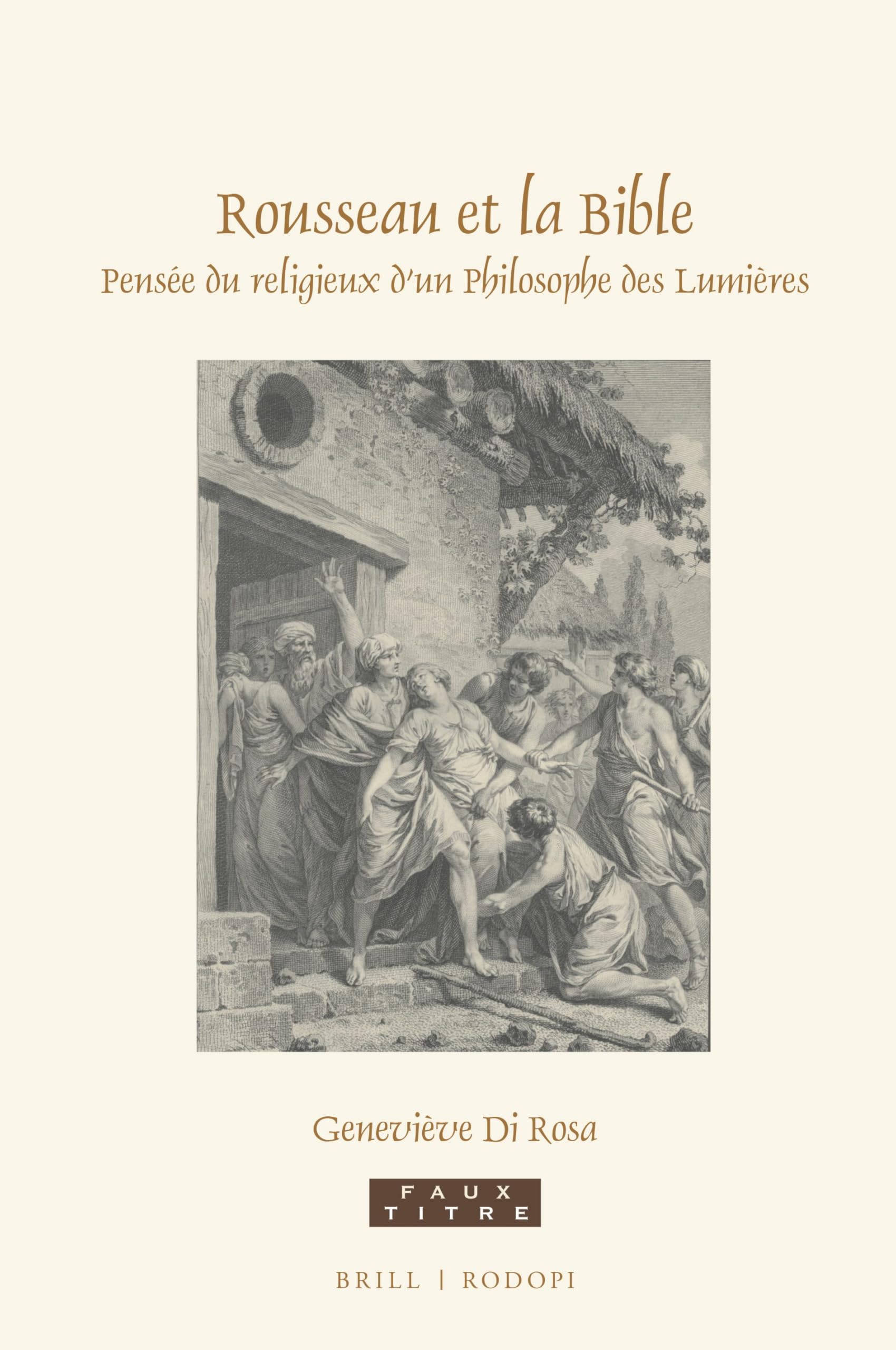
Rousseau et la Bible: Pensée du religieux d'un Philosophe des Lumières (Faux Titre, 410) (French Edition)
$168.79
by Geneviève Di Rosa



Le rapport au texte biblique est de toute évidence une voie d’entrée privilégiée pour qui veut étudier les représentations du religieux au XVIIIe siècle. A un moment où une méfiance bien plus ancienne vis-à-vis de L’Ancien Testament s’étend pareillement au Nouveau perçu lui aussi comme fabrique et donc, pour une part au moins, comme imposture, le cas Rousseau montre exemplairement comment la Bible, pour être de moins en moins appréhendée comme une Vérité Révélée, reste toujours un intertexte littéraire de toute première grandeur et sans doute même plus influent que jamais. La présente étude interroge donc les diverses représentations de Jean-Jacques lecteur de la Bible, ses réécritures de narrations bibliques et le retour, tout au long de son oeuvre, de schèmes de pensée chrétiens et christiques. The relation to the Biblical text is a privileged starting point for anyone interested in studying eighteenth-century religious representations. At a time when an old suspicion towards The Old Testament reverberates on The New Testament which is also perceived as man-made and thus partly as a sham, the example of Rousseau demonstrates how the Bible, although less and less considered as a Revealed Truth, remains a primary literary intertext, probably more influent than ever. The present study interrogates the different representations of Jean-Jacques as a reader of the Bible, his rewritings of Biblical narratives and the presence of Christian and Christ-like ways of thinking throughout his work. "With Di Rosa, the issue is no longer about how Rousseau imbibes, from his childhood, the content of the Bible and reflects it in his adult writings, but about how Bible-inspired thought in Rousseau’s literary works is conveyed by a language she has undertaken to read between the lines, and to split into new meanings, thanks to her linguistically technical approach. To achieve this feat, Di Rosa has mobilized all the interpretative machinery available in stylistics as well as the most elegant and impressive register in literary criticism, and thereby succeeds in placing her work on an eminent pedestal of intellectual productivity. This achievement has placed Rousseau et la Bible among books of the highest erudition in the field of literary criticism and stylistics. - Robert Yennah, Eighteenth-Century Fiction , 30.3, 2018. Geneviève Di Rosa, enseignante à l’ESPE-Sorbonne, est docteure ès lettres spécialisée dans le XVIIIe siècle, les questions religieuses et les liens entre littérature et peinture. Elle a publié de nombreux articles sur Rousseau, Diderot, Voltaire, Rétif de la Bretonne. Geneviève Di Rosa teaches at the ESPE-Sorbonne and is Doctor of Arts with a specialisation in eighteenth-century culture and literature, religious issues and the links between literature and painting. She has published many articles about Rousseau, Diderot, Voltaire, Rétif de la Bretonne.