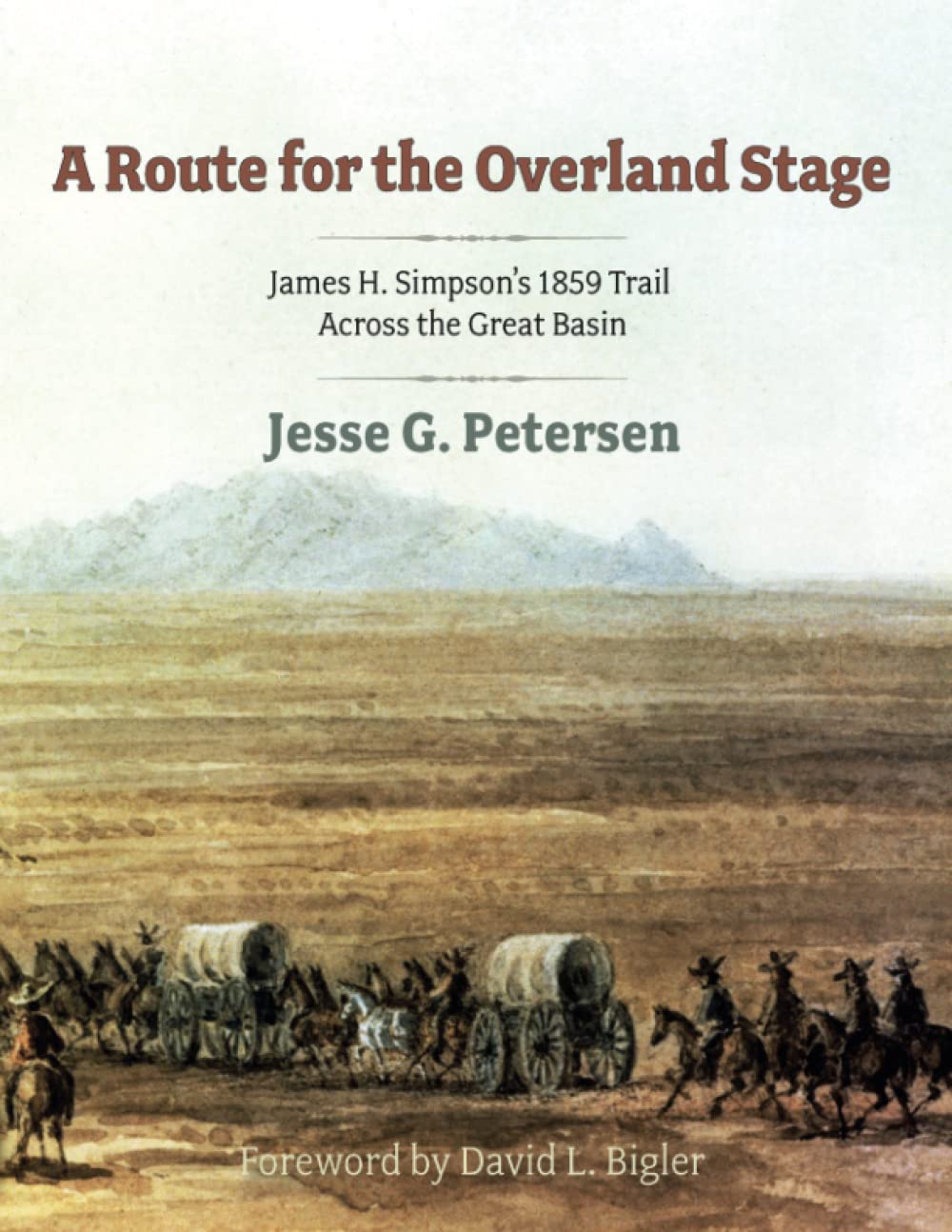
Route for the Overland Stage: James H. Simpson's 1859 Trail Across the Great Basin
$28.95
by Jesse G. Petersen



The 1859 exploration of the Great Basin by army topographical engineer James Simpson opened up one of the West's most important transportation and communication corridors, a vital link between the Pacific Coast and the rest of the nation. It became the route of the Pony Express and the Overland Mail and Stage, the line of the Pacific telegraph, a major wagon road for freighters and emigrants, and, later, the first transcontinental auto road, the Lincoln Highway, now Highway 50. No one has accurately tracked or mapped Simpson's original route, until now. Jesse Petersen shows in words, maps, and photos exactly where the explorer went. Sharing his detective-like reasoning as he walked or drove the entire trail west and Simpson's variant route returning east, Petersen takes readers on a mountain and desert trek through some of America's most remote and striking landscapes. A Route for the Overland Stage James H. Simpson's 1859 Trail Across the Great Basin By Jesse G. Petersen Utah State University Press Copyright © 2008 Utah State University Press All right reserved. ISBN: 978-0-87421-693-6 Contents Acknowledgments.....................................................viForeword............................................................vii1 Introduction......................................................12 The Journey Begins: Camp Floyd to Faust Creek.....................83 Faust Creek to Pleasant Valley....................................184 Pleasant Valley to Roberts Creek..................................385 Roberts Creek to Middlegate.......................................646 Middlegate to Genoa...............................................937 Genoa to Smith Creek Valley.......................................1208 Smith Creek Valley to Steptoe Valley..............................1429 Steptoe Valley to Swasey Mountain.................................16410 Swasey Mountain to Triple Peaks..................................18711 Triple Peaks to Camp Floyd.......................................19812 After the Return.................................................217Appendix: Geographic Coordinates....................................224Notes...............................................................231Bibliography........................................................237Index...............................................................240 Chapter One Introduction DURING THE SUMMER of 1859, Captain James Simpson of the US Army's Corps of Topographical Engineers led an expedition of exploration from Camp Floyd to Genoa. Camp Floyd was an army post in Cedar Valley, about forty miles southwest of Great Salt Lake City. Genoa was a small settlement located at the eastern foot of the Sierra Nevada mountains. The mission of the expedition was to find a practical route for wagons through the central part of Utah and Nevada. If such a route could be found, it was believed that it would shorten the distance between Salt Lake City and California by as much as two hundred miles. The members of the Simpson expedition were not the first to travel through this region of the American West. During the preceding three decades, a number of fur trappers, explorers, and emigrants had made their way across some sections of this area. Jedediah Smith, Joseph R. Walker, John Charles Frmont and Kit Carson, the Bidwell-Bartleson party, Lansford Hastings and James Clyman, the Donner-Reed party, Capt. E. G. Beckwith, O. B. Huntington, George Washington Bean, Orrin Porter Rockwell, and Howard Egan had all traveled through different sections of this territory. These travelers had cut across various portions of the region, traveling in various directions, but none of them had taken the shortest possible route from east-to-west or west-to-east, and it appears that Lansford Hastings was the only one who had taken any meaningful action toward the establishment of a wagon road through this central region. Before the Simpson expedition, most of the travelers who intended to make the journey from Salt Lake City to California followed a route that went around the northern end of the Great Salt Lake and joined the California Trail near City of Rocks, near the Utah-Idaho border. A smaller number of California-bound travelers headed south by way of the Mormon Corridor, now the route of Interstate 15, and got onto the Old Spanish Trail near present-day Cedar City. It is true that the relatively few travelers who followed the Hastings Road did take a more central route, but about a quarter of the way across present-day Nevada, near the southern tip of the Ruby Mountains, this road turned to the north along Huntington Creek and the South Fork of the Humboldt River, and joined the California Trail not far from the city of Elko. None of these wagon routes traveled through the area that the Simpson expedition intended to explore. It had always been apparent that a road through this central area could save many miles