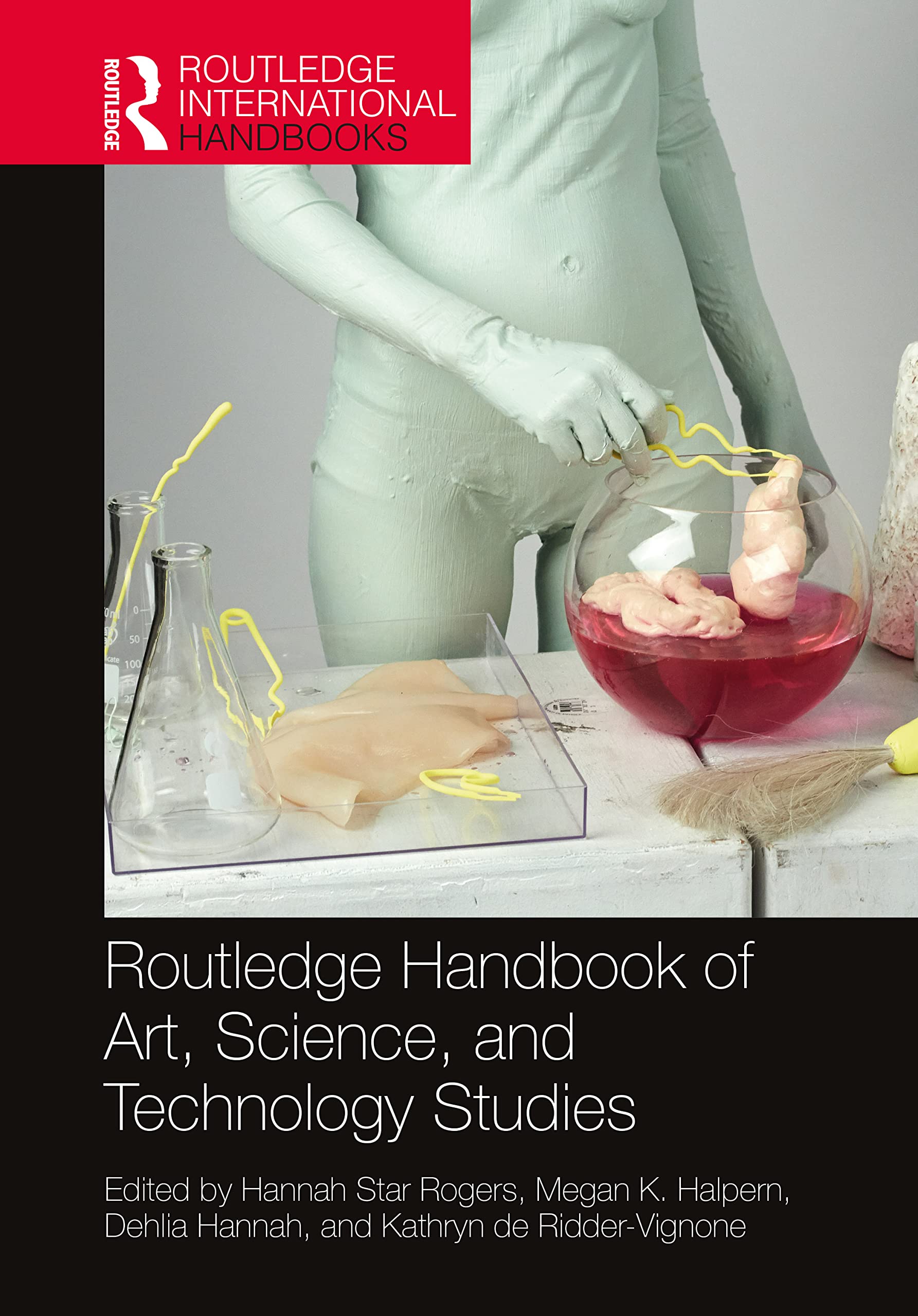
Routledge Handbook of Art, Science, and Technology Studies (Routledge International Handbooks)
$62.99
by Hannah Rogers



Art and science work is experiencing a dramatic rise coincident with burgeoning Science and Technology Studies (STS) interest in this area. Science has played the role of muse for the arts, inspiring imaginative reconfigurations of scientific themes and exploring their cultural resonance. Conversely, the arts are often deployed in the service of science communication, illustration, and popularization. STS scholars have sought to resist the instrumentalization of the arts by the sciences, emphasizing studies of theories and practices across disciplines and the distinctive and complementary contributions of each. The manifestation of this commonality of creative and epistemic practices is the emergence of Art, Science, and Technology Studies (ASTS) as the interdisciplinary exploration of art–science. This handbook defines the modes, practices, crucial literature, and research interests of this emerging field. It explores the questions, methodologies, and theoretical implications of scholarship and practice that arise at the intersection of art and STS. Further, ASTS demonstrates how the arts are intervening in STS. Drawing on methods and concepts derived from STS and allied fields including visual studies, performance studies, design studies, science communication, and aesthetics and the knowledge of practicing artists and curators, ASTS is predicated on the capacity to see both art and science as constructions of human knowledge- making. Accordingly, it posits a new analytical vernacular, enabling new ways of seeing, understanding, and thinking critically about the world. This handbook provides scholars and practitioners already familiar with the themes and tensions of art–science with a means of connecting across disciplines. It proposes organizing principles for thinking about art–science across the sciences, social sciences, humanities, and arts. Encounters with art and science become meaningful in relation to practices and materials manifest as perceptual habits, background knowledge, and cultural norms. As the chapters in this handbook demonstrate, a variety of STS tools can be brought to bear on art–science so that systematic research can be conducted on this unique set of knowledge-making practices. ‘Many of us have developed a love-hate relationship with our constructed disciplines. Deep knowledge in almost all areas of human inquiry has advanced society and quality of life for many of us. Yet as we advance, limitations and barriers within these systems reveal themselves begging for a new framework to move us forward – the creation of a new system of thought that is inclusive, collaborative and integrative. The noble efforts of the editors and thought leaders represented in Routledge Handbook of Art, Science, and Technology Studies strives to give us a new language by which we can collectively imagine a future that draws from all areas of investigation.’ J.D. Talasek, Director of Cultural Programs of the National Academy of Sciences (CPNAS), USA 'This massive and lavishly illustrated handbook presents and summarizes current work in an emergent field that the editors dub Art, Science, and Technology Studies (ASTS). The very presence of this handbook underlines the extent to which science, technology, and the arts have become interrelated without entirely erasing the integrity of each. Artists in residence have become commonplace in many scientific projects but, as the essays in this Handbook demonstrate, this is just the tip of the iceberg: art is intimately performed in science, and in art with scientific materials and techniques. Artists do not simply represent scientific and technological objects; they embed technoscience into works of art, without effacing those works as art. The dozens of authors who contributed to the handbook span numerous disciplines ranging from the natural and human sciences to the arts – often in unique combinations. At the same time, the Handbook maintains coherence by creatively drawing upon established themes from science and technology studies such as ‘social worlds’, ‘boundary work’ and ‘boundary objects’. The contributors include both well-known veterans and younger scholars who have begun to make their mark in ASTS. I know of no other source that provides such extensive and comprehensive coverage of this burgeoning trans-disciplinary field.' Michael Lynch, Professor Emeritus, Department of Science & Technology Studies, Cornell University, USA 'This far-ranging volume spans a stunning breadth of original creative work at the art, science, and technology nexus, building on the interwoven histories of Science and Technology Studies, Media Studies, and Transdisciplinary Studies. Unique to the handbook is the systematic organization of methodologies, artistic approaches, and conceptual concerns that drive this bold and dynamic field.' Patricia Olynyk, Multimedia Artist and Florence and Frank Bush Professor of Art, Washington University in St. Louis, USA 'The b