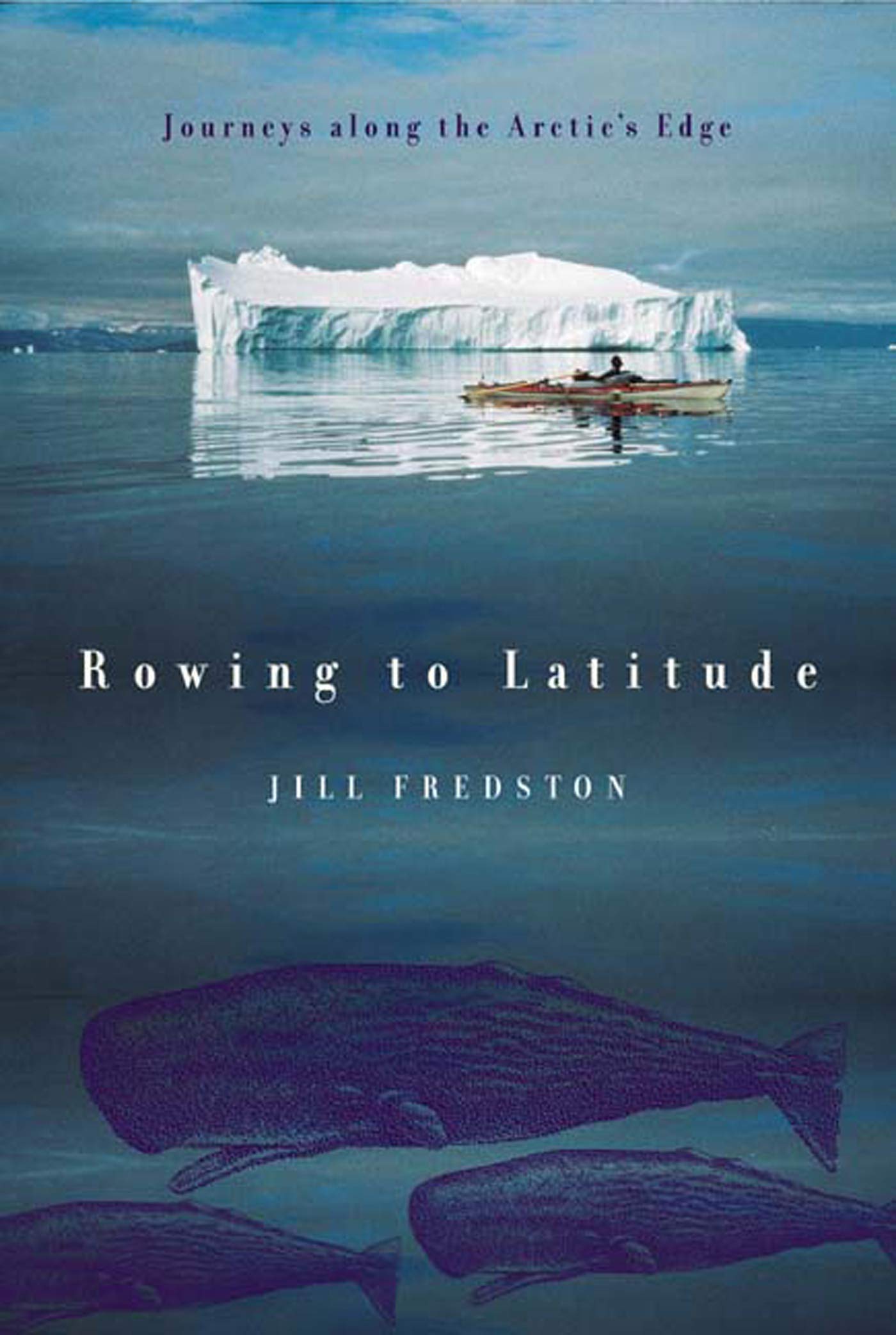



Two by sea: a couple rows the wild coasts of the far north in Rowing to Latitude: Journeys Along the Arctic's Edge. Jill Fredston has traveled more than twenty thousand miles of the Arctic and sub-Arctic-backwards. With her ocean-going rowing shell and her husband, Doug Fesler, in a small boat of his own, she has disappeared every summer for years, exploring the rugged shorelines of Alaska, Canada, Greenland, Spitsbergen, and Norway. Carrying what they need to be self-sufficient, the two of them have battled mountainous seas and hurricane-force winds, dragged their boats across jumbles of ice, fended off grizzlies and polar bears, been serenaded by humpback whales and scrutinized by puffins, and reveled in moments of calm. As Fredston writes, these trips are "neither a vacation nor an escape, they are a way of life." Rowing to Latitude is a lyrical, vivid celebration of these northern journeys and the insights they inspired. It is a passionate testimonial to the extraordinary grace and fragility of wild places, the power of companionship, the harsh but liberating reality of risk, the lure of discovery, and the challenges and joys of living an unconventional life. “As with most trips, Rowing to Latitude rewards you when you finally get to where you're going. Fredston makes you see wilderness as a more precious commodity than you thought, and inspires you to stretch your limits physically and mentally.” ― Lynne McNeil, The San Diego Union-Tribune “An honest and self-aware woman's record of her unusual life...a shrewd analytical look at human existence as a balance of danger and joy.” ― Judith Niemi, The Women's Review of Books “Beguiling.” ― Gail Caldwell, The Boston Globe “The book is far more than an adventure travel narrative. It also is deeply personal memoir and love story.” ― Brian Maffly, The Salt Lake Tribune “[Fredston] sticks to telling good stories about battling, on primitive terms, the weather, the water, the land, the animals and some of the demons that haunt us all.” ― Craig Medred, Anchorage Daily New “[Fredston] provides armchair travelers with a vivid portrait of wilderness rowing...full of intriguing personal digressions and moments of high drama.” ― John Freeman, The Wall Street Journal Jill Fredston and her husband, Doug Fesler, are avalanche experts and co-directors of the Alaska Mountain Safety Center. When they are not rowing, they live near Anchorage. Fredston is the author of Rowing to Latitude: Journeys Along the Arctic's Edge. Rowing to Latitude I wish to speak a word for nature, for absolute freedom and wildness. --Henry David Thoreau, "Walking" Preface FOR YEARS my husband, Doug Fesler, and I have led a double life. In the winter, we work together as avalanche specialists. Then, with the lighter days of summer, we disappear (though my mother hates that word) on three-to-five-month-long wilderness rowing and kayaking trips. Somehow, more than twenty thousand miles have slid under our blades, a function of time and repetitive motion rather than undue strength or bravery.Once, far down the Yukon River, which begins in western Canada and cleaves Alaska, an old Athabascan subsistence fisherman hailed us from his aluminum skiff. In keeping with local custom, he was in no hurry to talk, preferring to drift in silence while his eyes appraised us through a poker mask of wrinkles. In time he asked, "Where you come from?" And a minute or two later, "Where you go?" More silence, while he digested our answers. Eventually he pronounced, "You must be plenty rich tospend the summer paddling." Doug leaned back, grinned, and replied without a trace of the awkwardness I feared was lit in neon upon my face, "If we were rich, we'd have a boat with a motor like yours."Though we are far from rich and occasionally prey to bouts of motor envy, paddling is our preferred mode of travel, at least until our joints completely disintegrate. It allows us to tickle the shoreline, and opens our senses to the rhythms around us. We are more attuned to our surroundings when we are moving at only five miles per hour, maybe six on a good day. With hours to think, it is also a little harder to escape from ourselves.We always travel in two boats. This gives us an extra margin of safety and allows us to carry several months' worth of supplies. More important, such separation keeps us from hating each other. It would take better people than we are to share a small boat day after day and then to crawl into the same tent night after night, for weeks on end. Until 1994, there was also the practical consideration that we propelled our boats differently. I am firmly committed to rowing, which does not allow any part of my body to ride for free. My legs, when confined by the spray skirt of a kayak, instantly begin to twitch, and my arms feel cast in bronze. Doug favored kayaking for the first thirteen thousand of the miles we journeyed together; oddly, he thought it was important to see where he was going.