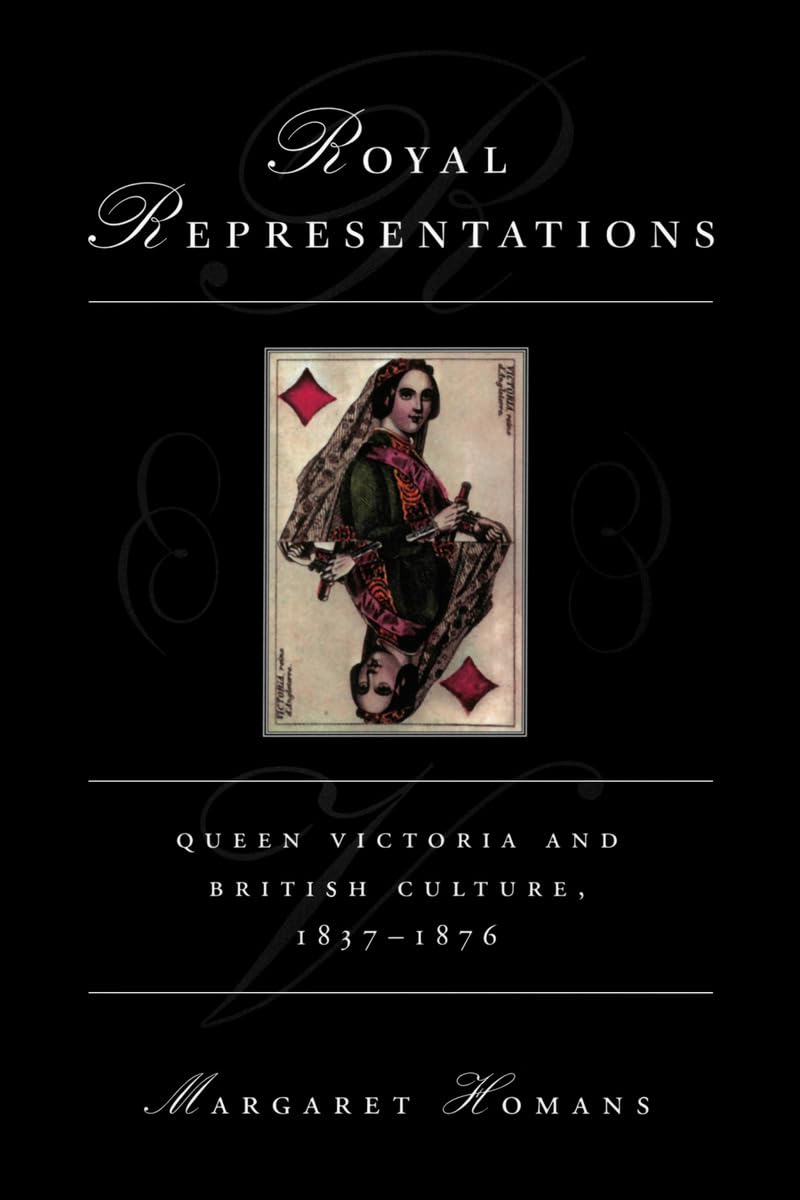
Royal Representations: Queen Victoria and British Culture, 1837-1876 (Women in Culture and Society)
$99.00
by Margaret Homans



Queen Victoria was one of the most complex cultural productions of her age. In Royal Representations , Margaret Homans investigates the meanings Victoria held for her times, Victoria's own contributions to Victorian writing and art, and the cultural mechanisms through which her influence was felt. Arguing that being, seeming, and appearing were crucial to Victoria's "rule," Homans explores the variability of Victoria's agency and of its representations using a wide array of literary, historical, and visual sources. Along the way she shows how Victoria provided a deeply equivocal model for women's powers in and out of marriage, how Victoria's dramatic public withdrawal after Albert's death helped to ease the monarchy's transition to an entirely symbolic role, and how Victoria's literary self-representations influenced debates over political self-representation. Homans considers versions of Victoria in the work of Elizabeth Barrett Browning, George Eliot, John Ruskin, Margaret Oliphant, Lewis Carroll, Alfred Lord Tennyson, and Julia Margaret Cameron. Royal Representations Queen Victoria and British Culture, 1837–1876 By Margaret Homans The University of Chicago Press Copyright © 1998 The University of Chicago All rights reserved. ISBN: 978-0-226-35113-1 Contents Figures, Foreword, by Catharine R. Stimpson, Acknowledgments, Introduction: The Queen's Agency, 1. QUEEN VICTORIA'S SOVEREIGN OBEDIENCE, 2. QUEEN VICTORIA'S WIDOWHOOD AND THE MAKING OF VICTORIAN QUEENS, 3. THE WIDOW AS AUTHOR AND THE ARTS AND POWERS OF CONCEALMENT, 4. QUEEN VICTORIA'S MEMORIAL ARTS, Epilogue: Empire of Grief, Notes, Index, CHAPTER 1 QUEEN VICTORIA'S SOVEREIGN OBEDIENCE [Acknowledging] one important truth [will make a successful marriage]—it is the superiority of your husband as a man. It is quite possible that you may have more talent, with higher attainments ... but this has nothing whatever to do with your position as a woman, which is, and must be, inferior to his as a man. Sarah Ellis, The Wives of England , 1843 Since the Queen did herself for a husband "propose," The ladies will all do the same, I suppose; Their days of subserviency now will be past, For all will "speak first" as they always did last! Since the Queen has no equal, "obey" none she need, So of course at the altar from such vow she's freed; And the women will all follow suit, so they say—"Love, honour," they'll promise, but never—"obey." London street ballad, 1841 "The Queen Has No Equal": The Problem of a Female Monarchy What made it possible, at a time when women were meant to "obey," for a woman to occupy the throne of England for sixty-three years and to leave the monarchy's domestic and international prestige, if not its political authority, enhanced? Despite notable exceptions, women were never meant to be Britain's monarchs. The throne was patrilineal. Dorothy Thompson indicates how peculiar it is "that in a century in which male dominion and the separation of spheres into sharply defined male and female areas became entrenched in the ideology of all classes, a female in the highest office in the nation seems to have been almost universally accepted." Adrienne Munich points out, moreover, that the idea of "maternal monarchy seems absurd," an outrageous mingling of separate spheres that created a "gap in representability" to be filled only by one paradox after another. And yet it is also arguable, on the model of Nancy Armstrong's contention "that the modern individual was first and foremost a woman" ( Desire and Domestic Fiction, 8), that, quite apart from the historical accident of Queen Victoria's reigning from 1837 to 1901, the modern British monarch was first and foremost a woman—to be specific, a wife, and a middle-class one. Paradoxical representations of Victoria, as monarch on the one hand and as wife on the other, became an effective strategy both for handling the public relations problem of female rule and, perhaps more important, for completing Britain's transition to parliamentary democracy and symbolic monarchy. The characteristics required of the monarch of a nineteenth-century parliamentary democracy were those also required of middle-class wives, and if a married woman had not occupied the throne for most of that century, the monarchy would have needed some other way of associating itself with wife-liness. Just like a middle-class wife, the monarch was obliged (since the seventeenth century, but increasingly so) not to intervene in politics. Like a middle-class wife spending her husband's income, she had to spend the wealth of her nation in a manner that displayed both its economic prowess and her dependency; she had to be the chief consumer in a nation of consumers. And she had to serve as a public, highly visible symbol of national identity and of her nation's values, just as a middle-class wife might be expected to display her husband's status. She had to be available for idealization a