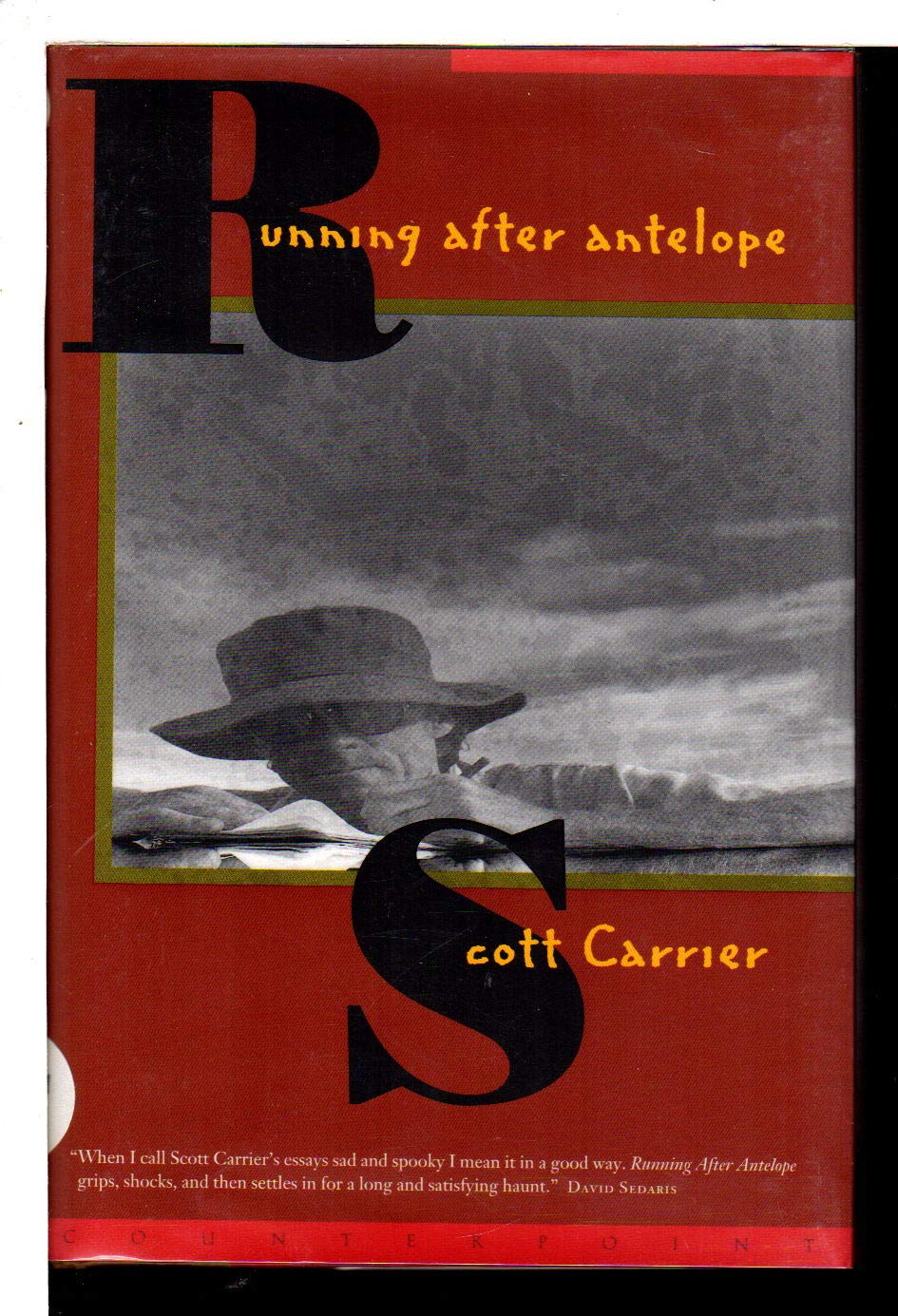



Independent radio producer Carrier has written a series of essays around his attempts to fulfill the unlikely dream of running down a pronghorn antelope. This collection of stories chronicles his travels, the people he met and the landscape, not only in the American West, but also in Cambodia, Kashmir, and Chiapas, where he was a correspondent for National Public Radio. Annotation c. Book News, Inc., Portland, OR (booknews.com) The signs that Scott Carrier was a writer and not an athlete showed up early. At the age of 12, Carrier was the free safety and captain of the defense on his football team. During one game he got his teammates into a huddle and told them he was going to do something different: We're going to line up in a six-three, but as they get set I'm going to say a haiku, and I want you guys to start moving around, dance around, stand on your head, do whatever you want. We'll kill them. Ready, break! When the quarterback started his count, Carrier shouted, "The wind brings dry leaves enough to start a fire!" and his teammates froze. When asked by his coach what on earth he'd been doing, Carrier calmly replied, "We're running a haiku." When pressed for a rationale, he said simply, "It was just an idea. It didn't really work out like I thought it would. I'm ready to move on, if you are." And move on he did, crisscrossing the country as a contributor for NPR for nearly two decades. Some of his radio pieces (as well as longer essays written for Esquire and Harper's ) have been collected in Running After Antelope . Sometimes sad, sometimes haunting, often funny, Carrier writes about travels to war-torn areas, personal relationship crises, and, of course, his quest to chase down an antelope--thus perhaps validating his vertebrate-morphologist brother's so-called running hypothesis: that humans became upright in order to breathe better. In the book's final essay, Carrier is chasing after an antelope he calls the Lone Male. His friends have kept the animal running for almost an hour when it crosses Carrier's path. Relatively fresh, he takes off after it, "And I laugh. I laugh and I run and it is, for sure, the best thing I've ever done. I have everything I need, the wilderness is unfolding in front of me." In the end, little is resolved--the wars and relationships continue, the thesis remains unproven. But Carrier would be the first to remind us that the pursuit--be it for peace, love, or science--has a purpose unto itself. Running After Antelope celebrates that pursuit in engaging fashion. --Sunny Delaney Carrier, a regular contributor to Ira Glass's This American Life, sees the experiences of life as a series of little stories to be shared. In this slim narrative, he gathers his autobiographical essays from radio as well as longer stories that have appeared in Harper's and Esquire, organizes them in chronological order, and envelopes the reader with his quests. He shares his pursuit of a pronghorn antelope and the challenges in his ultimate mission in search of adulthood, happiness, and success. Carrier's trek takes him from Lawrence, KS, through the American West to an assignment in Cambodia that left him exhausted and sad, to other foreign lands and back to Salt Lake City, where he is happiest. Carrier writes with humor and wit while inviting his readers into his thoughts, his stories, and his imagination. Recommended for all libraries. Cynde Bloom Lahey, New Canaan Lib., CT Copyright 2001 Reed Business Information, Inc. Scott Carrier was born in Lawrence, Kansas. Since 1983 he has been an independent producer for public radio, and is now a regular contributor to Ira Glass's "This American Life." He lives in Salt Lake City with his family. Used Book in Good Condition