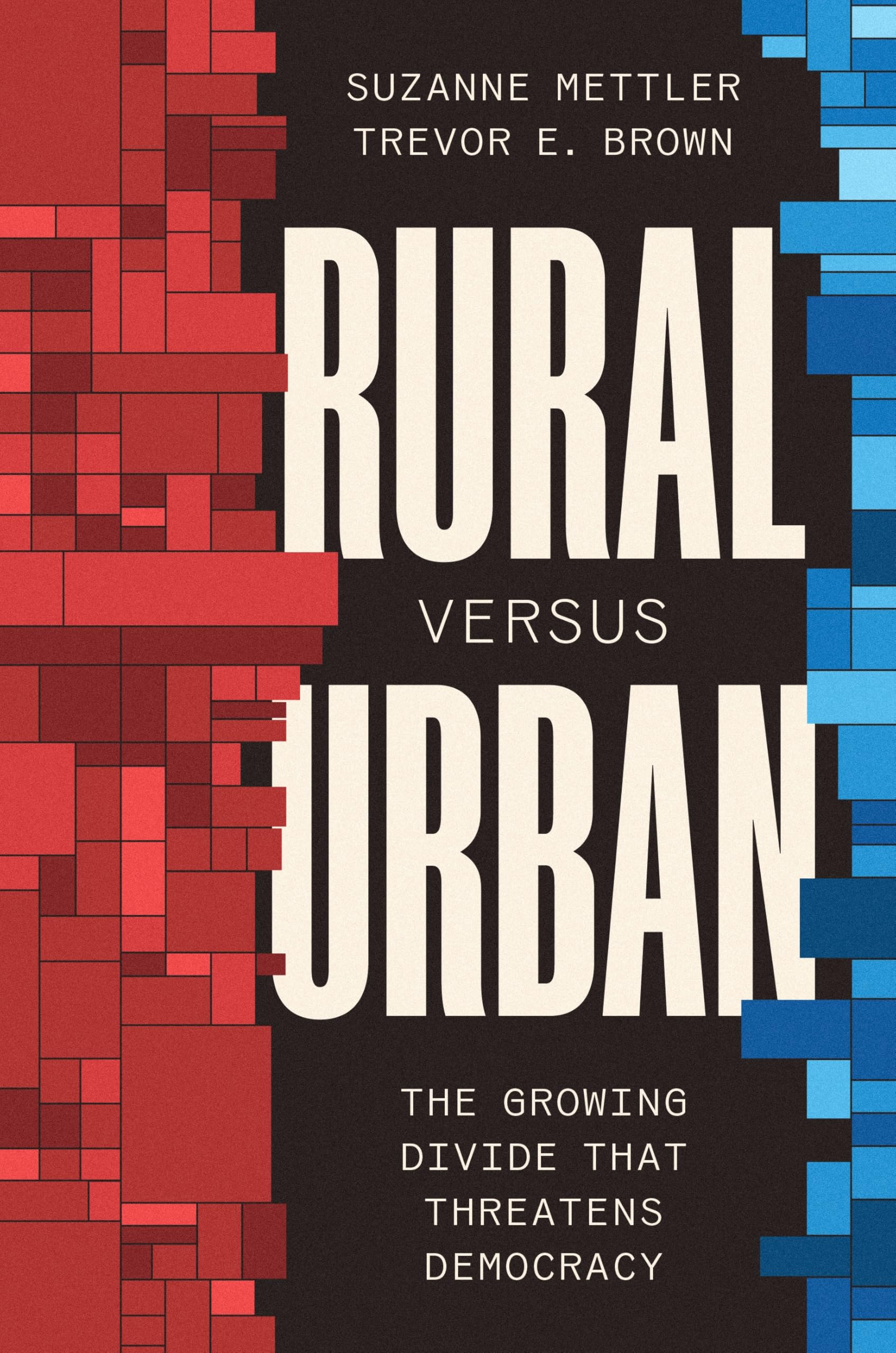



How the urban-rural divide drives partisan polarization Why have Americans living in different places come to experience politics as a battle between “us” and “them”? In Rural Versus Urban , Suzanne Mettler and Trevor Brown argue that political polarization is not just about red states and blue states, or coastal elites who alienate those in fly-over country. Instead, polarization permeates every region and every state—and has become organized through a pernicious rural-urban division. Mettler and Brown explain the evolution of this gulf across five decades, charting political trends in both places. Drawing on data on individuals, communities, and members of Congress, as well as interviews with local party leaders and former elected officials, they show how the divide emerged and why it poses a threat to democracy. Until about thirty years ago, both political parties attracted support from rural and urban voters. But after place-based inequality grew due to deregulation and trade liberalization, white rural dwellers began to view urban people and Democrats as affluent elites out of touch with their needs. Politically active evangelical churches, antiabortion organizations, and gun groups helped deepen the divide, encouraging many of these rural residents to become staunch supporters of the GOP. Now, regional one-party rule in rural America gives Republicans a systematic edge for gaining control of crucial political institutions, including the Senate, House of Representatives, the Presidency, and even the Supreme Court. This is helping enable an extremist political party and pushing democracy to the brink. Mettler and Brown argue that the divide can be repaired—but only if the Democrats build their own robust local organizations and offer citizens a meaningful choice. "A massive rural urban divide has opened in our country’s politics. Urban and rural voters used to vote pretty much in lock step. But then in the 1990s, that split. Urban voters became reliably Democratic, and rural voters became overwhelmingly Republican. We treat this as an inevitability in our politics, but it is only a few decades old, and our political future and stability might rest on reversing it. Certainly for the Democratic Party, any durable political power rests on reversing it. Reversing it isn’t going to be easy. But it begins with understanding it and taking seriously the resentments that fuel it. ‘ Rural Versus Urban ,’ a new book by the political scientists Suzanne Mettler and Trevor Brown is the best place I’ve found to start." ---Ezra Klein, New York Times "I read a very good book this week by Suzanne Mettler and Trevor Brown called Rural Versus Urban . I think that you need to revisit organizing all the way down in the country, and you need to put pressure on Republicans. Because until some of the Republicans who clearly know better are willing to say so, it’s going to be very hard to break this power that Trump is amassing." ---EJ Dionne, New York Times “I will be keeping this carefully researched and beautifully written book close at hand and sharing it with students, researchers, and the many members of the public I encounter who express concern about the rural versus urban divide. This is just an invaluable resource for understanding the origins of rural resentment and the divide in the United States, and how it has mattered for our national politics.”— Katherine J. Cramer, author of The Politics of Resentment “The partisan divide between metropolitan and rural America has become a canyon. It makes governing our country far more difficult and reaching consensus, even on once-unifying issues, nearly impossible. In Rural Versus Urban, Suzanne Mettler and Trevor Brown offer a brilliant and genuinely innovative analysis of how this happened. They bring together methodological sophistication, moral seriousness, and lively writing. It’s an essential book for everyone, but Democrats especially need to take heed.”— E. J. Dionne Jr. author of Our Divided Political Heart “Political science’s blind spot in understanding the politics of rural Americans has undermined its ability to make sense of the urban-rural divide. In this beautifully written and reasoned book, Mettler and Brown answer questions that a disproportionately nonrural profession has mostly ignored. It is a must-read for every scholar of American politics.”— Marc Hetherington, University of North Carolina Suzanne Mettler is the John L. Senior Professor of American Institutions in the Government Department at Cornell University. She is the author of The Submerged State and Degrees of Inequality: How The Politics of Higher Education Sabotaged the American Dream , among other books, and the coauthor of Four Threats: The Recurring Crises of American Democracy . Trevor E. Brown is a postdoctoral associate at Johns Hopkins University. In 2026, he will join the University of Oregon’s Department of Political Science as assistant professor.