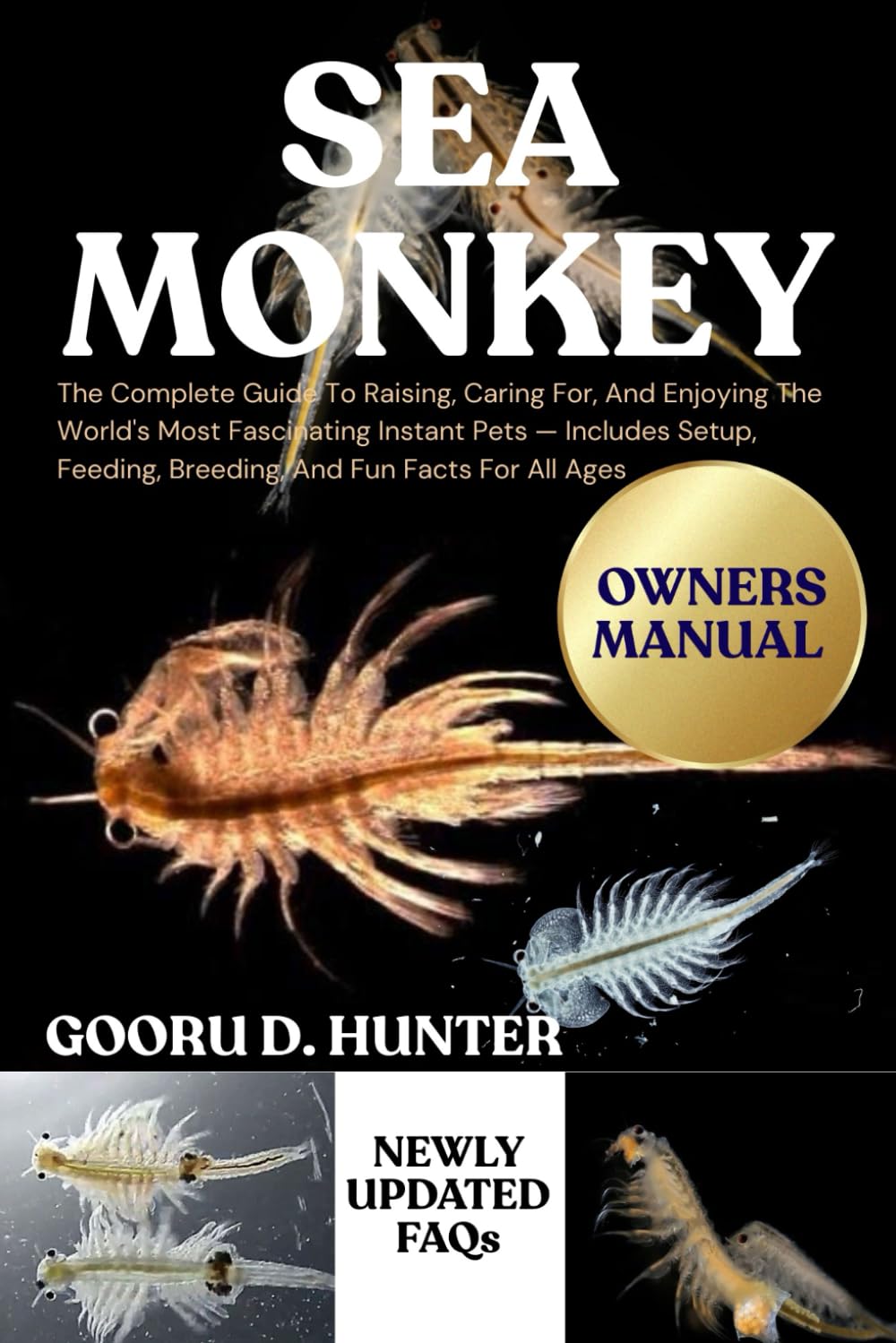
SEA MONKEY: The Complete Guide To Raising, Caring For, And Enjoying The World's Most Fascinating Instant Pets — Includes Setup, Feeding, Breeding, And
$13.99
by GOORU D HUNTER



What Are Sea Monkeys? Sea Monkeys, despite their whimsical name and cartoonish marketing, are not monkeys at all. In fact, they are a specialized strain of brine shrimp—a species scientifically known as Artemia nyos. These tiny aquatic crustaceans are part of a broader group of primitive organisms that have existed on Earth for millions of years. Sea Monkeys were developed in the 1950s and 1960s to be sold as novelty pets, engineered for resilience, ease of care, and long shelf life in their egg (cyst) form. What makes Sea Monkeys unique isn't just their miniature size or curious swimming patterns—it’s their incredible ability to survive in extreme conditions. Their eggs can remain dormant for years, even decades, and will hatch when placed in water under the right conditions. This process, known as cryptobiosis, allows the embryo inside the egg to suspend its metabolism, making it virtually indestructible by time, dryness, or harsh environments. This miraculous biological trait was the gateway to their transformation from a scientific curiosity into a household name. From comic book ads in the mid-20th century to science classroom experiments, Sea Monkeys captured the imagination of generations. Origins of Sea Monkeys The story of Sea Monkeys begins with an enterprising inventor named Harold von Braunhut. Born in 1926, von Braunhut was a marketer, inventor, and showman with a flair for novelty products. In the late 1950s, he partnered with marine biologist Dr. Anthony D’Agostino to create a more resilient breed of brine shrimp that could be sold as pets. Through selective breeding, they developed Artemia nyos—named after the New York Ocean Science Laboratories, where the breeding experiments took place. Von Braunhut saw massive potential in the idea of selling "instant life" to children and families. In 1957, he released his new product under the name “Instant Life”, though it didn't take off immediately. Realizing that branding was key, he later rebranded them as Sea Monkeys in the early 1960s. The name evoked a sense of magic and playfulness, suggesting an exotic aquatic creature rather than a humble crustacean. The name was inspired partly by the creatures’ tails, which resembled that of a monkey in some interpretations, and partly by the marketing angle that promised an exciting, miniature underwater world. Von Braunhut combined clever advertising, exaggerated illustrations, and an alluring promise: a colony of tiny pets that would "magically appear" from powder added to water. Comic Book Fame and Cultural Explosion Sea Monkeys might have remained a minor curiosity if not for a brilliant marketing strategy. Von Braunhut invested heavily in placing full-page ads in comic books throughout the 1960s, ’70s, and ’80s. These colorful and fantastical ads showed humanoid Sea Monkeys lounging in underwater castles, wearing crowns, blowing bubbles, and engaging in human-like behavior. The artwork, created by famed comic illustrator Joe Orlando, was both whimsical and misleading—but it worked. Children were captivated by the idea that they could grow their own civilization of tiny, smiling sea creatures. For under a dollar, they could receive a mail-order kit containing three envelopes labeled “Water Purifier,” “Instant Life Eggs,” and “Growth Food.” These mysterious powders, when added to water in succession, appeared to bring life from nothing. The anticipation and mystery built into the process made the experience thrilling. Kids waited anxiously for the tiny white specks to start swimming, imagining them as the cartoon kings and queens from the advertisements. While some were disappointed that their Sea Monkeys didn’t match the anthropomorphic fantasy, others were delighted by the strange, alien-like creatures darting around in their tanks.