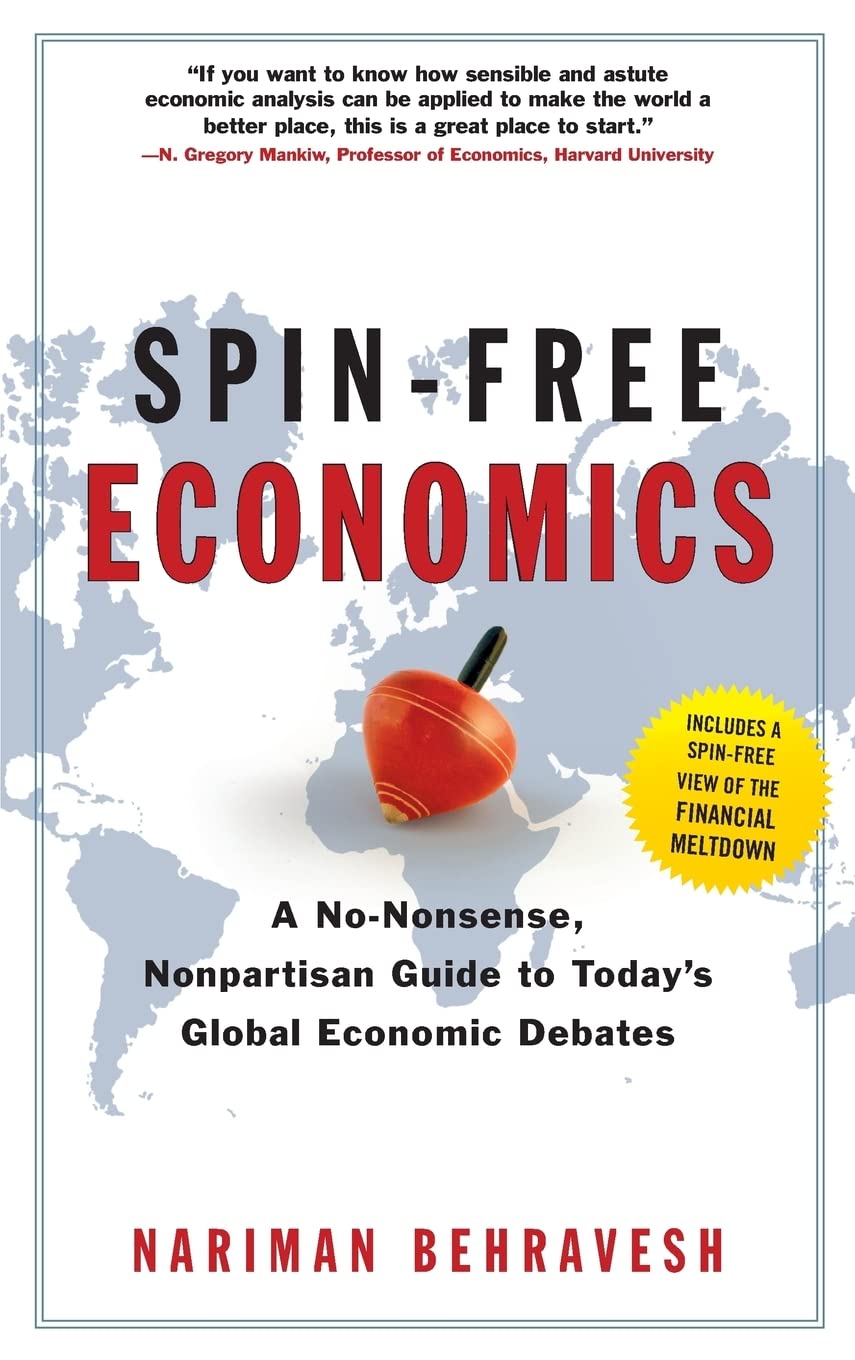



With technology and globalization advancing at breakneck speed, the world economy becomes more complex by the day. Activists, politicians, and media enablers―conservative and liberal, left and right, informed and just plain wrong―consistently seize this opportunity to present woefully simplistic explanationsand hype the latest myths regarding issues affecting the economy. Their purpose is not to educate but to advocate and, in many cases involving the media, manufacture outrage to drive ratings higher. So, where can you find the truth about today’s economy and how it affects you? Turn off the TV, put down the magazine, log off the Internet―and read this book. Spin-Free Economics places the current economic debates where they belong: in the middle of the road. With no political ax to grind, Nariman Behravesh takes a centrist approach to explain how today’s economic issues affect individuals and businesses. Along the way, he debunks myths regarding the effects of immigration, unemployment, regulation, productivity, education, health care, and other headline issues. Spin-Free Economics answers today’s most pressing questions, including Will more regulation prevent financial crises? - Are outsourcing and foreign ownership good or bad for Americans? - Should we fear or embrace Asia’s emerging economic powers? - Is aid or trade the solution to global poverty? The vast majority of economists, Behravesh points out, are independent analysts who are in agreement on many of today’s issues. Unfortunately, the subject has been taken over by opportunists, whose answers to the questions above invariably fall along partisan lines. Spin-Free Economics is a breath of fresh air for those seeking an alternative to the chatter of ideologues and cynics. Rejecting the manipulative approach of “sound-bite economics,” Nariman Behravesh uses facts and insight tempered by clearheaded reason to present the most accurate assessment of the subject to date. Nariman Behravesh is Chief Economist for Global Insight, an economic and financial analysis firm. He previously served as Chief International Economist at Standard & Poor's. Nariman Behravesh is Chief Economist for Global Insight, an economic and financial analysis firm. He previously served as Chief International Economist at Standard & Poor's. SPIN - FREE ECONOMICS A No-Nonsense Nonpartisan Guide to Today's Global Economic Debates By NARIMAN BEHRAVESH The McGraw-Hill Companies, Inc. Copyright © 2009 Nariman Behravesh All right reserved. ISBN: 978-0-07-154903-5 Contents Chapter One PART I Markets Know Best Markets and Trading Are Hard-Wired into Humans It is tempting to think of markets as modern, sophisticated institutions. In fact, commerce is one of the oldest types of human interaction. Anthropologists have uncovered evidence of trading activity in settlements that are between 30,000 and 60,000 years old. Markets have sometimes been described as brutal and inhumane. In reality, successful markets, both primitive and sophisticated, embody some of the purest and best aspects of human society, including lack of coercion and the opportunity to pursue one's own self-interest—in other words, the freedom to choose. So, markets are one of the quintessential human institutions. While far from perfect, they have been immensely successful in delivering a huge variety of goods and services and leading to a dramatic increase in living standards, as we will see in subsequent essays. Stone-Age Arbitrage Trading seems to be hard-wired into human beings. Recent studies have uncovered a very sophisticated system of barter among the aboriginal tribes of northern Australia, which practiced this form of commerce from the dawn of humanity to as late as the nineteenth century. These tribes were true hunter-gatherers, with no farming, no government, no rule of law, no money, and no science. They also could not read or write. Nevertheless, the system of trading that they developed was truly ingenious and, in many respects, very modern. Two of the items traded were spears tipped with the barbs of sting rays, which were produced along the coastal areas, and polished stone axes, which were produced hundreds of miles inland to the south, near stone quarries. The tribes producing the spears and those producing the axes did not trade directly with each other. Rather, they were linked by a long chain of other tribes that were part of the barter system, and that lived in the vast stretch of territory in between. As the spears were traded by successive tribes and moved south (away from where they were produced), their value relative to that of axes rose. Similarly, the value of axes rose as they moved north. This gave the middlemen (the tribes in between) the chance for profit. For example, a tribe in the middle of the chain could buy an axe from its southern neighbor for five spears and sell it to its northern neighbor for six spears. Even though the middlem