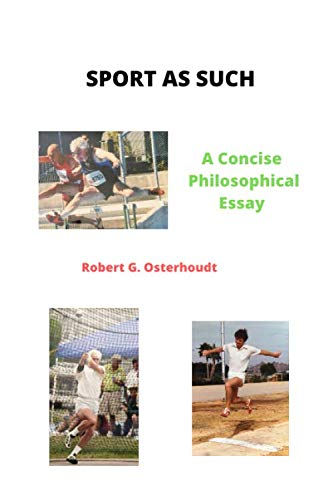



Sport has occupied a substantial place in the creative sweep of characteristically human activity. It therefore warrants a consequential station in any sober study of such activity. Philosophical accounts of sport are among those essential to an authentic understanding, appreciation, and practice of the activity. They disclose sport's nature and purpose; they reveal what sport is and what it is ultimately for; they unveil the basic place of sport in the full relief of distinctly human experience. This essay examines the three major philosophical visions of the ancient, medieval, and modern eras (the mechanistic [materialism and spiritualism], organic [humanism], and skeptical theses) in terms of reality's whole and its parts as well as in terms of the fundamental character of nature, divinity, humanity, knowledge, (moral, aesthetic, and jurisprudential) purpose, and the tangible world. It then inspects the relative merits of these visions in respect to their aptitude for explaining reality as a coherent, accessible, purposeful, developing, and free order and it declares the triumph of the organic thesis (and its proportionate interpretation of the world together with its intrinsic respect for humanity) over both the mechanistic (and its one-sided emphasis on either the body or the mind together with its extrinsic regard for humanity), and the skeptical (and its vacuous regard for the standard issues of philosophical discourse). Predictably, the three main philosophical interpretations of sport's basic nature and purpose issue from the bowels of the three main philosophical visions of reality in its broadest terms. These interpretations are themselves, in turn, grounded in the rules that define sports, in sport's constitutive rules. These rules embody three qualities which all sports (and only sports) share and which thus distinguish sport from all other features of life, mainly from the activities of the everyday; from imaginative pursuits such as the methodological, natural scientific, social scientific, artistic, and humanistic disciplines; and from dance, exercise, physical education, body building, non-zero-sum games, and board and card games. These qualities concern the play-work relation, the competitive motif, and physicality-movement. The organic thesis holds that sport is inherently and fundamentally playful (of intrinsic cast), competitive in a cooperative sense, and physical in an intrinsic sense. The mechanistic thesis argues that sport is inherently and fundamentally work-like (of extrinsic cast), competitive in an adversarial sense, and physical in an extrinsic sense. And the skeptical thesis claims that sport lacks distinguishing characteristics of the type referred to by the organic and mechanistic theses. It is on the basis of the three internal qualities of sport (and an external quality which concerns the breadth of sport's cultural and historical record) that the distinguished philosophical literature concerning sport has discerned the particular individual, dual, and team activities most plausibly considered sports. From these various judgments concerning the basic character and purpose of sport also issue profoundly telling ethical, aesthetic, and jurisprudential implications as well as perceptions of sport's historical development and its ideal. Despite sport's dominant historical embrace of mechanistic and extrinsic aims and despite sport's spare historical record as an instance of human illumination, decency, and consummation, the essay holds that sport is not inherently instrumental, that it instead constitutes a fundamental and universal form of human expression and fulfillment, and that it more so resembles art than either war or commerce. The essay concludes with a sharp critique of the instrumental and profane disposition of contemporary sport and an exhortation to its reform. Bob Osterhoudt was born in Scranton, Pennsylvania, U.S.A. in 1942. After three years in the United States Army, he won B.S. and M.S. degrees from the Pennsylvania State University and a Ph.D. degree from the University of Illinois. He was for more than thirty years a professor of humanistic subjects (mainly historical and philosophical subjects concerning sport) at Lock Haven (Pennsylvania) State College, State University of New York at Brockport, University of Minnesota, Arizona State University, and Semmelweis University (on Fulbright Fellowship in Budapest, Hungary). He has lectured in Europe, the Middle East, and Asia as well as in North America; has taught, conducted research, and directed graduate theses and dissertations in the United States; has published widely in national and international contexts (most notably his recent books, The Philosophy of Sport: An Overview and Sport as a Form of Human Fulfillment: An Organic Philosophy of Sport History ); and has won the Commendation for Research in the International Carl Diem Contest (from the German Sports Federation). He has been too a head colle