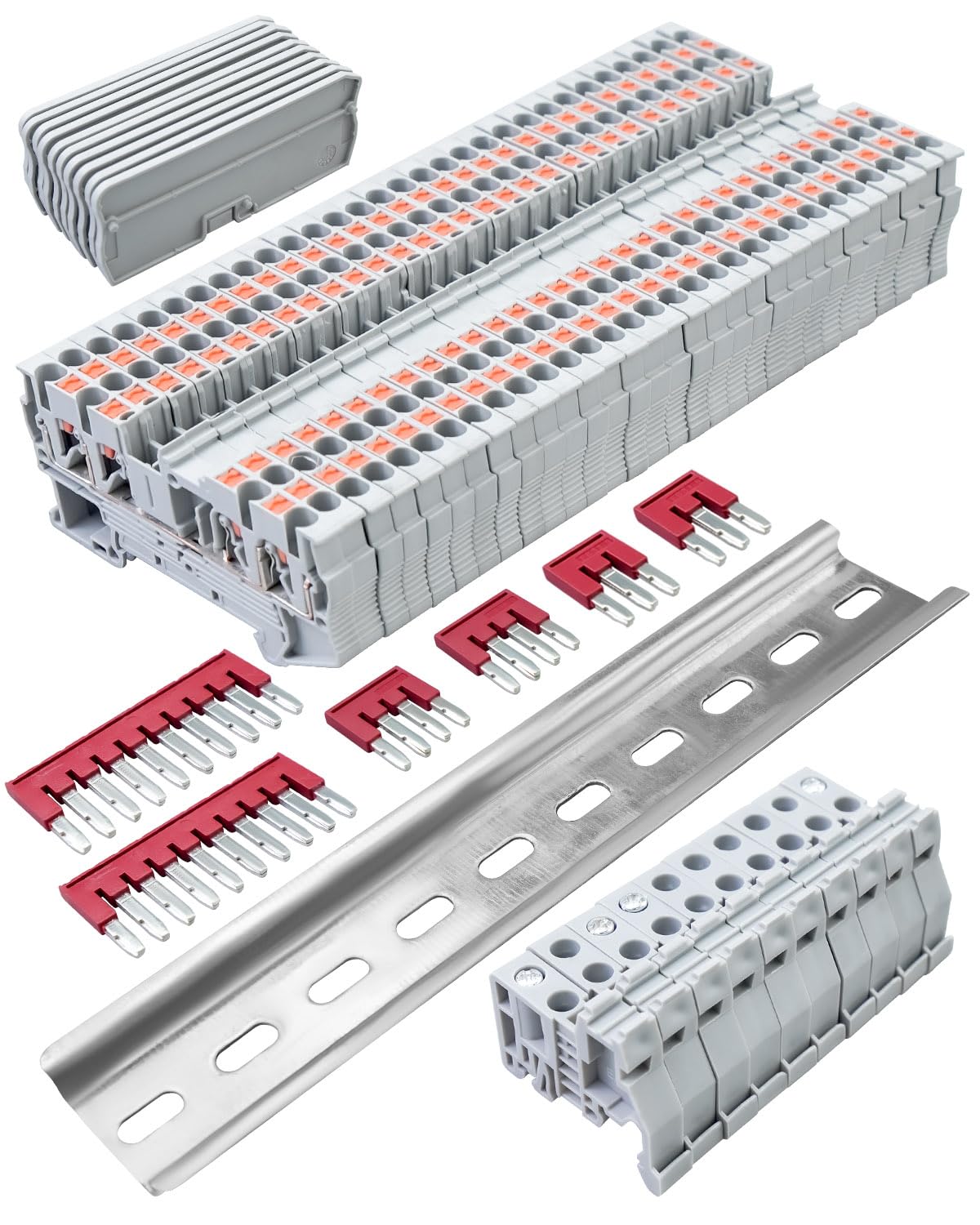



Standard Configuration List: Din rail terminal block kit contains 30 ST2-2.5/2X2 terminal blocks, 10 sets of gaskets and end stops, 2 sets of multi-pole jumpers (2 sets each for 3/5/10 poles) and 20cm standard rails, forming a complete electrical connection system Precision Modular Design: Single terminal size 72.2×36.8×5.2mm, accurately adapted to 35mm DIN rails. Rated to carry 32A current/800V voltage, meeting industrial-grade electrical standards Triple Safety Structure: Shell: flame-retardant polyacrylate (UL94 V-0 grade), Conductive: copper alloy contacts + stainless steel spring crimping, Protection: end stopper anti-loosening design Quick Assembly: Self-locking push-in wiring structure, supports quick access to wires below 6mm². The rail buckle realizes tool-free installation, and the tension self-compensation function ensures a stable cable connection Industrial Scene Adaptation: specially developed for scenes such as power distribution cabinets, control boxes, mechanical equipment, etc., and compatible with the wiring requirements of industrial equipment such as PLC systems and power monitoring devices Modular Installation, Industrial-grade Durability
The DIN rail terminal block kit contains 30 sets of terminals + rail components. The push-in self-locking design enables tool-free quick installation, and the copper-core stainless steel spring ensures stable transmission of 32A/800V high load. The flame-retardant and corrosion-resistant material is suitable for distribution boxes, control cabinets and other scenarios, and can be flexibly spliced and expanded, which increases wiring efficiency by 50% and reduces the space occupancy rate of electrical cabinets.
Safety Protection and Convenient Maintenance
The terminal group has a built-in anti-loosening structure, which is tensile and shock-resistant to ensure long-term safety. The modular design of the components supports partial replacement, and the line can be quickly reorganized with jumpers/spacers, which greatly reduces the time spent on equipment upgrades or troubleshooting, and meets the high-frequency maintenance needs of industrial scenarios.
The DIN rail terminal block kit contains 30 sets of terminals + rail components. The push-in self-locking design enables tool-free quick installation, and the copper-core stainless steel spring ensures stable transmission of 32A/800V high load. The flame-retardant and corrosion-resistant material is suitable for distribution boxes, control cabinets and other scenarios, and can be flexibly spliced and expanded, which increases wiring efficiency by 50% and reduces the space occupancy rate of electrical cabinets.
Safety Protection and Convenient Maintenance
The terminal group has a built-in anti-loosening structure, which is tensile and shock-resistant to ensure long-term safety. The modular design of the components supports partial replacement, and the line can be quickly reorganized with jumpers/spacers, which greatly reduces the time spent on equipment upgrades or troubleshooting, and meets the high-frequency maintenance needs of industrial scenarios.