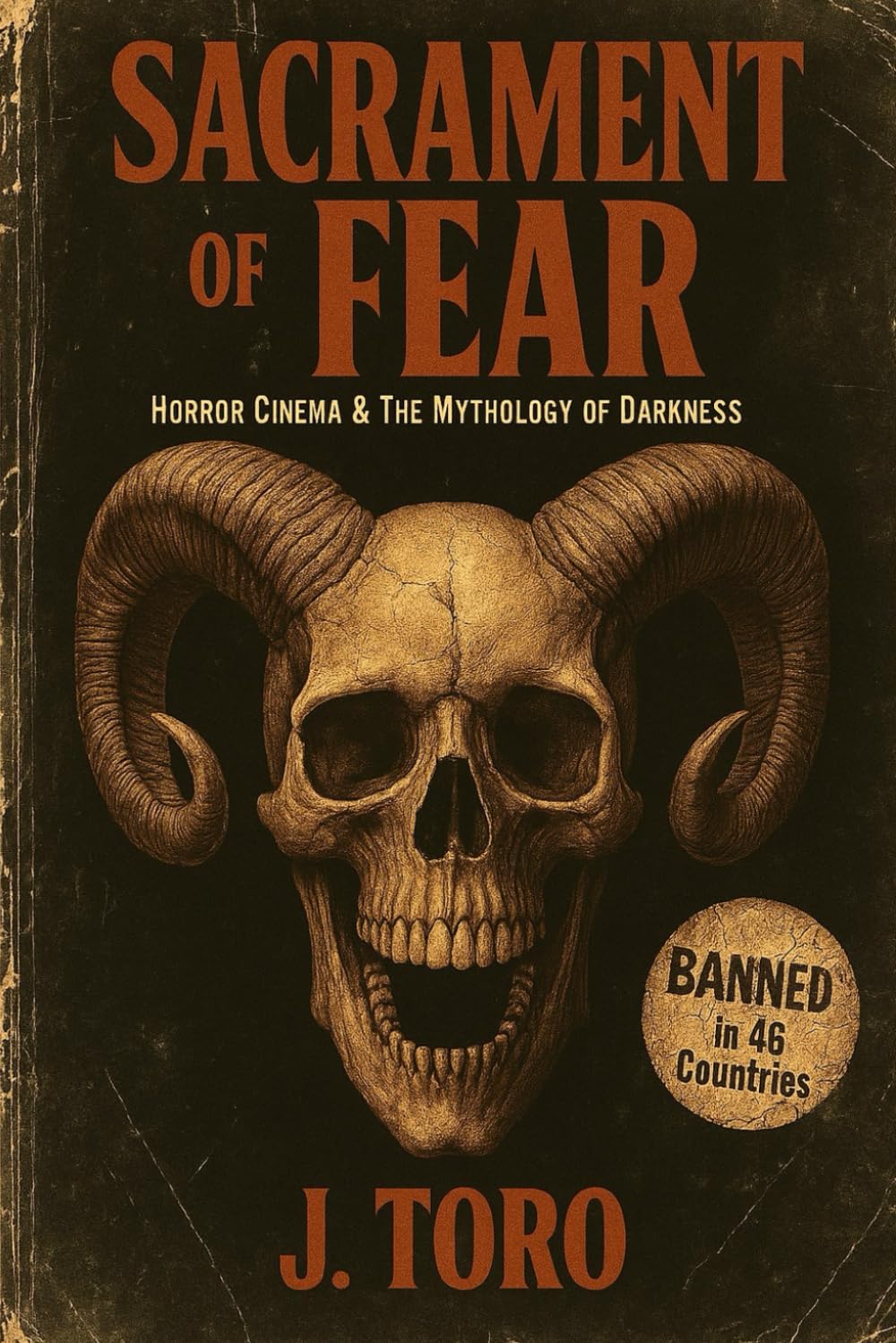



Horror is one of the last surviving rituals of a disenchanted world. Beneath the surface of monsters and murder lies a sacred language, one that transforms blood and dread into revelation. Drawing on the works of Joseph Campbell, Carl Jung, and Mircea Eliade, author J. Toro constructs a living mythology of horror cinema. He reveals how the horror genre is not nihilistic but sacramental, a medium through which modernity unknowingly reenacts the oldest mysteries of death and renewal. Sacrament of Fear elaborates how horror is an initiation ritual conducted through light and shadow. In this Mythology of Darkness, the Hero’s Journey is inverted: the descent into the Void is not a trial to escape but a truth to embrace. Toro suggests that the horror film is both mirror and altar, reflecting what culture represses while sanctifying its fears. The theater is a temple where light flickers like a votive flame, illuminating the secret correspondence between violence and transcendence. The core of the book charts horror’s evolution from primal archetype to apocalyptic vision, revealing how each cinematic age reenacts the sacred drama of death, transgression, and renewal: Michael Myers, Jason Voorhees, and Freddy Krueger are revealed to be modern avatars of mythic forces. Their masks are not disguises but vessels of archetypal power, allowing ancient deities of death, vengeance, and chaos to manifest through flesh. - With The Texas Chainsaw Massacre and Henry: Portrait of a Serial Killer , horror’s descent into documentary authenticity transforms film into an instrument of ritual violence, converting spectatorship into complicity. Found-footage and extreme horror inherit this impulse, turning realism into revelation and the lens itself into a form of confession. - The monstrous feminine and the theology of flesh emerge in Häxan , Carrie , and Alien . The witch, the victim, and the alien queen are avatars of the Great Mother archetype—life and death united in one sacred body. Horror’s obsession with nudity, blood, and transformation is a distorted echo of ancient fertility rites, restoring the sanctity of embodiment in a culture that fears it. - Apocalyptic horror transforms eschatology into cyclical ritual—worlds end not in judgment but in renewal. Through the zombie and alien mythologies of Night of the Living Dead , Dawn of the Dead , Alien , and Prometheus , destruction becomes rebirth. The undead and the extraterrestrial embody both the collapse of human boundaries and the return of cosmic indifference. Ultimately, horror cinema is not an escape from belief but its resurrection, flickering eternally in the dark. The scream becomes a hymn, the kill a sacrament, the film a reliquary of awe. Horror’s endless sequels thereby become liturgical repetition, the ouroboros of cinema devouring itself to live again. Sacrament of Fear speaks to horror fans and seekers of meaning alike. Within its pages, J. Toro reveals how every haunted house, every masked killer, and every monstrous transformation conceals a fragment of divine memory. Beneath the spectacle of fear lies a secret devotion: the belief that the sacred still breathes within the shadows, waiting to be seen, named, and understood—a reminder that fear is not the absence of faith, but its final, flickering form.