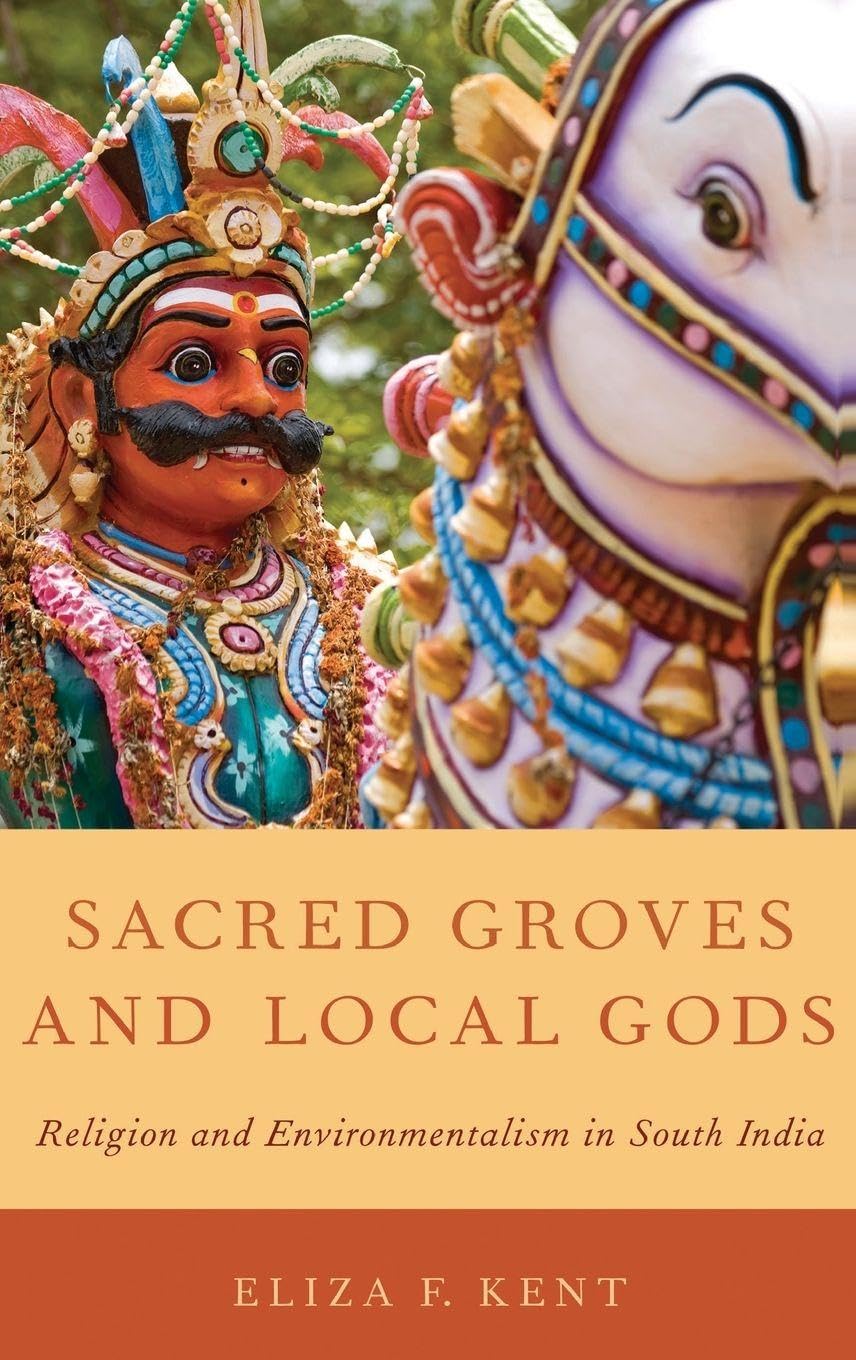
Sacred Groves and Local Gods: Religion and Environmentalism in South India
$145.00
by Eliza F. Kent



In recent years, India's "sacred groves," small forests or stands of trees set aside for a deity's exclusive use, have attracted the attention of NGOs, botanists, specialists in traditional medicine, and anthropologists. Environmentalists disillusioned by the failures of massive state-sponsored solutions to ecological problems have hailed them as an exemplary form of traditional community resource management. For in spite of pressures to utilize their trees for fodder, housing, and firewood, the religious taboos surrounding sacred groves have led to the conservation of pockets of abundant flora in areas otherwise denuded by deforestation. Drawing on fieldwork conducted in the southern Indian state of Tamil Nadu over seven years, Eliza F. Kent offers a compelling examination of the religious and social context in which sacred groves take on meaning for the villagers who maintain them, and shows how they have become objects of fascination and hope for Indian environmentalists. Sacred Groves and Local Gods traces a journey through Tamil Nadu, exploring how the localized meanings attached to forested shrines are changing under the impact of globalization and economic liberalization. Confounding simplistic representations of sacred groves as sites of a primitive form of nature worship, the book shows how local practices and beliefs regarding sacred groves are at once more imaginative, dynamic, and pragmatic than previously thought. Kent argues that rather than being ancient in origin, as has been asserted by other scholars, the religious beliefs, practices, and iconography found in sacred groves suggest origins in the politically de-centered eighteenth century, when the Tamil country was effectively ruled by local chieftains. She analyzes two projects undertaken by environmentalists that seek to harness the traditions surrounding sacred groves in the service of forest restoration and environmental education. "This volume is a welcome addition to a growing literature investigating the relationship of religion to sacred theology. Kent presents a very thorough analysis of sacred groves in South India... Very well written with little jargon, this volume is quite accessible to general, educated readers. It will also be valuable for courses in religiou studies, South Asian studies, and anthropology." -- CHOICE "Eliza Kent's wonderful (readable, teachable) book on sacred groves delivers lucid and refreshingly balanced understandings particularly welcome in the debates around ecology and religion. Uniting ethnographically and historically grounded case studies based in diverse regions of Tamil Nadu with global perspectives on environmental crisis, Kent ably presents the genuine potential of engaging religiosity for ecological restoration." ---Ann Grodzins Gold, Thomas J. Watson Professor of Religion and Professor of Anthropology, Syracuse University "Kent is an excellent story teller who narrates the complex story of Tamil religious environmentalism with fervour and flavour, just as she navigates very skillfully through India's socio-religio-cultural waters with ethnographic depth and theoretical clarity. The greatest strength of Eliza F. Kents's present work lies in its comprehensiveness, readability and accessibility."-- Journal of Hindu-Christian Studies Deepens our understanding of the changing nature of religion in contemporary India Eliza F. Kent is Associate Professor of Religion at Colgate University and the author of Converting Women: Gender and Protestant Christianity in Colonial South India (2004). Used Book in Good Condition