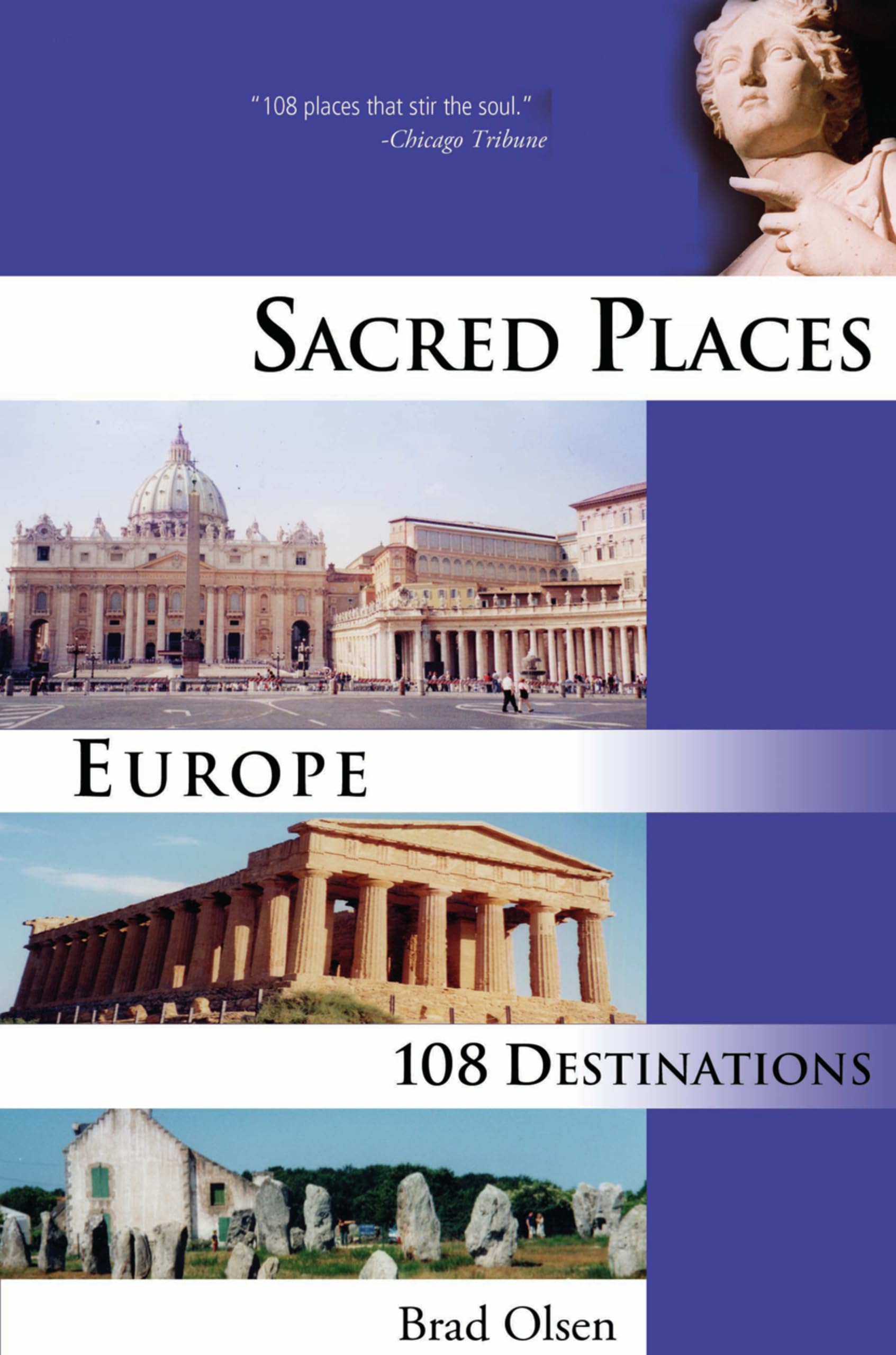
Sacred Places Europe: 108 Destinations (1) (Sacred Places: 108 Destinations series)
$19.95
by Brad Olsen



Discover the first comprehensive guide to all of Europe's holiest sites. Combining current trends, academic theories, and historical insights, this travel guide to the European continent brings famous, lesser-known and mysterious locations into perspective by explaining the significance of each sacred site. The cultural relevance, history, and spirituality of each site—including Stonehenge, the Acropolis, Mont Saint Michel, Pompeii, and Saint Peter’s Basilica—are explained, creating a moving and artistic travel experience. Each destination—with selections spanning more than 15 countries throughout Europe—is accompanied by easy-to-follow maps and directions. Editorial Reviews: “Author Brad Olsen is clearly a man who knows and loves his topic. If you're visiting Europe and have an interested in sacred sites from Glastonbury and Kildare to the Shroud of Turin or the Infant Jesus of Prague, Sacred Places Europe is well worth its reasonable price.” –Europe for Visitors "Olsen's marvelous drawings and mysterious maps enhance a package that is as bizarre as it is wonderfully accessible. The historical data and metaphysical ruminations make it an intriguing read." --San Francisco Examiner Brad Olsen is author of ten books, including three in his Esoteric Series: "Modern Esoteric" "Future Esoteric." and the newly-released “Beyond Esoteric.” An award-winning author, book publisher and event producer, his keynote presentations and interviews have enlightened audiences at Contact in the Desert, UFO Mega Conference, the 5D events and dozens of radio (including Coast to Coast, Ground Zero, and Fade to Black) and television shows (including Ancient Aliens, America Unearthed, Beyond Belief, and Mysteries of the Outdoors). Brad is founder and co-producer of the How Weird Street Faire. Sacred Places Europe: 108 Destinations By Brad Olsen Consortium of Collective Consciousness Copyright © 2007 Brad Olsen All rights reserved. ISBN: 978-1-888729-12-2 Contents Cover, Title Page, Copyright, Author's Karma Statement, Foreword by Martin Gray, Introduction to the European Continent, GREAT BRITAIN, IRELAND, FRANCE AND THE LOW COUNTRIES, CENTRAL EUROPE, EASTERN EUROPE, SCANDINAVIA, GERMANY AND THE ALPS, GREECE, ITALY AND MALTA, SPAIN AND PORTUGAL, Conclusion, Bibliography, Tour Outfitters to European Sacred Places, Index, CHAPTER 1 GREAT BRITAIN When Britain first, at heaven's command, Arose from out the azure main, This was the charter of the land, And guardian angels sung this strain: 'Rule, Britannia, rule the waves; Britons never will be slaves.' — James Thompson The first people to cross the English Channel and settle in Briton were small bands of hunters from Europe. This initial migration took place around 4000BCE; however, little remains of these earliest arrivals. Another wave of immigrants came around 3000BCE, bringing with them basic stone tools and a mysterious new religion. This religion focused on the sacred henge — a circular megalithic structure constructed of either wood or stone. There are seven known timber temples and about 3,000 stone circles throughout Britain from this era, most located in southwestern England. These Stone Age monuments, including the awesome Stonehenge, served as religious meeting centers, as well as astronomical observatories. The next great influx of culture began with the Celts, who introduced the skill of using bronze and iron. Their unique artistry and designs never went away, becoming a source of inspiration to the Romans and early Christians. In addition, the Celts brought diverse languages, which can still be heard today in Wales (Brythonic), and Ireland and Scotland (Gaelic). In 43 CE, the Romans crossed the English Channel to rule Britannia for 370 years. The Roman legacy still exists through some of their old roads and structures. Located just south of the Scottish border the 71-mile (115-km) long Hadrian's Wall extends across the country. The wall began construction in 122 CE, under Emperor Hadrian, in order to protect Roman territory in Britain from the Picts — a fierce pagan tribe that has long inspired Scottish freedom fighters. Afterwards, Christianity arrived in the third century CE with a new Germanic immigration, filling the vacuum left by the Romans. These Germanic tribes called themselves the English. After a period of relative calm, the next invaders came between the 7th to 10th centuries. The brutal Vikings from Scandinavia were a purely pagan people who briefly ruled various parts of the country. To ensure richness in the next life, several Viking kings were buried inside their ships on eastern British beaches. The relics excavated there are some of the finest that survive today. Taking advantage of a fractured nation, the Normans of France crossed the channel and conquered England in 1066. The Normans were descendants of Normandy Vikings who had certain allies in the country. Incidentally, they were the last inva