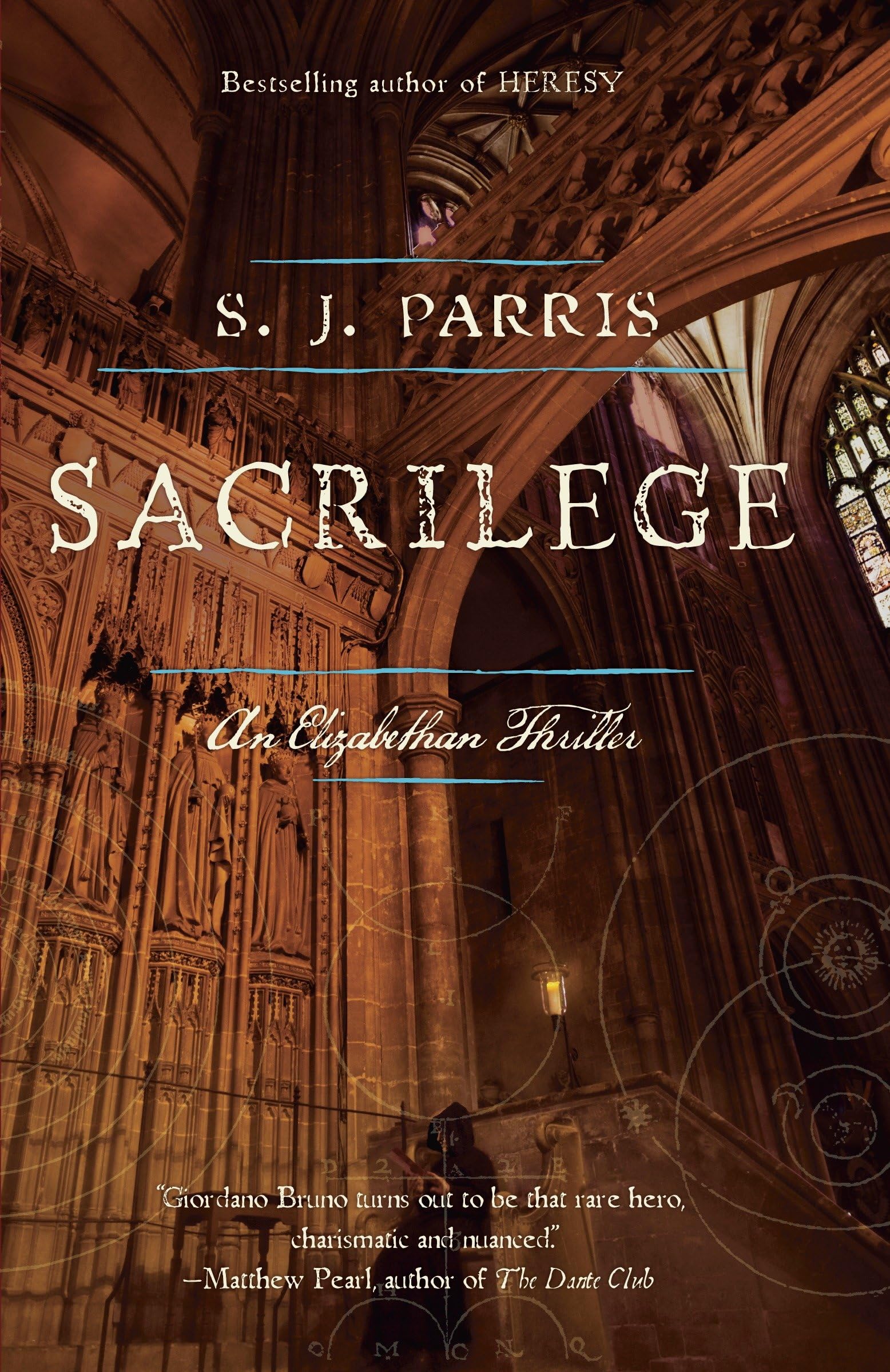



London, summer of 1584: Radical philosopher, ex-monk, and spy Giordano Bruno suspects he is being followed by an old enemy. Instead, he is shocked to discover that his pursuer is in fact Sophia Underhill, a young woman with whom he was once in love. When Bruno learns that Sophia has been accused of murdering her husband, a prominent magistrate of Canterbury, he agrees to do anything he can to help clear her name. But in the city that was once England’s greatest center of pilgrimage, Bruno uncovers a more dangerous plot in the making, one that forces him to turn his detective’s eye to the strange case of Saint Thomas Becket, a twelfth-century cardinal of Canterbury Cathedral whose mysterious murder is only matched by the legend surrounding the disappearance of his body. “Reinforces Parris’s position at the top of the Elizabethan historical pack. . . . Parris . . . masterfully mixes political intrigue, action, and sleuthing.” — Publishers Weekly (starred review) “Giordano Bruno turns out to be that rare hero, charismatic and nuanced.” —Matthew Pearl, author of The Dante Club “A feast for fans of historical thrillers. . . . [Bruno] is one of the most engaging characters ever created.” — Bookreporter “Move over C. J. Sansom, S.J. Parris has arrived. . . . Brilliant.” — The Globe and Mail (Toronto) “Bruno commands our attention and our sympathy as any likable heretic should.” — The Washington Post Book World “The novel's fast pace and numerous twists keep readers hooked until the end.” — Booklist “The politics of Elizabethan England play a part, but it’s the personal relationships that are front and center. A good read.” — The Free Lance-Star (Fredericksburg, VA) “Parris provides a sumptuously rich setting with an absorbing entangled plotline that will keep the reader on a precipice of sudden death.” — Historical Novels Review “Enjoyably ingenious.” — The Sunday Times (London) S. J. PARRIS is the pseudonym of Stephanie Merritt. Since graduating from Cambridge she has worked as a critic and feature writer for a variety of newspapers and magazines as well as for radio and television. She currently writes for The Observer and The Guardian and is the author of five books. Chapter 1 I knew that I was being followed long before I saw or heard my pursuer. I felt it by some instinct that by now had been sharpened by experience; a shifting of the air, a presence whose movements invisibly shadowed my own. Someone was watching me and had been for several days: from the mouths of alleyways, from behind pillars or walls, amid the crowds of people, carts, and animals that thronged the narrow streets of London or out among the river traffic. At times I even sensed eyes on me in the privacy of my room at Salisbury Court, though that was surely impossible and could only have been the tricks of imagination. It was the twenty-third day of July 1584, and I was hurrying to deliver my new book to my printer before he left London for the rest of the summer. A merchant ship from Portugal had recently docked at Tilbury, at the mouth of the River Thames. Plague was raging in Lisbon and the crew had been forcibly quarantined; despite these measures, rumours that the infection had begun to claim English victims were spreading through the city quicker than the disease itself ever could. Outbreaks of plague were common enough during London summers, I had been told, and any Londoner with the means to move to healthier air was packing as fast as they could. At the French embassy, where I lived as the ambassador's houseguest, whispers of the black plague had sent the household into such a frenzy of imagined symptoms that the ambassador had dispatched his private secretary to enquire about country houses in the neighbourhood of the Palace of Nonsuch, Queen Elizabeth of England's summer residence. Fear of the plague had only added to tensions at the embassy in the past few days. Our peace had been shattered the previous week by the arrival of the news from the Netherlands that William the Silent, Prince of Orange, had been assassinated, shot in the chest on the staircase of his own house in Delft by a man he knew and trusted. I imagined that in all the embassies of the Catholic and Protestant powers throughout the greatest cities of Europe, men and women would be standing much as we did when the messenger arrived, speechless in the face of an act whose repercussions would shake the world as we knew it. The shock and fear occasioned by the deed were still palpable in the streets of London; not that the English people gave two figs for William himself, but it was well known that the Catholic King Philip II of Spain had offered a reward of twenty-five thousand crowns for his murder. And if one Protestant ruler could be knocked down as easily as a skittle, there was no doubt that Queen Elizabeth of England would be next on Philip's list. The sense of foreboding was all the greater at Salisbury Court because Willia