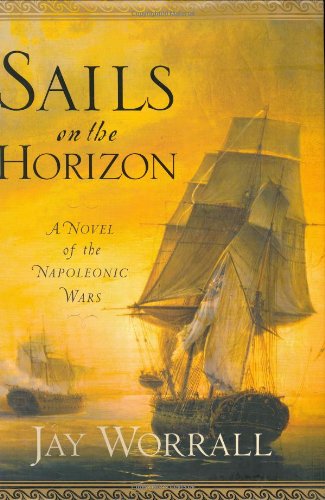



SAILS ON THE HORIZON Dientes de Diablo, 1797 With his first historical high-seas adventure chronicling the exploits of Naval Commander Charles Edgemont, Jay Worrall sets sail in the rousing tradition of C.S. Forester and Patrick O’Brian. The year is 1797. Napoleon Buonaparte is racking up impressive wins in the field against the enemies of revolutionary France. On the seas, England is putting up a staunch resistance. When a modest fleet of British ships off the coast of Portugal encounters a larger force of Spanish vessels on their way to rendezvous with the French, the English are quick to seize the opportunity for a victory–even at the risk of a calamitous defeat. Twenty-five-year-old Charles Edgemont is second lieutenant aboard the HMS Argonaut , the smallest ship in the British line of battle. When orders come for the Argonaut to engage in an all-but-suicidal maneuver to cut off the escape of the Spanish ships, he leads his gun crews bravely–until the death of the captain and the first lieutenant elevates him to command of the stricken vessel. In the chaos that follows, his defiant refusal to yield under enemy fire earns him a permanent promotion. Thanks to the purse awarded him by the Admiralty after the fight, Charles is wealthy beyond his wildest dreams. But there are challenges when he returns home after years at sea. His newfound riches will prove no help when it comes to winning the heart of Penelope Brown, the feisty Quaker with whom Charles falls in love. Even more of a hindrance is his profession, for Penelope regards war as sinful and soldiers as little better than murderers. Changing Penelope’s mind may just be the hardest battle Charles has ever fought–at least until fresh orders send him back to sea, where he faces a more traditional and equally formidable adversary in a series of stirring battles of will and might. Debut novelist Worrall sails into the well-traveled waters of the Napoleonic Wars. Obviously inspired by the salty tales of seasoned maritime novelists C. S. Forester and Patrick O'Brian, he delicately balances action and adventure with introspection. Worrall's hero is Second Lieutenant Charles Edgemont, an untested officer in His Britannic Majesty's formidable fleet. Acquitting himself admirably in his first battle after taking over for his mortally wounded captain, he is rewarded with both a promotion and a share of the Spanish booty. Armed with his new commission and his prize money, he returns home and becomes enamored with pacifist Quaker Penelope Brown. Their unlikely courtship is put on hold when Charles is called back to duty to face an old enemy. Fans of seafaring military sagas will welcome this latest addition to the genre. Margaret Flanagan Copyright © American Library Association. All rights reserved “Inspired by the salty tales of seasoned maritime novelists C. S. Forester and Patrick O’Brian, [Worrall] delicately balances action and adventure with introspection. . . . Fans of seafaring military sagas will welcome [Sails on the Horizon].” –Booklist “Well-executed . . . demonstrating Worrall’s expertise in ship and sea warfare history . . . Readers will root for [Charles Edgemont]. . . . He handily defeats veteran seamen, takes enormous chances and is always rewarded.” –Publishers Weekly From the Trade Paperback edition. Born a Quaker into a military family, JAY WORRALL grew up in a number of countries around the world. During the Vietnam War he worked with refugees in the central highlands of that country, and afterward he taught English in Japan. Worrall has worked in developing innovative and humane prison programs, policies, and administration. He is married and the very proud father of five sons, and he currently lives and works in Pennsylvania. ONE St. Valentine's Day, 1797 Eight leagues southwest of Cape St. Vincent, Portugal "The f-flagship's signaling again, sir. 'engage the enemy,' I think it says." The adolescent midshipman stood in an oversized jacket and flapping trousers at the top of the forward ladderway, squinting into the distance along the line of British warships, each laboring more or less one cable's length behind the other, pointed toward a gap between two large Spanish squadrons. He fairly danced with excitement. "Thank you, Mr. Bowles. You may come down now," said Charles Edgemont, the second lieutenant aboard His Britannic Majesty's sixty-four-gun ship of the line Argonaut. At twenty-five, Edgemont's career in the navy had already spanned thirteen years, seven as a midshipman himself and six as a commission officer. His responsibility with the ship at quarters was the upper gundeck and its twenty-eight brightly painted black twelve-pounder cannon, neatly aligned on their carriages, fourteen to a side. The smallish and outdated Argonaut, captained by Sir Edward Wood, had taken her position as the last in the nearly mile-long fifteen-ship English line. Charles had watched as the fleet arranged itself into formation e