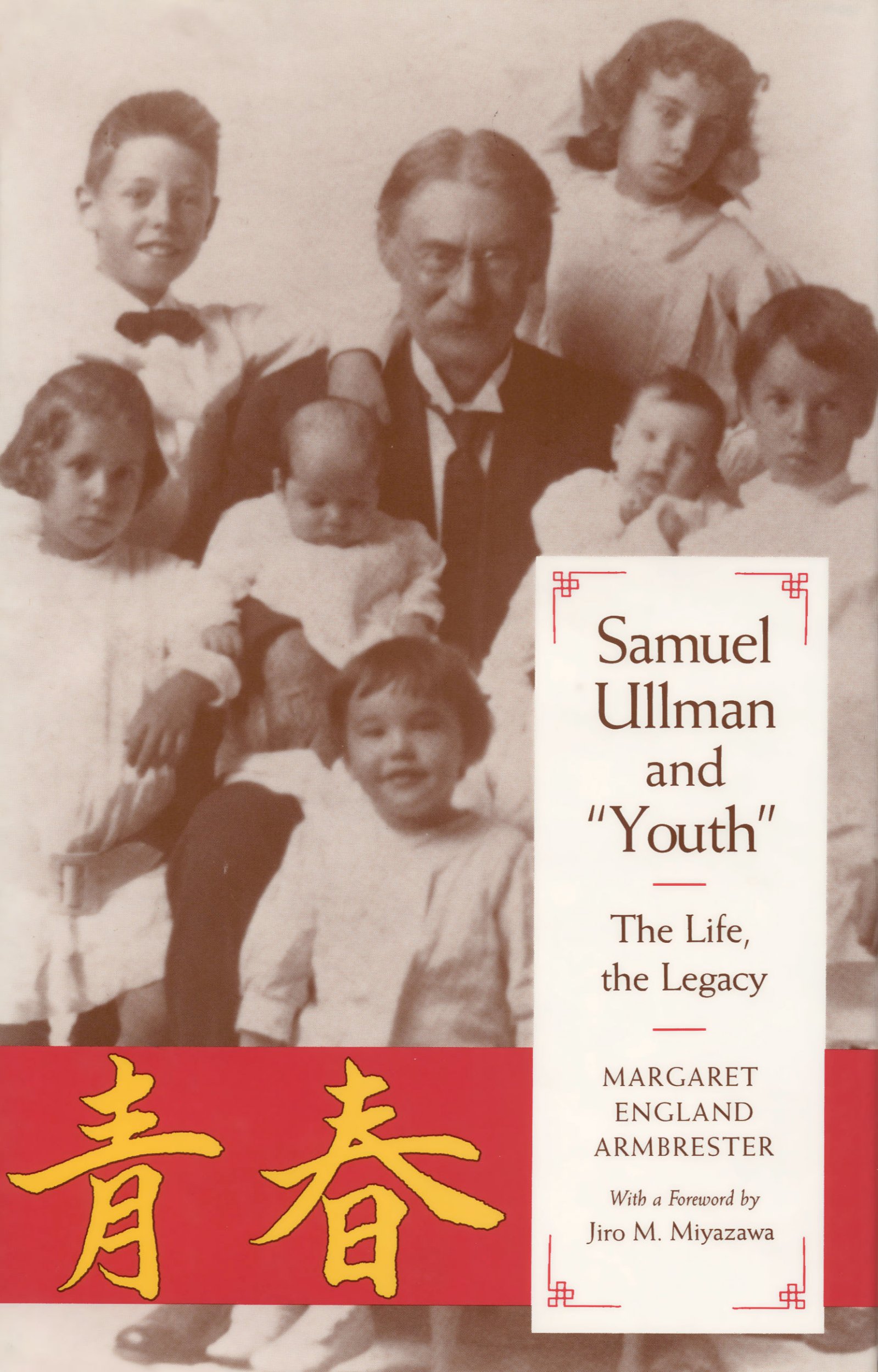



Examines a poem that has not only withstood the vicissitudes of time, but has spread around the world like the waves lapping at a beach Thousands of wonderful and sometimes strange fads have captured the public fancy in the almost five decades since the end of World War II. Most have been short-lived and soon faded away. There is, however, a poem that has not only withstood the vicissitudes of time, but has spread around the world like the waves lapping at a beach. This is the poem "Youth," by Samuel Ullman. In December 1945, the Reader’s Digest published the poem and reported that General Douglas MacArthur, Commander of the Allied Forces, Far East, kept a copy of the poem near his desk. Around that time, Yoshio Okada, a Japanese businessman, bought a copy of that December 1945 edition of the Reader's Digest, read the poem and was deeply affected by it. He translated it into Japanese and displayed it in his office as a guiding inspiration. Many of Okada's friends read the poem and were fascinated by its beauty. It began to receive national publicity through newspapers and magazines and became popular throughout Japan, especially among the intellectual community. Part of the reason for this widespread popularity is the excellence of the translation. Yoshio Okada, a man of noble character, gifted with a profound philosophy of life and literary talent, translated the poem into a beautiful, soulstirring Japanese version. Samuel Ullman's “Youth” reflects the truth of life, and his outcry of spirituality touches the intrinsic nature of man. “An engaging view of an American life that, as the author demonstrates, ‘refined the meaning of success.’” —Asahi Evening News “Ullman today would be largely forgotten but for an accident: in his retirement he wrote poetry. Some of this verse was printed in a book in 1922 and one of these poems was somehow seen by Douglas MacArthur, who hung a framed copy on the wall of his office in Japan. This poem was ‘Youth,’ and it became enormously popular among the Japanese, who became curious about the author. . . . Almost nothing on the man existed, leading to frustration on all levels. With the publication of Armbrester’s biography of Ullman, the situation is rectified. Her account . . . provides a highly readable and well-documented history of Ullman [and] reprints his verse, which is almost impossible to locate. The book provides the first account of a man who inadvertently changed many peoples’ lives, it is enjoyably written, and it is nicely indexed.” —Academic Library Book Review For many years Samuel Ullman (1840-1924) and his prose poem "Youth" have been known and admired among the Japanese. But both the man and his work are largely unknown in the United States, even in Alabama where he spent the last 40 years of his life in service to the city of Birmingham, devoting his energies especially to the development of educational opportunities for both black and white children. From the days when a framed copy of "Youth" hung on the wall of General Douglas MacArthur's office in Tokyo to the moment, decades later when the founder of Panasonic found inspiration in the poem, "Youth" has provided encouragement to hundreds of Japanese citizens. Americans, too, are beginning to respond to the positive message of "Youth" and are curious about its author. It was that expressed curiosity in the United States and Japan that led Margaret Armbrester to write about the life and times of Samuel Ullman. Ullman was born in Germany, came to the United States at the age of eleven, and settled in Port Gibson, Mississippi. After serving briefly in the Confederate Army, he took up residence in Natchez where he married, started a business, served as a city alderman, and was a member of the local board of education. In 1884, upon moving to the booming city of Birmingham, Alabama, Ullman was placed on that city's first board of education where, during his 18 years of service, he advocated educational benefits for black children similar to those provided for whites. While sitting on that board, Ullman also served as president and then lay rabbi of the city's reform congregation at Temple Emanu-El. Often controversial but always respected, Ullman left his mark on the religious, educational, and community life of the cities of Natchez and Birmingham. In his retirement he began to write poetry and left a body of over 50 poems and poetic essays that cover subjects as varied as love, nature, the hurried lifestyle of a friend, death, dying, and living "young." It is appropriate that "Youth" is the element that brought Ullman's life into public scrutiny. The message of "Youth" - its optimism and its challenge - reflects the substance of Ullman's life. Spanning the experience of Jewish immigrant, vanquished soldier, and progressive community activist, Samuel Ullman and "Youth": The Life, the Legacy tells the story of one man's vision that continues to affect people decades after his