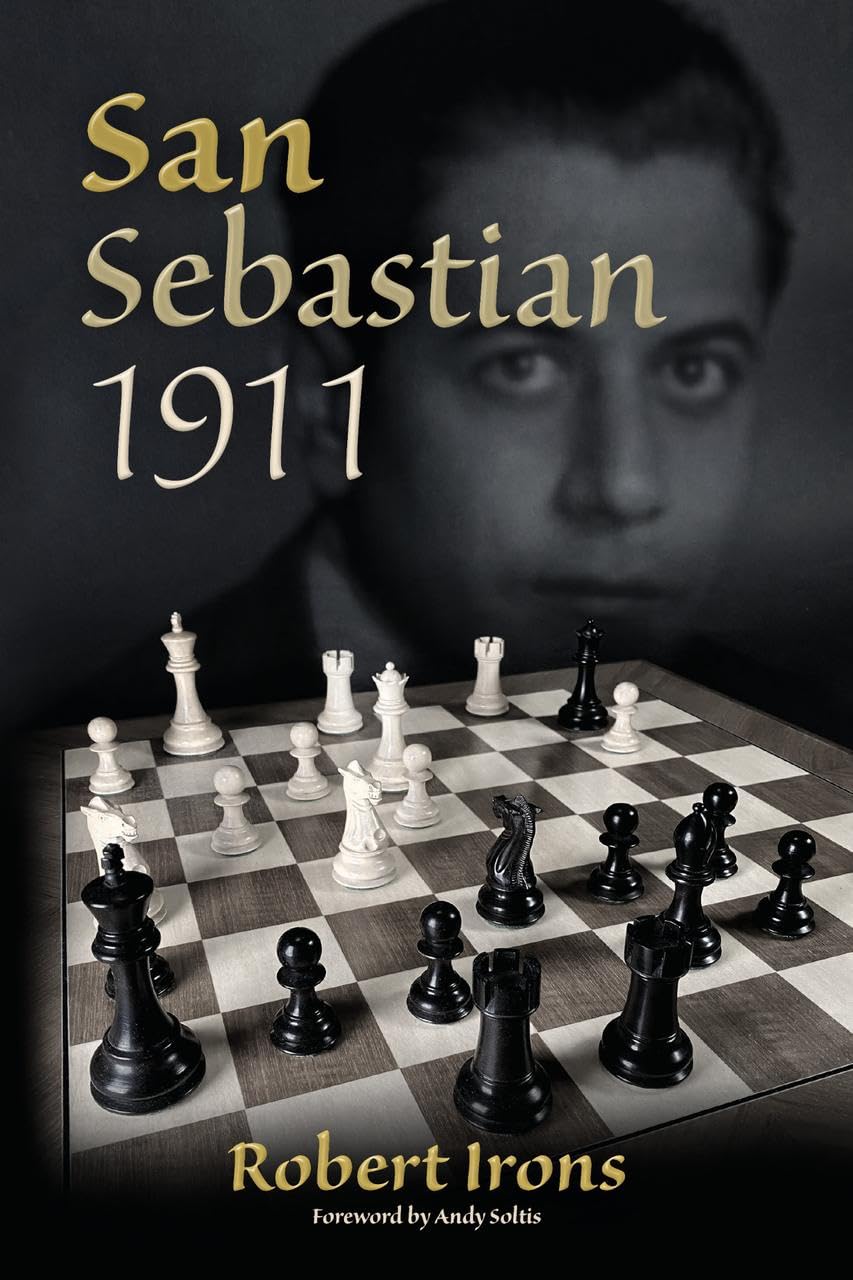



Capablanca’s Dazzling Debut The international tournament held in San Sebastian, Spain in 1911 is one of the legendary chess tournaments of all time. Of the top ten players in the world at that time, only Emanuel Lasker was missing; he was getting married. This remarkable book has all 105 games played, and each one is annotated. Rounds are introduced with an overview of the results and the significance of game. Based on the original work in German by Jacque Mieses, other contemporary sources are also used to give the reader the complete picture and feel of the tournament. And Andy Soltis’s Foreword gives historical depth to the competition and its participants. San Sebastian 1911 is one of the most influential tournaments in history. It prompted other organizers to try to get the world’s top ten players. It introduced “hospitality” and the financial basis for the careers of professional players. And it firmly established Capablanca’s claim to be a future world champion. – From the Foreword by Andy Soltis Capa stepped onto the world stage in this powerful event and demonstrated beyond any doubt that he would be someone to be reckoned with. And now you are invited to follow the rise of the young Cuban in his dazzling debut, as he does battle with some of the strongest players of the era. The momentous tournament of San Sebastion 1911 is now available in English, in a fine, hard cover edition. Robert Irons was the Correspondence Chess Editor for the US Chess Federation from October 2022 to March 2024, and during that period he wrote the monthly column for Chess Life on correspondence chess, The Check is in the Mail. He earned a PhD from the Illinois Institute of Technology and has published 20 articles in peer-reviewed academic journals. Irons has previously written two textbooks, one in Finance and one in Politics. He is currently on the faculty of the School of Business and Economics at Illinois Wesleyan University in Bloomington, IL. The third round has more decisive results as the players settle in for the long haul. The front runners are starting to separate themselves from the rest of the pack, and at the end of the round Capablanca sits alone in first place. At the same time, several of the game results are half-points lost. (16) Capablanca – Burn Ruy Lopez [C77] 1.e4 e5 2.Nf3 Nc6 3.Bb5 a6 4.Ba4 Nf6 5.d3 d6 6.c3 This position saw a slight resurgence in the early 1940s, then again in the late 1970s, still again in the mid-1990s, and has become hugely popular again since the early 2000s. It has been recently played by the likes of Carlsen, Caruana, Morozevich, and Tiviakov. 6...Be7 7.Nbd2 0-0 8.Nf1 b5 9.Bc2 d5 Taking central space, pressuring White’s center, and threatening to open the center while the white king has not yet castled. The position is equal. 10.Qe2 dxe4 11.dxe4 Bc5?r Not at all satisfactory, for the “pinning” of his knight gives rise to a lot of trouble. A preferable line of play is 11...Nd7, to be followed in due course by Nc5 and Ne6. (Helms, ACB) SF disagrees and finds that after 11...Nd7 12.Ne3 Bd6 13.0-0, Black has nothing better than 13...Nf6y. Instead, SF prefers 11...Be6 12.Ne3 Bd6 13.0-0 Ne7 14.h3 Ng6=. 12.Bg5 Be6 13.Ne3 Re8 14.0-0 Qe7 [diagram] If 14...Be7 15.Rad1 (15.Rfd1y) 15...Qc8 16.Nd5 Bg4?! (16...Nd7y) 17.Bxf6 Bxf6 18.h3 Bh5 19.Nxf6+ gxf6 20.Qe3 Na5 21.Nh4! Bxd1 22.Rxd1, White has a ready-made attack with such moves as 22.Nf5, 23.Qh6 and 24.Rd3-g3. 15.Nd5y Planting a thorn in his adversary’s side, and from now on Black has an uphill game on his hands. (Helms, ACB) 15...Bxd5 16.exd5 Nb8?!i [diagram] 17.a4?!r Giving up a significant part of his advantage. Much better is 17.d6! Bxd6 (17...Qxd6 18.Rad1i) 18.Bxh7+ Kxh7 19.Bxf6 Qxf6 20.Qe4+i. You can see the difference in how the position is evaluated today versus how the old masters thought about it. In the original book on the tournament Lasker says that 17.a4 “hits the weakness” while Golombek calls this, “A strong move which takes advantage of the fact that the black rooks are momentarily cut off from each other.” 17...b4?!i This just loses. Both Lasker and Capablanca (1) prefer 17...Nbd7, which is reasonable. But it is all downhill from here. 18.cxb4 Bxb4 19.Bxf6 Qxf6 20.Qe4 Bd6 After 20...Qg6, White wins with 21.Qb4 Qc2 22.Rac1 Qd3 23.Rfd1. 21.Qxh7+ Kf8 22.Nh4 Qh6 23.Qxh6 gxh6 24.Nf5 h5 25.Bd1 25.a5! 25...Nd7 26.Bxh5 Nf6?! 26...Rab8 is better.