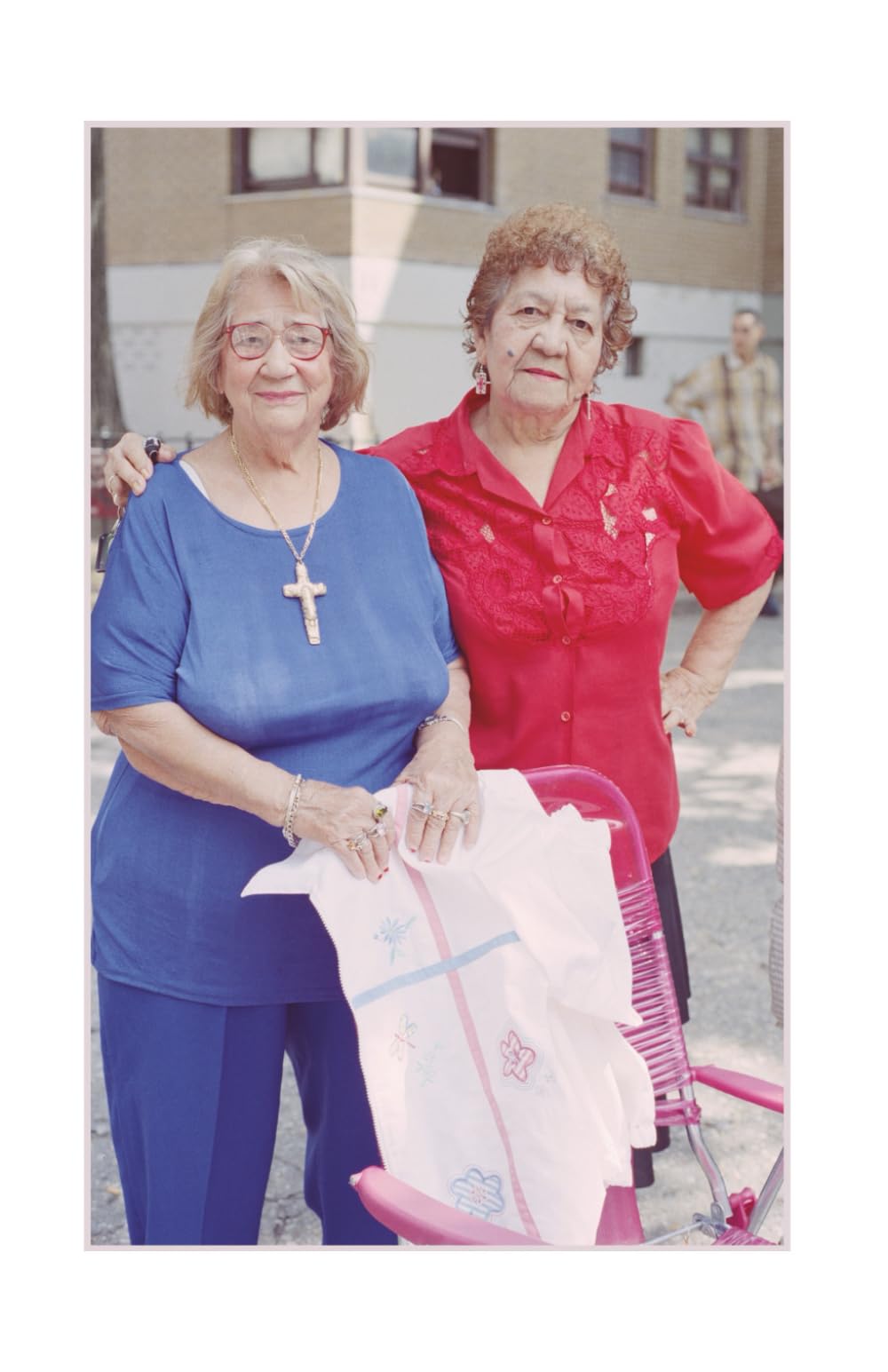



Whose streets? Tanyth Berkeley’s Sanctuary City captures early-aughts celebrants in the Puerto Rican and Dominican Day parades of NYC sporting chunky flip phones, open gazes, and an unfettered, exuberant cultural visibility that feels chilled in our I.C.E.y America. Berkeley’s pictures, though firmly in the street photography tradition, carve her own path full of whit and humanity. Her subjects are (un)dressed to be seen in a crush of gazes, flexes, and a prideful claiming to be where they are as they are. Berkeley’s slightly off colors, shift the scene to another realm between fact and fiction, slowing our encounter with her already engrossing pictures. Where are we? Who is there? When are we? What does it mean? How have things changed in 20 years technologically, socially, politically, existentially? Whose streets? OUR streets! -Eileen Quinlan ************* The mythology of a nation is the intelligible mask of that enigma called “the national character.” Through myths the psychology and world view of our cultural ancestors are transmitted to modern descendents, in such a way and with such power that our perception of contemporary reality and our ability to function in the world are directly, often tragically affected. Richard Slotkin, Regeneration through Violence Harry Truman received a telegram on August 9, 1945 from the general secretary of the Federal Council of The Churches of Christ in America expressing that, “many Christians” were “deeply disturbed” by the atomic bombing of Japanese cities, their “necessarily indiscriminate” destruction and killing, and the terrible portent the atomic bombings held for the future. Truman responded two days later, saying, yes it’s terrible to have used these weapons, but Pearl Harbor, and the Japanese “murder of our prisoners of war,” has shown us that “[t]he only language they seem to understand is the one we have been using to bombard them. When you have to deal with a beast you have to treat him as a beast. It is most regrettable but nevertheless true.” Demonizing stories about other cultures burrow into the nervous system. But an education guided by a desire to reproduce a decent society is imaginable. We could be taught to look for people on the other end of the dreams we have about them. The Europeans used gold looted from the New World to finance the spice trade with Asia. 1899 “They’re bringing drugs, they’re bringing crime, they’re rapists,” he said about Latin Americans after that spectacular ride down the golden escalator in 2015, reminding us that they’re also probably coming from the Middle East over the Mexican border, that they’re probably also from ISIS, you never know. No one can build a more beautiful wall than I can." "..I was thirteen and was crossing Fifth Avenue on my way to the Forty-second Street library, and the cop in the middle of the street muttered as I passed him, “Why don’t you niggers stay uptown where you belong?” When I was ten, and didn’t look, certainly, any older, two policemen amused themselves with me by frisking me, making comic (and terrifying) speculations concerning my ancestry and probable sexual prowess, and, for good measure, leaving me flat on my back in one of Harlem’s empty lots.’ James Baldwin, “Letter from a Region in My Mind” “When have you ever seen a map of the United States that had Puerto Rico on it?” Daniel Immerwahr, How to Hide an Empire Excerpted from Paul Abruzzo's writing about my work. ********** In 2007, 2008 and 2009 I made portraits at the Puerto Rican, Mexican, Dominican and Hispanic Heritage Day Parades in NYC. The photos were made during celebrations on Fifth Avenue in Manhattan and in Williamsburg, Brooklyn. -Tanyth Berkeley