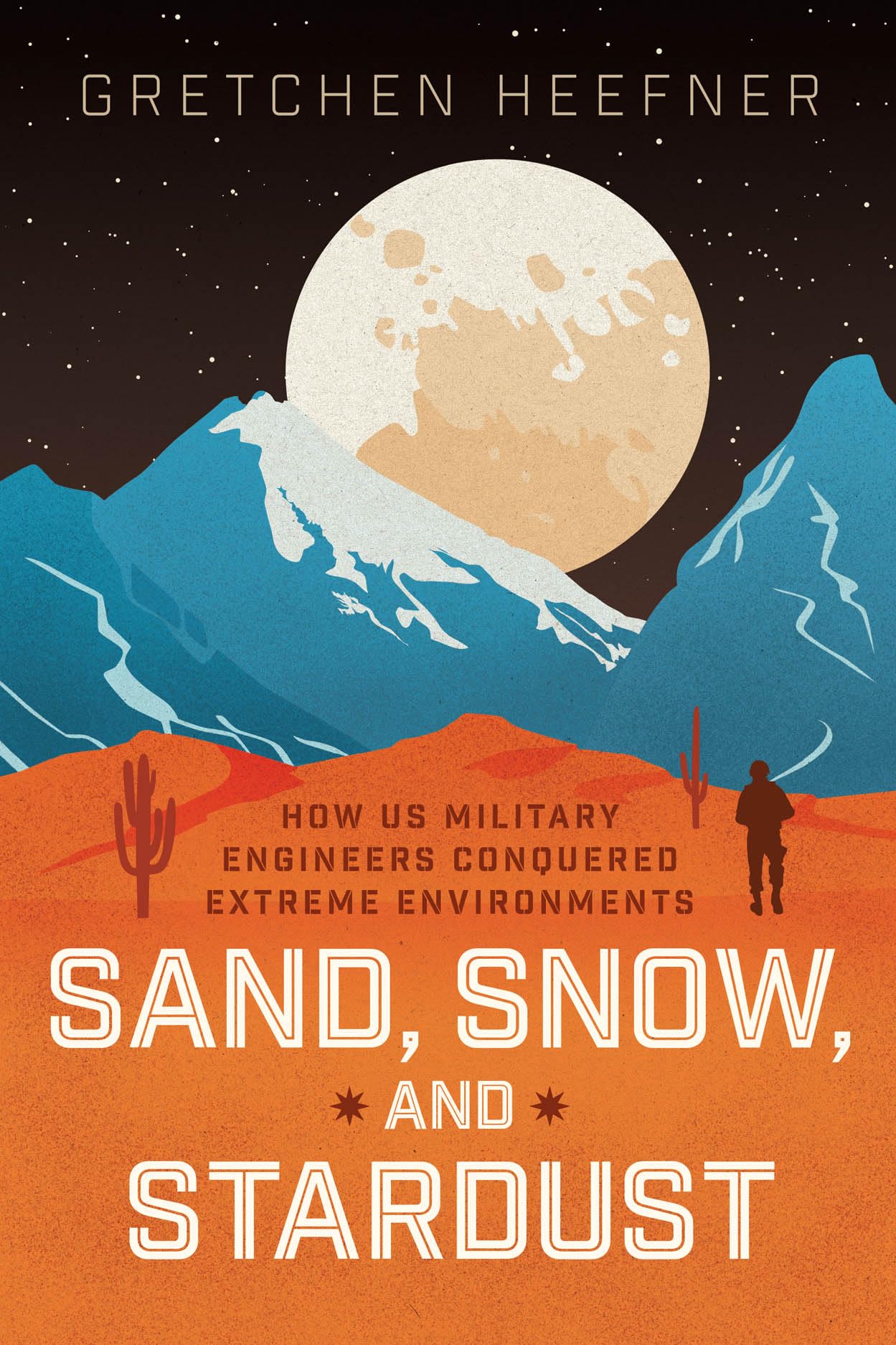
Sand, Snow, and Stardust: How US Military Engineers Conquered Extreme Environments
$28.99
by Gretchen Heefner



A vivid tour of US military efforts to understand, survive, and command harsh environments worldwide—and beyond. Deserts, the Arctic, outer space—these extreme environments are often seen as inhospitable places at the edges of our maps. But from the 1940s through the 1960s, spurred by the diverse and unfamiliar regions the US military had navigated during World War II, the United States defense establishment took a keen interest in these places, dispatching troops to the Aleutian Islands, North Africa, the South Pacific, and beyond. To preserve the country’s status as a superpower after the war, to pave runways and build bridges, engineers had to understand and then conquer dunes, permafrost, and even the surface of the moon. Sand, Snow, and Stardust explores how the US military generated a new understanding of these environments and attempted to master them, intending to cement America’s planetary power. Operating in these regions depended as much on scientific and cultural knowledge as on military expertise and technology. From General George S. Patton learning the hard way that the desert is not always hot, to the challenges of constructing a scientific research base under the Arctic ice, to the sheer implausibility of modeling Martian environments on Earth, Gretchen Heefner takes us on a wry expedition into the extremes and introduces us to the people who have shaped our insight into these extraordinary environments. Even decades after the first manned space flight, plans for human space exploration and extraplanetary colonization are still based on what we know about stark habitats on Earth. An entertaining survey of the relationship between environmental history and military might, Sand, Snow, and Stardust also serves as a warning about the further transformation of the planet—whether through desertification, melting ice caps, or attempts to escape it entirely. “After leading us through World War II, where the Allies learned most of their lessons on the fly, Ms. Heefner takes us through the next four decades, from building air bases in Libya and Greenland to thinking about colonies on the moon and Mars. . . . The author documents our fascination with space from before we even had the technology to get there, including early science-fiction films, novels and artwork . . .” ― Wall Street Journal “ Sand, Snow, and Stardust is the story of how the US military shed its ignorance and, by harnessing logistical intelligence and environmental knowledge, turned America into a global superpower. . . . As we contemplate the exploration and settlement of places so far-flung that we need rockets to reach them, we end up revisiting all the naiveties and apparent errors of a bygone generation. . . . Heefner’s history of how we acquired knowledge of the Earth’s extreme places is critical of the waste involved, and testifies to the human, political, and ecological damage it inflicted on some of the most vulnerable people on the planet. On the other hand (and with what disquiet one can easily imagine), she leaves open the possibility that some knowledge will only ever be wrested from nature by ugly means.” ― The Spectator “Adds up to a fascinating account with Heefner mixing in colorful anecdotes, personal experience, and technical information. The book will appeal to readers interested in military issues and engineering, but there’s plenty here for general readers as well. A vivid excursion into an unknown aspect of the Cold War.” ― Kirkus “Before the Second World War, the United States had only 14 military bases overseas; by 1960, it had more than 1,000. One such base lay beneath the Greenland ice cap, another on the Sahara Desert’s edge. Engineers learnt to build a runway on permafrost and restrain blowing sand. Both proved crucial for NASA’s lunar exploration in the 1960–70s, argues historian Gretchen Heefner in her pioneering exploration of how the military ‘acquisition of environmental knowledge turned the United States into a planetary power.’” ― Nature “In this fascinating book, Heefner explores the dichotomy between global power and granular detail. . . . Innovative argumentation and meticulous research combine with vivid storytelling to make this book a gem.” ― CHOICE “The US military’s dream of global power collided with extreme environments. Heefner’s breathtaking book reveals how the stunning sweep of the US defense establishment required overcoming such extremes by getting granular, enlisting scientists to understand environments in painstaking detail—the titular sand, snow, and stardust. Heefner captures the hidden history of this planetary security infrastructure in irresistible prose, illuminating how the global environment itself became visible at the murky edges, geopolitical and material.” -- Megan Black, author of “The Global Interior: Mineral Frontiers and American Power” “In this beautifully written, handsomely illustrated, and thoroughly researched book, Heefne