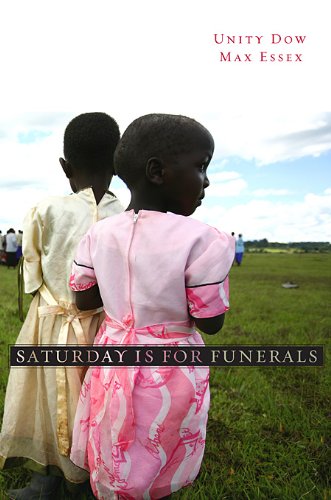



In the year 2000 the World Health Organization estimated that 85 percent of fifteen-year-olds in Botswana would eventually die of AIDS. In Saturday Is for Funerals we learn why that won't happen. Unity Dow and Max Essex tell the true story of lives ravaged by AIDS—of orphans, bereaved parents, and widows; of families who devote most Saturdays to the burial of relatives and friends. We witness the actions of community leaders, medical professionals, research scientists, and educators of all types to see how an unprecedented epidemic of death and destruction is being stopped in its tracks. This book describes how a country responded in a time of crisis. In the true-life stories of loss and quiet heroism, activism and scientific initiatives, we learn of new techniques that dramatically reduce rates of transmission from mother to child, new therapies that can save lives of many infected with AIDS, and intricate knowledge about the spread of HIV, as well as issues of confidentiality, distributive justice, and human rights. The experiences of Botswana offer practical lessons along with the critical element of hope. In 2000, the World Health Organization predicted that 85 percent of 15-year-olds in Botswana would eventually die of AIDS. Life expectancies were projected to be shortened by 44 years. But in 2006, Botswana began receiving antiretroviral drugs, and its health prospects turned around dramatically. Dow brings a legal and human-rights perspective and Essex brings a medical-research perspective to chronicling the extent of the devastation of HIV/AIDS and the lessons learned from treating the disease and beating back the dire predictions. At one point, deaths were so prevalent that every Saturday was set aside for funerals. The traditional yearlong mourning was cut short, and family members had to help overwhelmed hospital staff. Dow recalls his mother’s recitation of the long list of friends, relatives, and neighbors who died, the stigma and shame that has led to divorce in a nation that takes marriage very seriously. Essex details the course of the disease, the public health issues, and the private suffering of AIDS patients. Together, they present a compelling look at the toll of AIDS in Africa and some hopeful developments. --Vanessa Bush This is a remarkable account of the human effect of a pandemic, written by two people with an intimate knowledge of Botswana and its struggle to deal with AIDS. I recommend this book most warmly for its humanity and insight. (Alexander McCall Smith) This extraordinary book brings to life the utterly unique stories of people in Botswana; yet the fact is that struggle, suffering and redemption are also universal stories with which we can all identify. The partnership of Dow and Essex, storyteller and scientist, results in a precious alchemy: a book that is engrossing, transforming and an important addition to the canon of the literature of HIV. (Abraham Verghese, author of Cutting for Stone and My Own Country ) This is the AIDS book to read—first, because of its novel approach of describing true and very moving stories of the Botswana experience, coupled with lucid and relevant scientific explanations fitting for each of the stories, and second, because of the experience and caliber of its authors. Saturday Is For Funerals is at once highly moving, while providing unforgettable lessons from the greatest pandemic in medical history. Unity Dow knows her people and their tragic stories, and as we would expect from a highly regarded novelist, displays these stories with grace and beauty. Coauthor Professor Max Essex has as much or more public health scientific experience and more insights into HIV/AIDS than anyone I know in the world. This book would be valuable not only for people impacted by HIV, but also for politicians, educators, students, and anyone who wants an education on mankind's greatest 'plague.' (Robert C. Gallo, M.D., Director, Institute of Human Virology, University of Maryland School of Medicine) This wonderful book is an inspiration to anyone who wants to learn more about the HIV/AIDS epidemic and its impact on Africa. The authors have collaborated on a well-written tome that is highly informative yet easy to read and digest. This book will have to be considered for a Pulitzer Prize and other suitable recognition. (Mark A. Wainberg, President Emeritus, International AIDS Society) Unity Dow and Max Essex have crafted an extraordinarily effective synergy of science and societal journalism. Saturday Is For Funerals explores the fragility and resilience of human spirit through poignant personal narratives around courtships, young love, and family tradition, centered in the Botswana 'hot zone' of the most devastating epidemic in recorded history. In conversational and gripping prose Saturday Is For Funerals engages as it informs, standing alongside Randy Shilts ( And the Band Played On ) and Abraham Verghese ( My Own Country ) as a heartfel