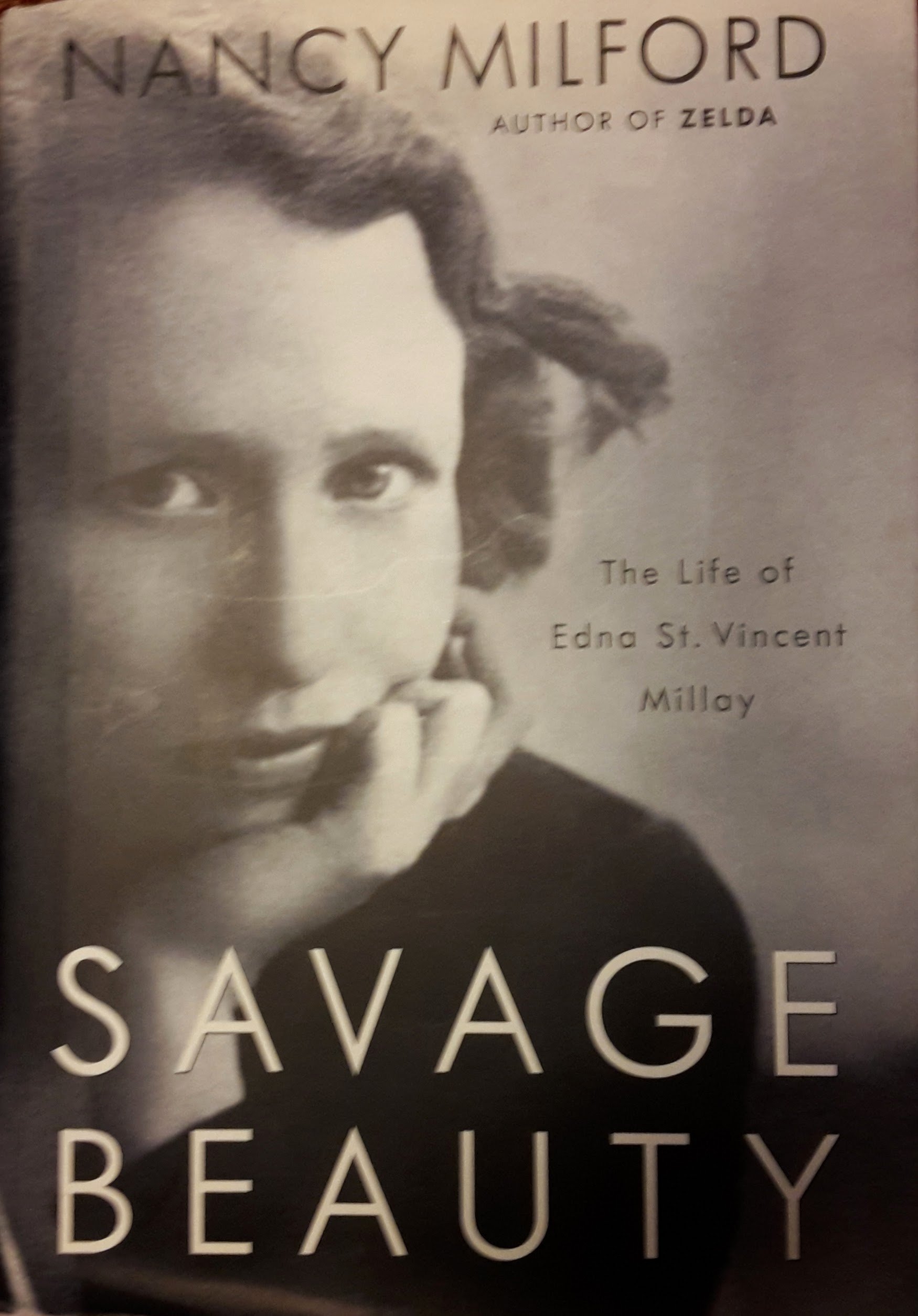



Thirty years after the smashing success of Zelda , Nancy Milford returns with a stunning second act. Savage Beauty is the portrait of a passionate, fearless woman who obsessed American ever as she tormented herself. If F. Scott Fitzgerald was the hero of the Jazz Age, Edna St. Vincent Millay, as flamboyant in her love affairs as she was in her art, was its heroine. The first woman ever to win the Pulitzer Prize, Millay was dazzling in the performance of herself. Her voice was likened to an instrument of seduction and her impact on crowds, and on men, was legendary. Yet beneath her studied act, all was not well. Milford calls her book "a family romance"--for the love between the three Millay sisters and their mother was so deep as to be dangerous. As a family, they were like real-life Little Women , with a touch of Mommie Dearest . Nancy Milford was given exclusive access to Millay's papers, and what she found was an extraordinary treasure. Boxes and boxes of letter flew back and forth among the three sisters and their mother--and Millay kept the most intimate diary, one whose ruthless honesty brings to mind Sylvia Plath. Written with passion and flair, Savage Beauty is an iconic portrait of a woman's life. Fans of Zelda , Nancy Milford's groundbreaking (and bestselling) biography of F. Scott Fitzgerald's tortured wife and muse, have been waiting impatiently since 1970 for Milford's promised follow-up about poet Edna St. Vincent Millay (1892-1950). It's finally here, and they will not be disappointed. Milford's vivid narrative limns an electric personality with psychological acuity while capturing the freewheeling atmosphere of America in the turbulent years following World War I. After "Renascence" was published (when she was only 20) and she moved to Greenwich Village, Millay was the queen of bohemia, taking lovers with zest and voicing the reckless gaiety of a generation in her famous lyric, "My candle burns at both ends; / It will not last the night; / But, ah, my foes, and, oh, my friends-- / It gives a lovely light." With her flame-red hair, milk-white skin, and a voice that thrilled audiences (making her poetry readings a welcome source of income), Millay was the archetypal "new woman": powerful, passionate, and not to be ignored. But Milford makes it clear that her first loyalty was to her mother and sisters, and her deepest commitment to her writing. This juicy chronicle has famous names aplenty--critic Edmund Wilson and Masses editor Floyd Dell were among the men devastated by her refusal to be faithful--and lots of dissipation: Millay drank heavily and became addicted to morphine. It also takes a perceptive look at how an artist draws material from her life and at the strategies she uses to protect the wellsprings of creativity. Brief passages interspersed throughout delineating Milford's interactions with Norma Millay, the poet's younger sister and literary executor, might have been self-indulgent and self-aggrandizing; instead they offer intriguing snapshots of the complex process by which biography is made. The resulting book is a tour de force, and wildly entertaining as well. --Wendy Smith In 1923, Edna St.Vincent Millay (1892-1950) became the first woman to win the Pulitzer Prize for POETRY. To write her biography, Milford whose one other major publication is a highly praised and best-selling biography, Zelda persuaded Millay's younger sister and sole heir, Norma, to give her access to hundreds of Millay's personal papers, letters, and notebooks. Selecting from "this extraordinary collection," Milford meticulously integrates Millay's major poems, letters received and sent, reactions of friends, and comments from extensive interviews with Norma into an orderly and affecting narrative. The result is an intimate look at a complex, charismatic, imperfect woman, someone who evokes both admiration and sympathy. Among the less glamorous revelations are the sometimes damaging intertwining of the poet's life with that of her mother and two sisters, Millay's promiscuity and uncanny seductiveness, and the dynamics of her 27-year marriage to a man who adored and promoted her while enabling her infidelities and addictions. Milford's lengthy portrait is a testimonial to her scholarship, stamina, and commitment to her craft. This should serve as a model of a highly readable biography, as well as a standard source for future Millay studies. Recommended for all libraries. - Carol A. McAllister, Coll. of William & Mary Lib., Williamsburg, VA Copyright 2001 Reed Business Information, Inc. *Starred Review* Millay scholars were frustrated for decades by the inaccessibility of a vast treasure trove of letters, journals, and other private papers jealously guarded by the poet's sister, Norma. Milford, the author of Zelda (1970), the best-selling biography of Zelda Fitzgerald, gradually earned Norma's trust during the 1970s and now presents the first comprehensive authorized biography of the first