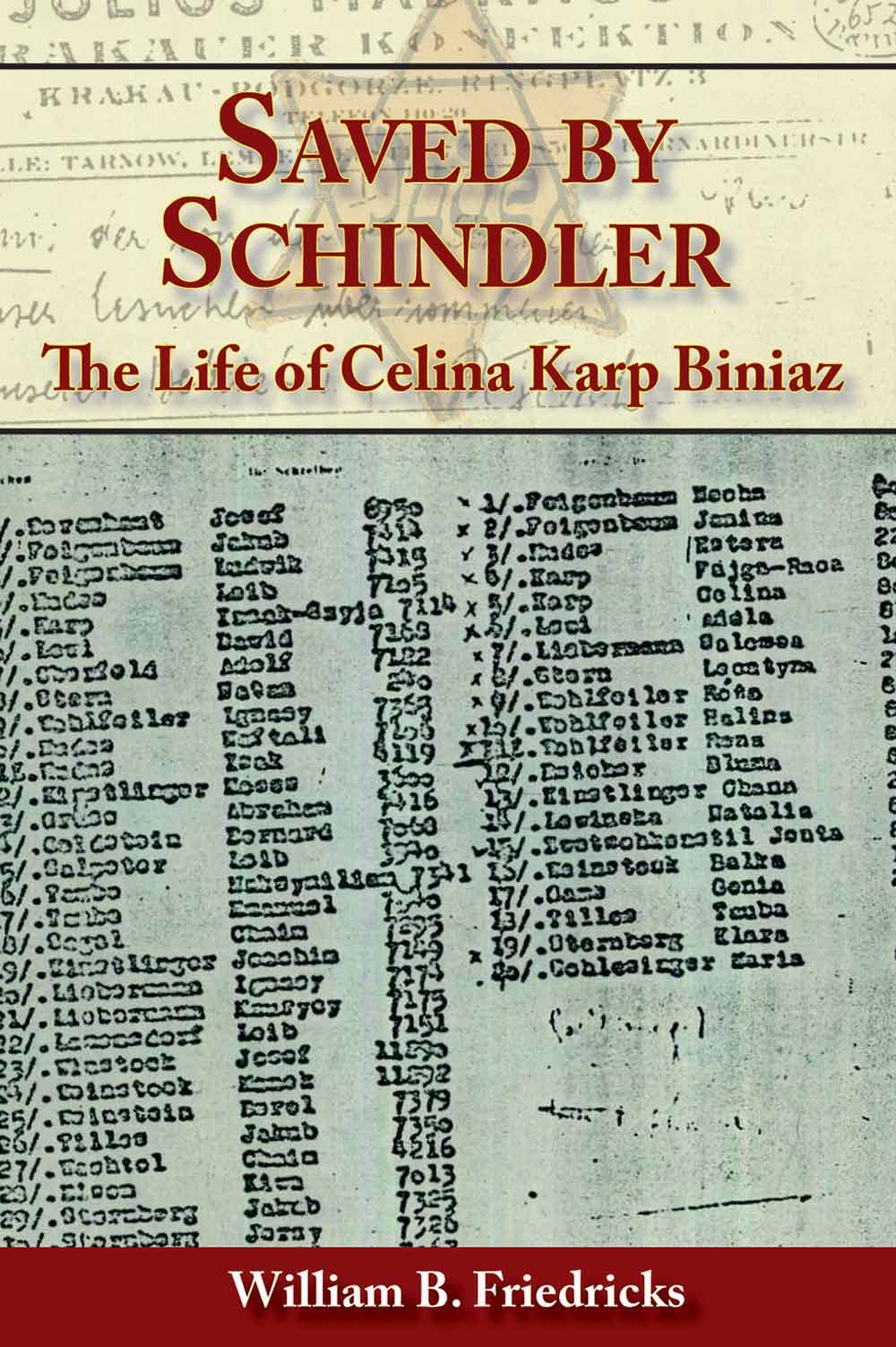



Celina Karp Biniaz was just eight years old when the Germans invaded her homeland of Poland in 1939. Over the next six years, the child from Krakow endured the Holocaust as the Nazis took away her schooling and civil rights, then herded her and her family into a ghetto. Life grew worse when the ghetto was liquidated, and the family was sent to Plaszów, a slave labor/concentration camp where they lived in constant fear, witnessing unspeakable horrors. Ultimately, Celina and her parents landed on Schindler's list, but before being sent to safety at Schindler's factory, Celina spent several terrifying weeks at Auschwitz where she faced down the infamous Dr. Josef Mengele. When the war ended, she and her family eventually made their way to the United States, where Celina got on with her life. With great strength and resilience, she moved forward and embraced the American dream. She finished her education, got married, had a family, and eventually enjoyed a career in teaching. But she kept her Holocaust experience a secret because the years were too terrible to describe, and she did not believe anyone would understand. That all changed with Steven Spielberg's film Schindler's List, which brought the Holocaust and the story of Oskar Schindler to millions around the world. The movie prompted Celina to confront her painful past and begin speaking publicly about it. As she often explains, “Oskar Schindler gave me my life, but Steven Spielberg gave me my voice.” excerpt from The Times of Israel review: As a Holocaust survivor and a teacher of comparative religion with a focus on Jewish tradition, I have had many opportunities to learn about the Holocaust. Yet, with the exception of reading a few key books on the Holocaust over the years, I have avoided Holocaust studies for the first sixty years of my life. There are 4,000 years of Jewish history and I did not want to make the Holocaust the central event in Judaism or my career. In 2001, as my full-time teaching was winding down, I made a trip with other Holocaust survivors to Vilnius, Lithuania, which gave me the opportunity to visit Turmantas, the small village where I was born. Gradually I began a more serious study of the Holocaust and, by 2014, I felt a great responsibility to tell my own story of survival. I have now read numerous books by historians, theologians, and especially by the survivors, but I can’t remember the last time I was as moved as I was after reading Celina’s story by William Friedricks. In this well-written book, Friedricks tells the incredible story of Celina Karp Biniaz, a child of the Shoah and a witness to some of the greatest Nazi horrors. He tells not only the story of Celina. We also learn a great deal about life in the Krakow ghetto and the Plaszow concentration camp. Of the sixty- to eighty-thousand Polish Jews who lived in Krakow, most were sent to be murdered at Belzec or at Auschwitz concentration camp. Celina and her family were sent to Plaszow slave labor camp. It took many miracles for Celina to survive Plaszow, the most notorious concentration camp in Poland, where Amon Goeth, the most evil SS Nazi murderer, was the Commander. One survivor of this concentration camp said that when he saw Goeth, he saw Death. During Celina’s brief stay in Auschwitz when she was only 13 years old, she confronted Dr. Joseph Mengele, the Nazi physician who was responsible for the selection of victims to be killed in the gas chambers. Mengele also performed inhumane medical experiments on children. He became known as the “Angel of Death.” When Celina stood in line in front of him and he sent her to the left, to death, she said to him in German “Let me go.” And he did. Celina was one of the youngest children saved by Oskar Schindler and his wife, Emilia. As it was the case with every Holocaust survivor, it took many people to save Celina. I was puzzled by Schindler, who belonged to the Nazi party and originally went to Krakow to make a fortune. Later, he used his fortune to save 12,000 Jewish lives. This issue is never explored in the book and maybe is something we will never know. Perhaps equally important to her life was Mater Leontime, a 90-year-old German nun. She tutored Celina in German and English for two years after the war. It was her compassion that left Celina unbroken, with intact love for humanity. Although Celina could no longer believe in God after experiencing such unspeakable horrors, Sister Leontime’s influence led Celina to spend her life teaching young children forgiveness and love. According to the Jewish tradition, God is more interested in acts of loving kindness than in belief. From 1939 to 1945, Celina had been denied any education. So, when she arrived in America in 1947, and first came to Des Moines, Iowa, she had a strong hunger for knowledge. In Iowa, she graduated from Grinnell College, and later devoted many decades to teaching and helping children to live meaningful life. I had the pleasure of meeting Celina in 2017 w