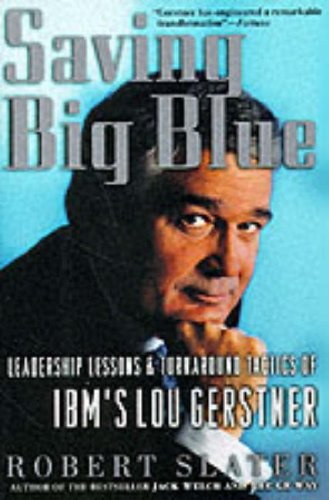
Saving Big Blue: Leadership Lessons & Turnaround Tactics of IBM's Lou Gerstner
$19.10
by Robert Slater



Documents how Lou Gerstner rescued IBM and discusses his leadership secrets From the early 1950s into the late '80s, IBM was the computer industry. Not only that, IBM was, to many, industry itself. It consistently set the standard for corporate performance and profitability, both in the U.S. and worldwide. But that all changed in a strange, swift, and brutal way. IBM--which had fiddled while Microsoft and Intel created a firestorm in the personal-computer world--lost money for three consecutive years in the early '90s. The decision to allow Microsoft to control PC software and Intel to supply the microprocessors (they're both companies IBM could've easily bought out early in the game) came back to bite IBM on its bloated blue butt. And its no-layoffs policy, though admirable, meant the company kept a workforce of more than 300,000, making decisions at a glacial pace while other companies nimbly jumped from one new market to the next. All that changed when Lou Gerstner was named CEO of IBM in 1993. Gerstner had already led turnarounds at American Express and RJR Nabisco, and, as Saving Big Blue details, he proved to be the right man for the job. Gerstner started by changing the company's funereal dress code and eventually redirected the company to provide computer services rather than just computers. Saving Big Blue makes for interesting reading as a case study, but also provides a blueprint for any manager attempting to turn around a business. --Lou Schuler Louis Gerstner, an ex-biscuit man (he was chairman and CEO of RJR Nabisco), was appointed chairman and CEO of IBM in April 1993, taking control of a company that had posted three years of losses. He turned a profit of $6.3 billion for the year 1998. Taking advantage of being an outsider, Gerstner examines every nook and cranny of IBM with a fresh, bottom-line eye, and the results are the corporate marvel of the 1990s. Once the company stops its financial hemorrhaging, Gerstner turns his attention to growth strategies with an emphasis away from mainframes and minicomputers and instead sees IBM's future in networking, software, and services. The jury is still out on the long-term prospects for IBM, but the first six years of Gerstner's reign has brought spectacular results. The author acknowledges assistance from IBM for this book, but not any direct input from Gerstner. It is unclear if this access makes the story more accurate or less. Mary Whaley Slater's Saving Big Blue , thorough and informative, is ultimately an embarrassingly derivative reconstruction. It is pieced together from scores of articles or interviews in the business press, duly footnoted... -- The New York Times Book Review , Fred Andrews Get Inside the Mind of Lou Gerstner - The Maverick CEO Who Seized Control, Defied Sacred Traditions, and Saved IBM. Date: January 19, 1993. IBM announces a stunning $4.97 billion loss for 1992, the largest financial bath in American corporate history. The venerated Big Blue is sinking fast... Date: April 22, 1999. The Wall Street Journal: "International Business Machines Corp. ...blew past estimates to report a 42% earnings gain for the first quarter. An analyst at Merrill Lynch & Co. said the quarter was 'a blowout,' adding that it was 'the best quarter I have seen from IBM' in more than a decade of covering the company." What made the difference? The answer is simple: Lou Gerstner. Saving Big Blue reveals how, with determination and grit, Lou Gerstner saved IBM and cemented his reputation as one of the greatest turnaround CEOs in history. It is the first blow-by-blow account that charts Gerstner's micraclework at IBM and reveals the leadership secrets that underpinned his every step. In these pages you'll learn such key tenets as: "Sweep Aside the Old Corporate Culture If Necessary, But Do It Quickly." Gerstner's focus was absolute. When it came to cleaning house, even his own brother wasn't protected. "Set High Expectations: Don't Settle for Mediocrity." Gerstner couldn't understand, and wouldn't tolerate lackluster performance. He made it clear that he wouldn't accept second best - and that rewards awaited the winners. "Listen to Customers - The Know Best What They Need." Relive the legendary Chantilly meeting, where Gerstner invited the Chief Information Officers of IBM's 200 largest customers to meet with - and confront - the new IBM chief.