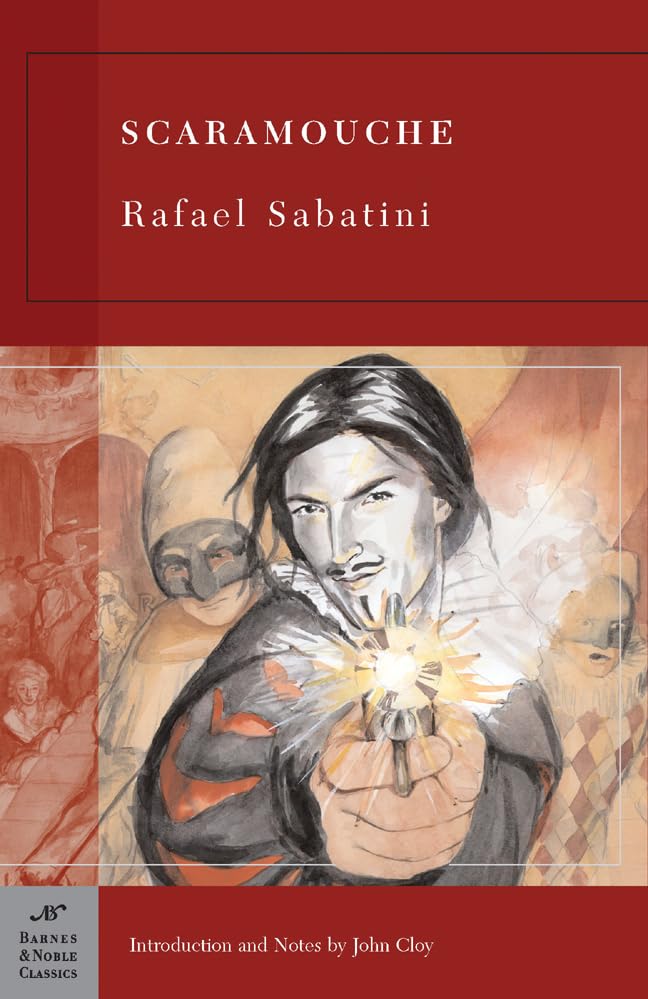



&&LDIV&&R&&LDIV&&R&&LDIV&&R&&LDIV&&R&&LI&&RScaramouche&&L/I&&R, by &&LB&&RRafael Sabatini&&L/B&&R, is part of the &&LI&&R &&LI&&RBarnes & Noble Classics&&L/I&&R &&L/I&&Rseries, which offers quality editions at affordable prices to the student and the general reader, including new scholarship, thoughtful design, and pages of carefully crafted extras. Here are some of the remarkable features of &&LI&&RBarnes & Noble Classics&&L/I&&R: &&LDIV&&R New introductions commissioned from todays top writers and scholars - Biographies of the authors - Chronologies of contemporary historical, biographical, and cultural events - Footnotes and endnotes - Selective discussions of imitations, parodies, poems, books, plays, paintings, operas, statuary, and films inspired by the work - Comments by other famous authors - Study questions to challenge the readers viewpoints and expectations - Bibliographies for further reading - Indices & Glossaries, when appropriate All editions are beautifully designed and are printed to superior specifications; some include illustrations of historical interest. &&LI&&RBarnes & Noble Classics &&L/I&&Rpulls together a constellation of influences―biographical, historical, and literary―to enrich each readers understanding of these enduring works.&&L/DIV&&R&&L/DIV&&R&&L/DIV&&R&&LDIV&&R &&L/DIV&&R&&LDIV&&RRaised by a supposed "godfather," Andre-Louis Moreau knows nothing about his background or his real parents―not even his real name. All he knows is that he wants vengeance against the vicious, arrogant aristocrat who brutally murdered his best friend. As France plummets into revolution at the end of the eighteenth century, Moreaus journey toward revenge takes him through several careers, from lawyer to fugitive to actor and playwright―and eventually to member of the French National Assembly. Hiding with a troupe of itinerant actors, he gleefully plays the traditional Commedia Dell-Arte role of Scaramouche, the trouble-making trickster who, like Shakespeares fools and jesters, speaks painful truths disguised as harmless comedy. &&LP&&R&&LSTRONG&&RRafael Sabatini&&L/B&&R was a twentieth-century Alexandre Dumas: a masterful creator of swashbuckling historical romances. Mixing real people with fictional characters and actual events with invented ones, Sabatini drew vivid, accurately detailed pictures of revolution-addled France. In Scaramouche, he turns a sweeping adventure epic into a subtle psychological study, as Moreaus odyssey gradually becomes less about revenge than about self-discovery.&&L/P&&R&&L/DIV&&R&&LSTRONG&&RIncludes 8 pieces of original art.&&L/B&&R&&LBR&&R&&L/DIV&&R&&LDIV&&R&&LDIV&&R&&LB&&RJohn D. Cloy, Ph.D.&&L/B&&R, is Bibliographer for the Humanities at the University of Mississippi Libraries. He is the author of &&LI&&RPensive Jester: The Literary Career of W.W. Jacobs&&L/I&&R (University Press of America, 1996) and &&LI&&RMuscular Mirth: Barry Pain and the New Humor&&L/I&&R (University of Victoria Press, 2003), as well as various articles on turn-of-the-century English literature and humor, comparative literature, and British short fiction.&&L/DIV&&R&&L/DIV&&R&&L/DIV&&R John D. Cloy, Ph.D. , is Bibliographer for the Humanities at the University of Mississippi Libraries. He is the author of Pensive Jester: The Literary Career of W.W. Jacobs (University Press of America, 1996) and Muscular Mirth: Barry Pain and the New Humor (University of Victoria Press, 2003), as well as various articles on turn-of-the-century English literature and humor, comparative literature, and British short fiction. From John Cloy’s Introduction to Scaramouche When Rafael Sabatini’s Scaramouche: A Romance of the French Revolution was published in 1921, he was already an established author, with a dozen books to his credit. This swashbuckling novel, set during the French Revolution, won him an even larger audience and made him a tidy sum of money. Hailed as the “new Dumas” by his admirers, the author was welcomed by lovers of action literature, historical fiction, and period stories. The novel was initially turned down by several publishers before being accepted by London publisher Hutchinson, who happily watched it sell hundreds of thousands of copies (the American publisher was Houghton Mifflin). Scaramouche was instrumental in resurrecting a flagging literary genre, the historical novel. Although historical fiction had enjoyed a brief rebirth during the years of World War I (probably because of a widespread demand for escapist literature), its vogue had quickly faded as soon as the conflict ended. Perhaps the popularity of that relatively new medium, the movie, contributed to Sabatini’s success with this somewhat unfashionable literary form. Scaramouche was made into several films, one starring box office idols Stewart Granger and Janet Leigh. The writer’s well-crafted prose, his meticulous historical research, fluency in at least six languages, cosmopolitan background, and singular a