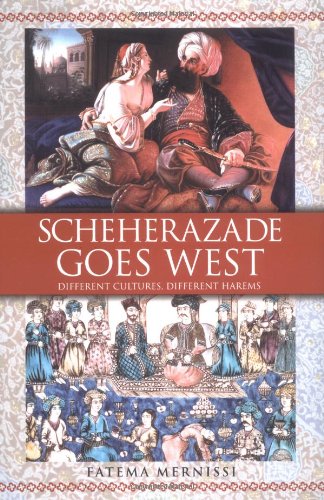



Throughout my childhood, my grandmother Yasmina, who was illiterate and grew up in a harem, repeated that to travel is the best way to learn and to empower yourself. "When a woman decides to use her wings, she takes big risks," she would tell me, but she was convinced that if you didn't use them, it hurt.... So recalls Fatema Mernissi at the outset of her mesmerizing new book. Of all the lessons she learned from her grandmother -- whose home was, after all, a type of prison -- the most central was that the opportunity to cross boundaries was a sacred privilege. Indeed, in journeys both physical and mental, Mernissi has spent virtually all of her life traveling -- determined to "use her wings" and to renounce her gender's alleged legacy of powerlessness. Bursting with the vitality of Mernissi's personality and of her rich heritage, Scheherazade Goes West reveals the author's unique experiences as a liberated, independent Moroccan woman faced with the peculiarities and unexpected encroachments of Western culture. Her often surprising discoveries about the conditions of and attitudes toward women around the world -- and the exquisitely embroidered amalgam of clear-eyed autobiography and dazzling meta-fiction by which she relates those assorted discoveries -- add up to a deliciously wry, engagingly cosmopolitan, and deeply penetrating narrative. In her previous bestselling works, Mernissi -- widely recognized as the world's greatest living Koranic scholar and Islamic sociologist -- has shed unprecedented light on the lives of women in the Middle East. Now, as a writer and scholarly veteran of the high-wire act of straddling disparate societies, she trains her eyes on the female culture of the West. For her book's inspired central metaphor, Mernissi turns to the ancient Islamic tradition of oral storytelling, illuminating her grandmother's feminized, subversive, and highly erotic take on Scheherazade's wife-preserving tales from The Arabian Nights -- and then ingeniously applying them to her own lyrically embellished personal narrative. Interwoven with vivid ruminations on her childhood, her education, and her various international travels are the author's piquant musings on a range of deeply embedded societal conditions that add up, Mernissi argues, to a veritable "Western harem." A provocative and lively challenge to the common assumption that women have it so much better in the West than anywhere else in the world, Mernissi's book is an entrancing and timely look at the way we live here and now. By inspiring us to reconsider even the most commonplace aspects of our culture with fresh eyes and a healthy dose of suspicion, Scheherazade Goes West offers an invigorating, candid, and entertaining new perspective on the themes and ideas to which Betty Friedan first turned us on nearly forty years ago. Fatima Mernissi's unclassifiable book, at turns scholarly, playful, watchful, and admonitory, perfectly juxtaposes the relations between men and women in Europe with those in the Muslim world. In Scheherazade Goes West: Different Cultures, Different Harems , there is a studied casualness in Mernissi's observations, which she presents as a series of discoveries reached through conversations with friends, through reading and travels, and through her own lived experience as a liberated Moroccan woman, a feminist professor of sociology at a Moroccan university. In 1994, Mernissi traveled to 10 Western cities to promote her bestselling book, Dreams of Trespass: Tales of a Harem Girlhood , a luxury not available to her illiterate grandmother Yasmina, to whom the harem was a prison, rather than the idealized sanctuary of Western myth. The contrasts Mernissi discovered between East and West were not as simple as one might imagine. In Berlin, for example, she leafed through pornographic German photo books of "harem women," produced for an eager audience of Western men, and in Paris, she accompanied a male friend on a walking tour of his favorite odalisques, from Ingres to Matisse, while he explained how comforting an insecure man found these nude, silent women. While the medieval caliphs tended to prize intelligence and erudition among the women of their harems, Western writers have lauded beauty over every other quality; as Kant put it, a learned woman "might as well even have a beard." In deceptively light prose, Mernissi introduces the sexual politics of Islam to a Western audience, while pointing out the inconsistencies and illogic in the Western tradition. --Regina Marler When Moroccan sociologist Mernissi went on tour to promote her 1994 book, Dreams of Trespass: Tales of a Harem Girlhood, she was perplexed when Western audiences reacted to the word harem as though she had uttered something salacious. Eager to understand this phenomenon, she began to study European and American art, dance, and literature. Her queries revealed that the non-Arab world sees the harem as a "peaceful pleasure-garden where omnipotent men