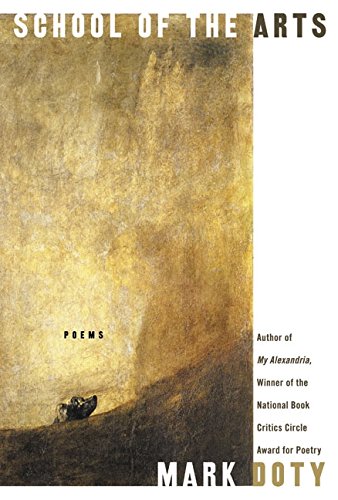



The darkly graceful poems in Mark Doty's seventh collection explore the ways in which we are educated by the implacable powers of time and desire. The world constantly renews itself, and the new brings both possibility and erasure. Given the limits of our own bodies, how are we to live within the inevitability of despair? This is the plainest of Doty's books, its language stripped and humbled. But whatever depths are sounded in these poems, their humane and open music sustains. Art itself instructs us. Lucian Freud's startling renditions of human skin, Virginia Woolf's ecstatic depiction of consciousness, Caravaggio's only-too-real people elevated to difficult glory -- all turn the light of human intelligence upon "the night of time." Formally inventive, warm, at once witty and disconsolate, School of the Arts represents a poet reinventing his own voice at midlife, finding a way through a troubled passage. Acutely attentive, insistently alive, this is a book of "fierce vulnerability." If the expression of an artist's personal search for truth can manifest as a discovery process for the reader, Doty, a highly regarded writer with six poetry collections and three creative nonfiction works to his name, has mastered that approach and more. Here Doty presents poems that intertwine feeling and intellect through the symbolism of the everyday world. Whether observing the futile action of his old dog trying to climb a flight of stairs or recording the changes in a beloved Cape Cod town, Doty notices the physicality of time and place while connecting his observations to universal questions, longings, truths. Although this collection may be the sparsest yet in terms of word use, the poems are ever more sophisticated in their structure. Doty's writing continues to evolve. Rather than sticking with the voice that made him successful, he pushes the boundaries of thought and form, always searching and considering and never wavering in his attempt to not only understand the world but determine the best way to "be" in it. Janet St. John Copyright © American Library Association. All rights reserved “Vivid, inviting, descriptive verse.” — Publishers Weekly “Achieve[s] a quiet grandeur with a voice marked by the clarity and thoughtful lyricism that distinguished his earlier collections.” — Ilya Kaminsky, Library Journal, starred review “Memorable, essential, big hearted, joyous in music ... this is the finest book of poems by one of our finest poets.” — Alan Shapiro The darkly graceful poems in Mark Doty's seventh collection explore the ways in which we are educated by the implacable powers of time and desire. The world constantly renews itself, and the new brings both possibility and erasure. Given the limits of our own bodies, how are we to live within the inevitability of despair? This is the plainest of Doty's books, its language stripped and humbled. But whatever depths are sounded in these poems, their humane and open music sustains. Art itself instructs us. Lucian Freud's startling renditions of human skin, Virginia Woolf's ecstatic depiction of consciousness, Caravaggio's only-too-real people elevated to difficult glory -- all turn the light of human intelligence upon "the night of time." Formally inventive, warm, at once witty and disconsolate, School of the Arts represents a poet reinventing his own voice at midlife, finding a way through a troubled passage. Acutely attentive, insistently alive, this is a book of "fierce vulnerability." Mark Doty's books of poetry and nonfiction prose have been honored with numerous distinctions, including the National Book Critics Circle Award, the PEN/Martha Albrand Award, the Los Angeles Times Book Prize, and, in the United Kingdom, the T. S. Eliot Prize. In 2008, he won the National Book Award for Fire to Fire: New and Selected Poems . He is a professor at the University of Houston, and he lives in New York City.