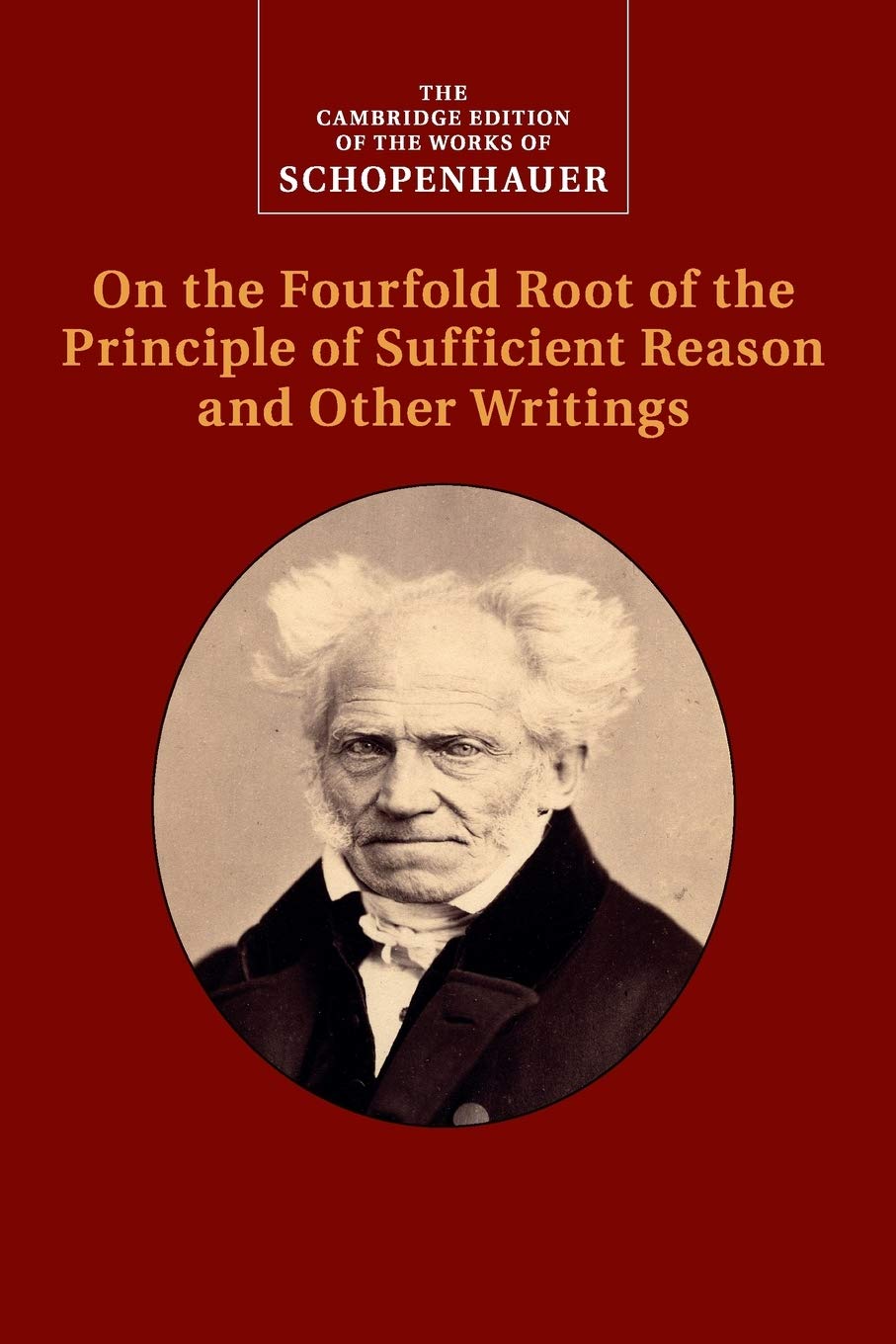
Schopenhauer: On the Fourfold Root of the Principle of Sufficient Reason and Other Writings (The Cambridge Edition of the Works of Schopenhauer)
$64.00
by Arthur Schopenhauer



This volume of new translations unites three shorter works by Arthur Schopenhauer that expand on themes from his book The World as Will and Representation. In On the Fourfold Root he takes the principle of sufficient reason, which states that nothing is without a reason why it is, and shows how it covers different forms of explanation or ground that previous philosophers have tended to confuse. Schopenhauer regarded this study, which he first wrote as his doctoral dissertation, as an essential preliminary to The World as Will. On Will in Nature examines contemporary scientific findings in search of corroboration of his thesis that processes in nature are all a species of striving towards ends; and On Vision and Colours defends an anti-Newtonian account of colour perception influenced by Goethe's famous colour theory. This is the first English edition to provide extensive editorial notes on the different published versions of these works. "...it’s a pleasure to welcome the latest volume from the Cambridge University Press uniform series of the philosopher’s works, On the Fourfold Root of the Principle of Sufficient Reason and Other Writings, published just last month. The enthusiast will be very glad to see that, along with a new translation of Schopenhauer’s dissertation, there are also new translations of On Vision and Colors and On Will in Nature, the first influenced by the young Schopenhauer’s friendship with the older Goethe and the second a treatise about the ways in which Schopenhauer’s metaphysical “will” operates through the physical world. These essays have been among the hardest to get a hold of, and now that we have these new translations (by David E. Cartwright, Edward E. Erdmann, and Christopher Janaway), we can look forward to meeting Schopenhauer’s expectations of us through the rest of the winter..." --George Hunk, Superfluities Redux "This new translation of three of Schopenhauer’s essays is of a very high quality and is testament to the customary rigor of the Cambridge Translations, Undoubtedly, this new edition will become in time the standard work of reference for English-speaking scholars worldwide." Dennis Vanden Auweele, Leuven, Philosophischer Literaturanzeiger vol. 66 (2013), no. 2 These translations provide a comprehensive view of Schopenhauer's contribution to epistemology, theory of perception and philosophy of nature. David E. Cartwright is a Professor of Philosophy and Religious Studies and the chair of the Department of Philosophy and Religious Studies at the University of Wisconsin, Whitewater. He has numerous publications in nineteenth-century German philosophy and has edited and translated a number of Schopenhauer's books, most recently, with Edward E. Erdmann, The Two Fundamental Problems of Ethics (2010); and he is the author of Schopenhauer: A Biography (2010). Edward E. Erdmann is an emeritus faculty member of the University of Wisconsin, Whitewater with a scholarly background in classical and early modern rhetorical theory. He writes regularly on subjects in agriculture, has edited German translations of textbooks and scientific reports on organic agriculture. Christopher Janaway is Professor of Philosophy at the University of Southampton. He has published widely on nineteenth-century German philosophy, including Self and World in Schopenhauer's Philosophy (1989), The Cambridge Companion to Schopenhauer (1999), Schopenhauer: A Very Short Introduction (2002), and Beyond Selflessness: Reading Nietzsche's Genealogy (2007). He is General Editor of The Cambridge Edition of the Works of Schopenhauer, in which he has translated The Two Fundamental Problems of Ethics and co-translated The World as Will and Representation, Volume 1.