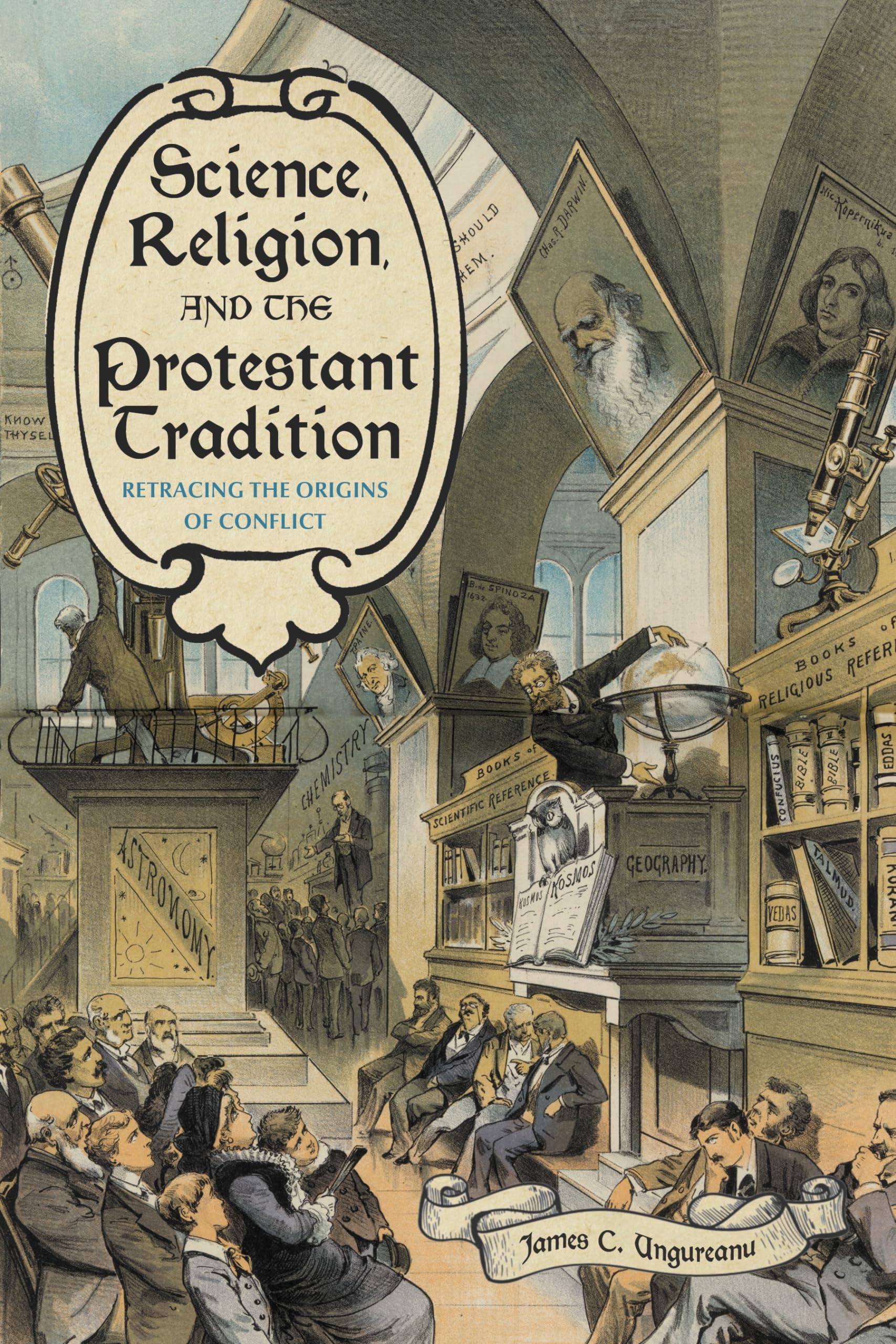
Science, Religion, and the Protestant Tradition: Retracing the Origins of Conflict (Sci & Culture in the Nineteenth Century)
$37.50
by James C. Ungureanu



The story of the “conflict thesis” between science and religion―the notion of perennial conflict or warfare between the two―is part of our modern self-understanding. As the story goes, John William Draper (1811–1882) and Andrew Dickson White (1832–1918) constructed dramatic narratives in the nineteenth century that cast religion as the relentless enemy of scientific progress. And yet, despite its resilience in popular culture, historians today have largely debunked the conflict thesis. Unravelling its origins, James Ungureanu argues that Draper and White actually hoped their narratives would preserve religious belief. For them, science was ultimately a scapegoat for a much larger and more important argument dating back to the Protestant Reformation, where one theological tradition was pitted against another―a more progressive, liberal, and diffusive Christianity against a more traditional, conservative, and orthodox Christianity. By the mid-nineteenth century, narratives of conflict between “science and religion” were largely deployed between contending theological schools of thought. However, these narratives were later appropriated by secularists, freethinkers, and atheists as weapons against all religion. By revisiting its origins, development, and popularization, Ungureanu ultimately reveals that the “conflict thesis” was just one of the many unintended consequences of the Protestant Reformation. Ungureanu proposes a persuasive new reading of the two figures, and in the process he reveals fascinating understudied dimensions of the history of liberal Protestantism. ― Journal of Religion Ungureanu’s book is well written, an impressive piece of scholarship and will be essential reading for anyone who wants to understand the origins of the conflict narrative. ― Science & Christian Belief Meticulously researched and routinely insightful, this book provides a refreshing contribution to the historiography of the ‘conflict thesis’ and develops a compelling argument for historians of science to give more weight to religious history when appraising matters of science and religion. Albeit aimed at the Protestant tradition, Ungureanu’s work proffers a veritable treasure trove of Western intellectual history and, as such, speaks to a much wider audience. ― Isis Ungureanu . . . draws out the distinct positions held by Draper and White in enough detail to convince a reader that something other than a simple conflict between science and religion was being addressed in their work. His own work is comprehensively presented, meticulously documented, and exhaustively referenced. ― Reading Religion Ungureanu’s is relevant history. . . . This is fine scholarship, dense, detailed, and documented. . . . It is also well written, with frequent pauses to review arguments and conclusions, and persuasive. Required reading for historians, this work should also interest nonspecialists curious about the complex origins of the infamous conflict thesis, its ideological uses, and the value of the history of religion for historians of science. ― Perspectives in Science and Christian Faith In a time of alternative facts, rampant conspiracy theories, climate change denial, and an apparent upsurge in flat-earthers, it is a breath of fresh air to read James Ungureanu’s erudite analysis of why so many people came to believe, and still do, that religion and science are implacable enemies. In six eminently readable chapters and an excellent summary conclusion. . . . Ungureanu’s book makes an important contribution to understanding the role the Protestant Reformation played in paving the way for modernity and setting the stage for secularism. ― Church History James Ungureanu has undertaken extraordinarily exhaustive research and produced a book that offers an insightful, refreshing re-evaluation of two of the most influential figures in the modern history of religion and science. This book promises to reshape how historians understand the origin of the conflict thesis. -- David Mislin, Temple University Ungureanu develops an arresting reinterpretation of John William Draper and Andrew Dickson White, traditionally perpetrators of the ‘conflict thesis,’ but whose intentions, he argues, were not to attack ‘religion’ but to protect its progressive forms from obstructive theological orthodoxies. I highly recommend this book, which is particularly important for historians of liberal Protestantism and its secularizing legacy in late nineteenth-century Anglophonic debates about ‘science and religion.’ -- John Hedley Brooke, University of Oxford Ungureanu manages that most difficult task facing scholars writing for their own, as well as a more general readership, to keep up his narrative’s momentum and readability while at the same time refusing to trivialize or take short cuts. He does this very well, unfolding fascinating aspects of the emerging backdrop to Draper and White, such as the predominantly Anglo-American influences of the