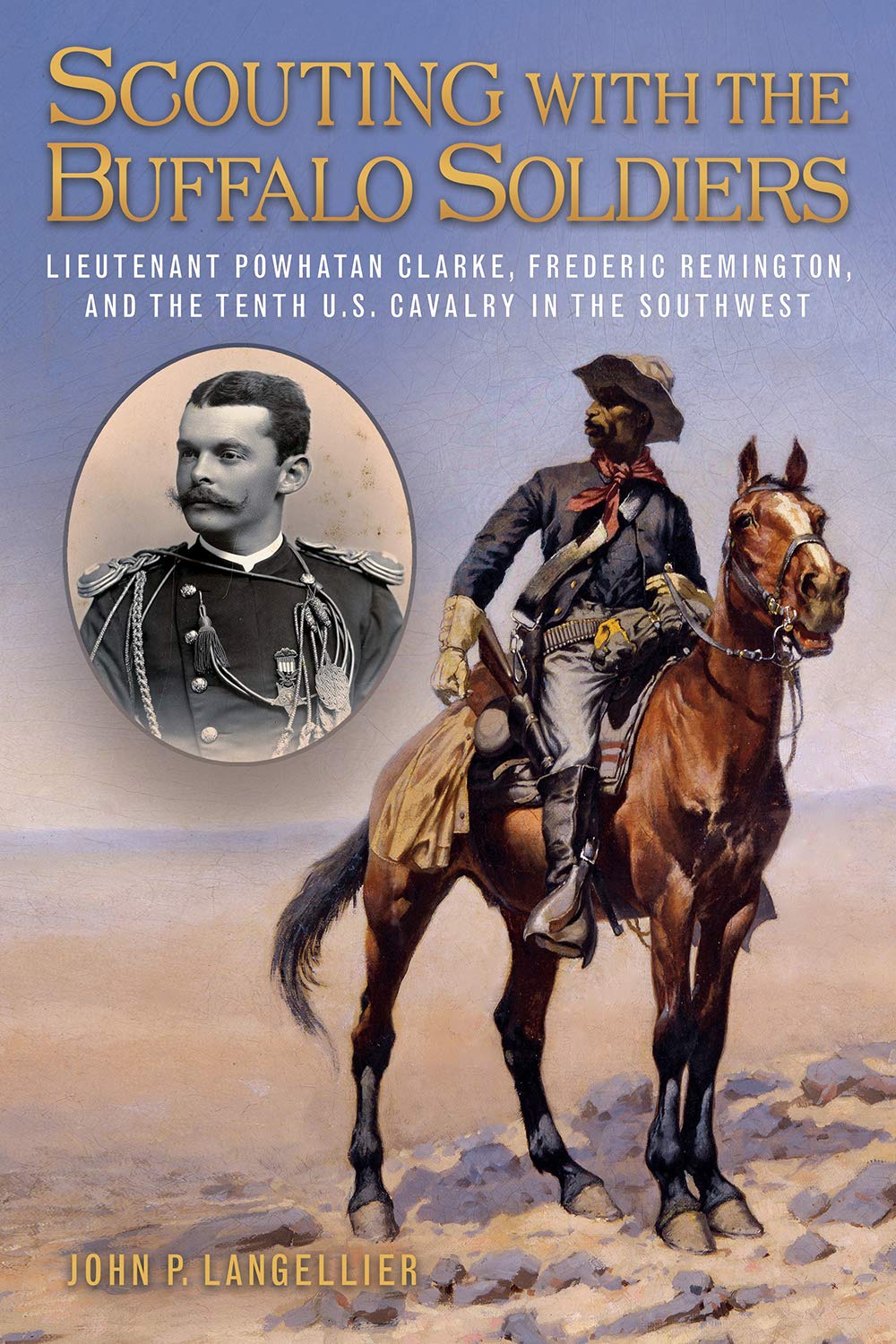
Scouting with the Buffalo Soldiers: Lieutenant Powhatan Clarke, Frederic Remington, and the Tenth U.S. Cavalry in the Southwest (Volume 19) (North
$34.95
by John P Langellier



On a hot summer’s day in Montana, a daring frontier cavalry officer, Powhatan Henry Clarke, died at the height of his promising career. A member of the U.S. Military Academy’s Class of 1884, Clarke graduated dead last, and while short on academic application, he was long on charm and bravado. Clarke obtained a commission with the black troops of the Tenth Cavalry, earning his spurs with these “Buffalo Soldiers.” He evolved into a fearless field commander at the troop level, gaining glory and first-hand knowledge of what it took to campaign in the West. During his brief, action-packed career, Clarke saved a black trooper’s life while under Apache fire and was awarded the Medal of Honor. A chance meeting brought Clarke together with artist Frederic Remington, who brought national attention to Clarke when he illustrated the exploit for an 1886 Harper’s Weekly . The officer and artist became friends, and Clarke served as a model and consultant for future artwork by Remington. Remington’s many depictions of Clarke added greatly to the cavalryman’s luster. In turn, the artist gained fame and fortune in part from drawing on Clarke as his muse. The story of these two unlikely comrades tells much about the final stages of the Wild West and the United States’ emergence on the international scene. Along the way Geronimo, The Apache Kid, “Texas” John Slaughter, and others played their roles in Clarke’s brief, but compelling drama. “ Scouting with the Buffalo Soldiers brims with insights into daily life at the company level in the Tenth Cavalry, the late Apache wars, a Medal of Honor episode, and a compelling cross-play with the artist Frederic Remington. The included artwork makes this a Remington must-have.”— Paul L. Hedren , author of Rosebud, June 17, 1876: Prelude to the Little Big Horn and Fort Laramie and the Great Sioux War “ Scouting with the Buffalo Soldiers takes a deep dive into Remington's important time with the 10th Cavalry that provided a lifetime of inspiration. It will be essential reading for our staff and for any Remington fan.”— Laura A. Foster , Director, Frederic Remington Art Museum, Ogdensburg, NY “John Langellier has done a marvelous job of researching the life of Powhatan Clarke and recounting his fascinating military career with the Buffalo Soldiers of the Tenth Cavalry. I found Langellier’s study of Clarke’s symbiotic relationship with Frederic Remington especially intriguing.”— Brian G. Shellum , author of Black Officer in a Buffalo Soldier Regiment: The Military Career of Charles Young “Once more, scholar and historian John P. Langellier has favored us with a readable, thoroughly researched book on the relationships and contributions of the remarkable nineteenth century U.S. black soldiers, also known as the Buffalo Soldiers. Langellier focuses on the two white compatriots of those intrepid black soldiers, one an officer and the other an artist. The first, Lieutenant Powhatan Clarke, and the second, prominent artist Frederic Remington, not only encouraged each other but also spoke highly and successfully of the behavior and exploits of the black soldiers in the west of the late nineteenth century. In the process, Langellier’s book becomes an interesting, knowledgeable, and enjoyable presentation of those worthy troops.”— Bruce A. Glasrud , editor of Brothers to the Buffalo Soldiers: Perspectives on the African American Militia and Volunteers, 1865-1917 and co-editor of Buffalo Soldiers in the West: A Black Soldiers Anthology "As inherently fascinating a read as it is informed and informative, Scouting with the Buffalo Soldiers is an extraordinary work of historical and meticulous scholarship."-- Midwest Book Review "[A]n insightful, extremely well-researched biography of a son of a Southern doctor whose life burned bright with unexpected fame from a serendipitous relationship with Remington."-- True West "The description of army life along the Texas and New Mexico borders with Mexico is particularly engaging. . . . [T]he book provides a welcome addition to the understanding of life as a Buffalo Soldier and the White officers who led them."-- Southwestern Historical Quarterly "It is an insightful work, letting the reader see working cavalry garrisons and how Troop K of the Tenth Cavalry operated in the field. While incidental to the overall work, the reader also sees brief glimpses into how Indian Scouts worked with the cavalry and how the Black troopers of the Tenth Cavalry fared on the frontier."-- Chronicles of Oklahoma "Langellier's analysis of Clarke's correspondence illuminates the monotony of garrison life, emotions during combat and scouting expeditions, civil-military relations, racial attitudes toward Black soldiers, personal rivalries, romantic pursuits, and other subjects. Soldiers' perspectives on these aspects of army life in the U.S. West are largely absent from official army records, and Langellier has certainly drawn attention to alternative