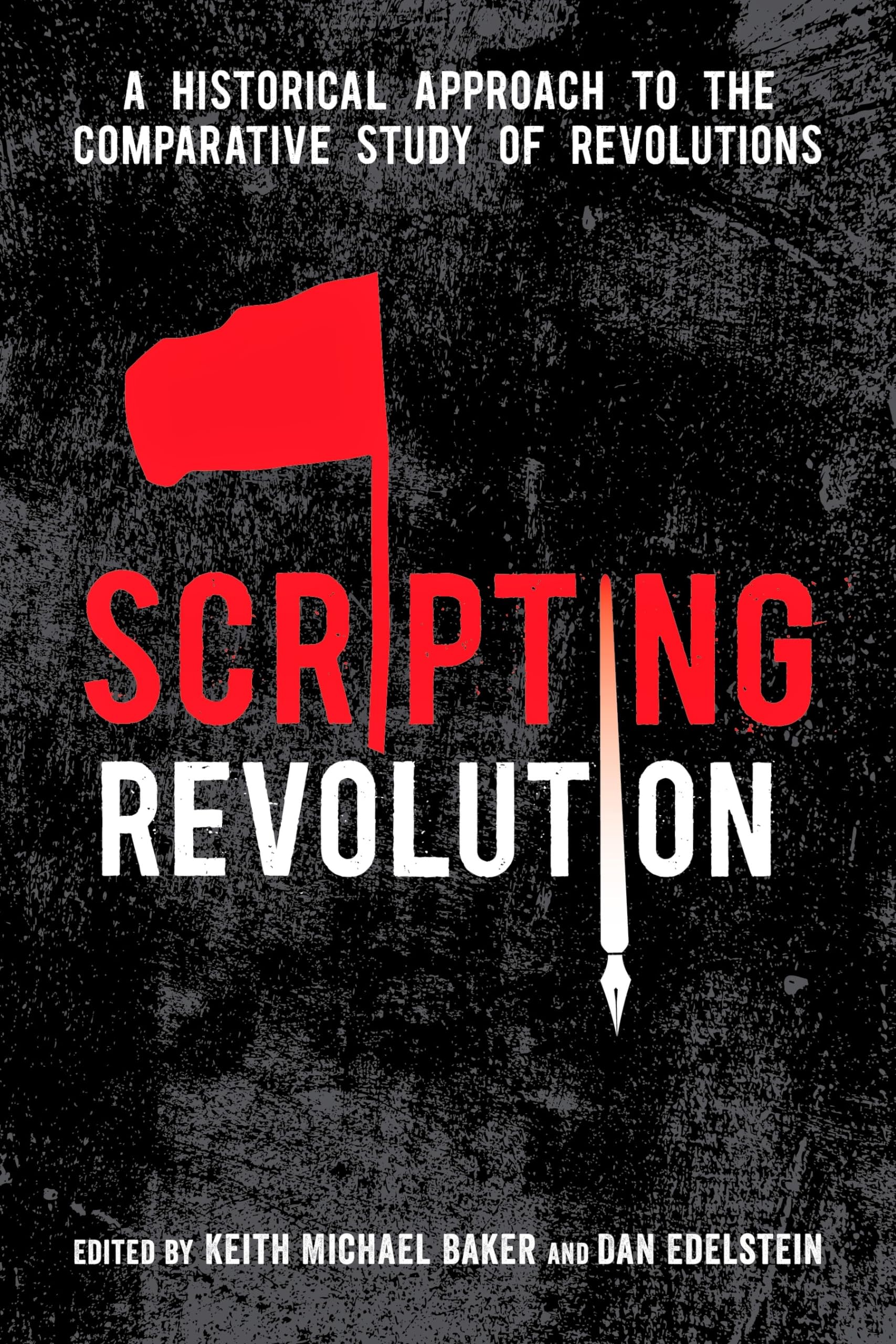
Scripting Revolution: A Historical Approach to the Comparative Study of Revolutions
$22.45
by Keith Baker



The "Arab Spring" was heralded and publicly embraced by foreign leaders of many countries that define themselves by their own historic revolutions. The contributors to this volume examine the legitimacy of these comparisons by exploring whether or not all modern revolutions follow a pattern or script. Traditionally, historians have studied revolutions as distinct and separate events. Drawing on close familiarity with many different cultures, languages, and historical transitions, this anthology presents the first cohesive historical approach to the comparative study of revolutions. This volume argues that the American and French Revolutions provided the genesis of the revolutionary "script" that was rewritten by Marx, which was revised by Lenin and the Bolshevik Revolution, which was revised again by Mao and the Chinese Communist Revolution. Later revolutions in Cuba and Iran improvised further. This script is once again on display in the capitals of the Middle East and North Africa, and it will serve as the model for future revolutionary movements. "The comparative study of revolutions has been left to sociologists and political scientists for too long. This book is long overdue and will undoubtedly become a landmark in the comparative study of revolutions and a spur to further research on revolutions."―Darrin McMahon, Dartmouth College "An important and exciting book in several respects, this volume provides a rare opportunity for today's historians to engage in some hard-nosed, systematic comparative history in a highly constructive manner while greatly widening their own personal perspective on the spectrum of modern revolutions. It also makes a splendid teaching tool." ―Jonathan Israel, H-France "Keith Michael Baker and Dan Edelstein have edited an important and timely book that reassesses how the concept of revolution has evolved over the past three centuries....[T]he editors are right to insist that humanists can and should get back into the comparative revolutions business."―Nathan Perl-Rosenthal, Journal of Modern History Keith M. Baker is Professor of Early Modern European History at Stanford University. His books include What's Left of Enlightenment? and Inventing the French Revolution . Dan Edelstein is Professor of French and History at Stanford University. He is the author of The Terror of Natural Right: Republicanism, the Cult of Nature, and the French Revolution , which won the 2009 Oscar Kenshur Book Prize. Scripting Revolution A Historical Approach to the Comparative Study of Revolutions By Keith Michael Baker, Dan Edelstein STANFORD UNIVERSITY PRESS Copyright © 2015 Board of Trustees of the Leland Stanford Junior University All rights reserved. ISBN: 978-0-8047-9616-3 Contents Introduction KEITH MICHAEL BAKER AND DAN EDELSTEIN, Part I: Genealogies of Revolution, Did the English Have a Script for Revolution in the Seventeenth Century? TIM HARRIS, God's Revolutions: England, Europe, and the Concept of Revolution in the Mid-seventeenth Century DAVID R. COMO, Every Great Revolution Is a Civil War DAVID ARMITAGE, Part II: Writing the Modern Revolutionary Script, Revolutionizing Revolution KEITH MICHAEL BAKER, Constitutionalism: The Happiest Revolutionary Script JACK RAKOVE, From Constitutional to Permanent Revolution: 1649 and 1793 DAN EDELSTEIN, Scripting the French Revolution, Inventing the Terror: Marat's Assassination and its Interpretations GUILLAUME MAZEAU, The Antislavery Script: Haiti's Place in the Narrative of Atlantic Revolution MALICK W. GHACHEM, Part III: Rescripting the Revolution, Scripting the German Revolution: Marx and 1848 GARETH STEDMAN JONES, Reading and Repeating the Revolutionary Script: Revolutionary Mimicry in Nineteenth-Century France DOMINICA CHANG, "Une Révolution Vraiment Scientifique": Russian Terrorism, the Escape from the European Orbit, and the Invention of a New Revolutionary Paradigm CLAUDIA VERHOEVEN, Scripting the Russian Revolution IAN D. THATCHER, Part IV: Revolutionary Projections, You Say You Want a Revolution: Revolutionary and Reformist Scripts in China, 1894–2014 JEFFREY WASSERSTROM AND YIDI WU, Mao's Little Red Book: The Spiritual Atom Bomb and Its Global Fallout ALEXANDER C. COOK, The Reel, Real and Hyper-Real Revolution: Scripts and Counter-Scripts in Cuban Documentary Film LILLIAN GUERRA, Writing on the Wall: 1968 as Event and Representation JULIAN BOURG, Scripting a Revolution: Fate or Fortuna in the 1979 Revolution in Iran ABBAS MILANI, The Multiple Scripts of the Arab Revolutions SILVANA TOSKA, Afterword DAVID A. BELL, Contributors, Notes, Index, CHAPTER 1 Did the English Have a Script for Revolution in the Seventeenth Century? TIM HARRIS The seventeenth-century English joked about themselves being a rebellious people. "The King of Spain," ran a common adage, was "said to be Rex Hominum, the king of men, his subjects being generally well affected towards him: the King of Fran