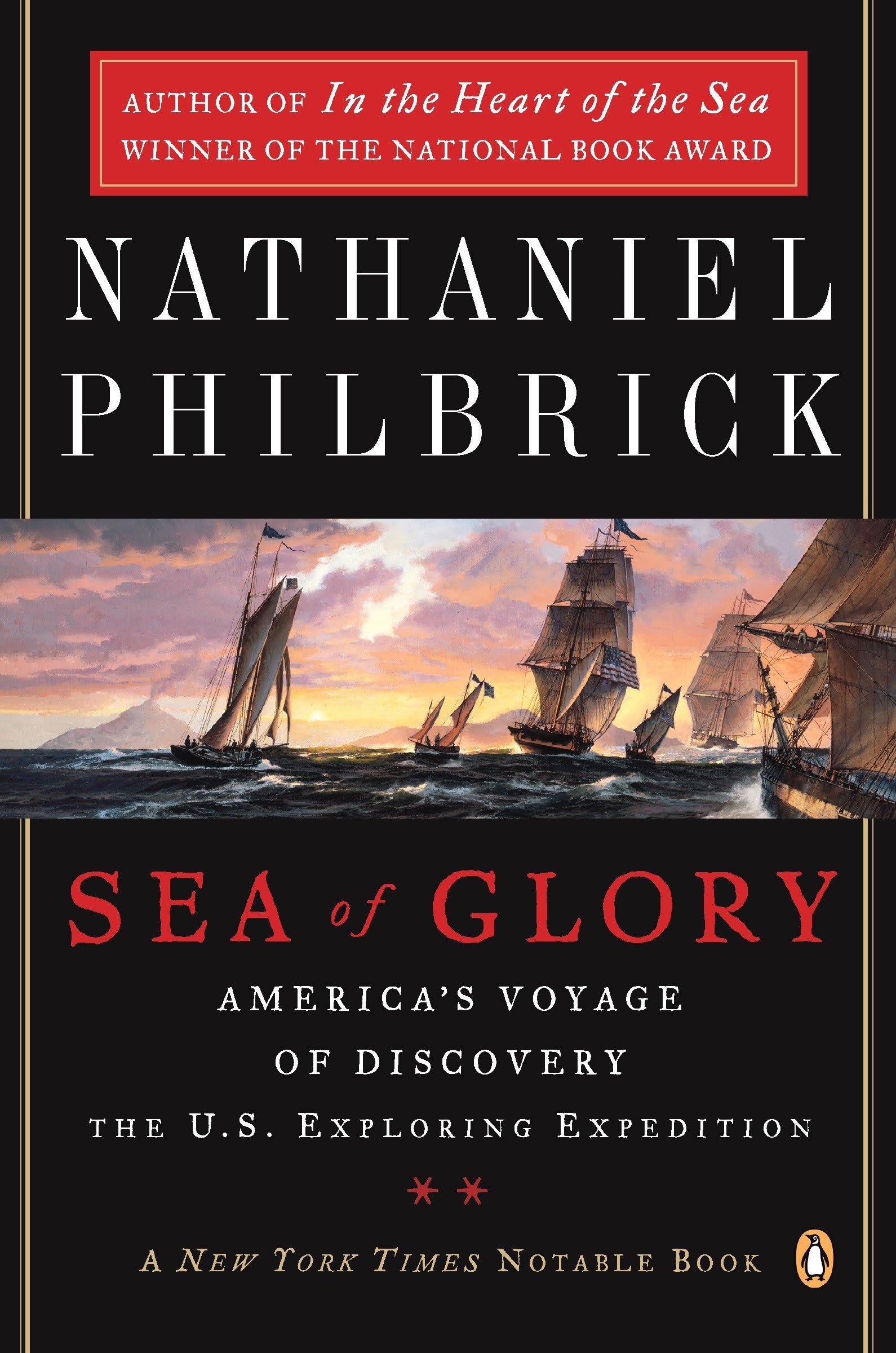
Sea of Glory: America's Voyage of Discovery, The U.S. Exploring Expedition, 1838-1842
$9.93
by Nathaniel Philbrick



"A treasure of a book."—David McCullough The harrowing story of a pathbreaking naval expedition that set out to map the entire Pacific Ocean, dwarfing Lewis and Clark with its discoveries, from the New York Times bestselling author of Valiant Ambition and In the Hurricane's Eye . A New York Times Notable Book America's first frontier was not the West; it was the sea, and no one writes more eloquently about that watery wilderness than Nathaniel Philbrick. In his bestselling In the Heart of the Sea Philbrick probed the nightmarish dangers of the vast Pacific. Now, in an epic sea adventure, he writes about one of the most ambitious voyages of discovery the Western world has ever seen—the U.S. Exploring Expedition of 1838–1842. On a scale that dwarfed the journey of Lewis and Clark, six magnificent sailing vessels and a crew of hundreds set out to map the entire Pacific Ocean and ended up naming the newly discovered continent of Antarctica, collecting what would become the basis of the Smithsonian Institution. Combining spellbinding human drama and meticulous research, Philbrick reconstructs the dark saga of the voyage to show why, instead of being celebrated and revered as that of Lewis and Clark, it has—until now—been relegated to a footnote in the national memory. Winner of the Theodore and Franklin D. Roosevelt Naval History Prize "Fascinating and meticulous . . . A wonderful retelling." —The New York Times Book Review "A breathtaking account of one of history's greatest adventures." — Entertainment Weekly "A worthy successor to In the Heart of the Sea ." — The Wall Street Journal " Sea of Glory is a grand saga of scientific and nautical accomplishment." — Newsweek Nathaniel Philbrick is the author of In the Heart of the Sea , winner of the National Book Award; Mayflower , finalist for the Pulitzer Prize; Bunker Hill , winner of the New England Book Award; Sea of Glory ; The Last Stand ; Why Read Moby Dick? ; and Away Off Shore . He lives in Nantucket. His latest book is Valiant Ambition: George Washington, Benedict Arnold, and the Fate of the American Revolution . PREFACE Young Ambition He was not yet forty-five, but he looked much older, his health broken by four years of hardship and danger. But he had done it. He had successfully completed the voyage of a lifetime—the kind of voyage that had made heroes of Christopher Columbus and James Cook. The odds had been against him from the start. When his squadron of six sailing vessels set out from the Norfolk Navy Yard in 1838, most of the world’s oceans had already been thoroughly explored. That had not prevented the United States from sending him on a bold, some said foolhardy mission: to scour the Southern Hemisphere of the earth for new lands. Miraculously, he had made discoveries that would redraw the map of the world. He and his officers had surveyed dozens of uncharted Pacific islands. They had completed America’s first survey of what would one day become the states of Oregon and Washington. His team of scientists had brought back forty tons of specimens and artifacts, including two thousand never-before-identified species. Most impressive of all, he had established the existence of a new continent. Battling icebergs and gale-force winds in his fragile wooden ships, he had charted a 1,500-mile section of Antarctic coast that still bears his name: Wilkes Land. But on that September day in 1842, just a few months after his return to the United States, Lieutenant Charles Wilkes was anything but a hero. Instead of being honored with speeches and parades, he had been put on trial in the crowded cabin of the USS North Carolina anchored in New York Harbor. Beside him sat his attorney; across from them were the judges—thirteen naval officers who were about to decide whether he was guilty of illegally whipping his men, massacring the inhabitants of a tiny Fijian island, lying about the discovery of Antarctica, and other outrages. Sitting in the gallery were many of his own officers. They whispered among themselves and smiled, confident that their hated commander would soon get his due. He was a slight man with brown hair and a sharp blade of a nose, his cheeks pitted from smallpox and burned red by the sun and wind. Despite his haggard appearance, there was a fierceness in his eyes. After almost three weeks of testimony, it was now time for him to deliver his defense. He cleared his throat, and in a quavering, indignant voice, he began to tell his side of the story. America’s first frontier was not the West; it was the sea. The United States began as a string of coastal communities dominated by the Atlantic Ocean—a storm-wracked wilderness that made the forests of the interior look like a beckoning refuge. But travel by road was slow and difficult in the early years of the nation, while the sea was a highway that led to just about anywhere in the world. By the late eighteenth century, American mariners had ventured aro