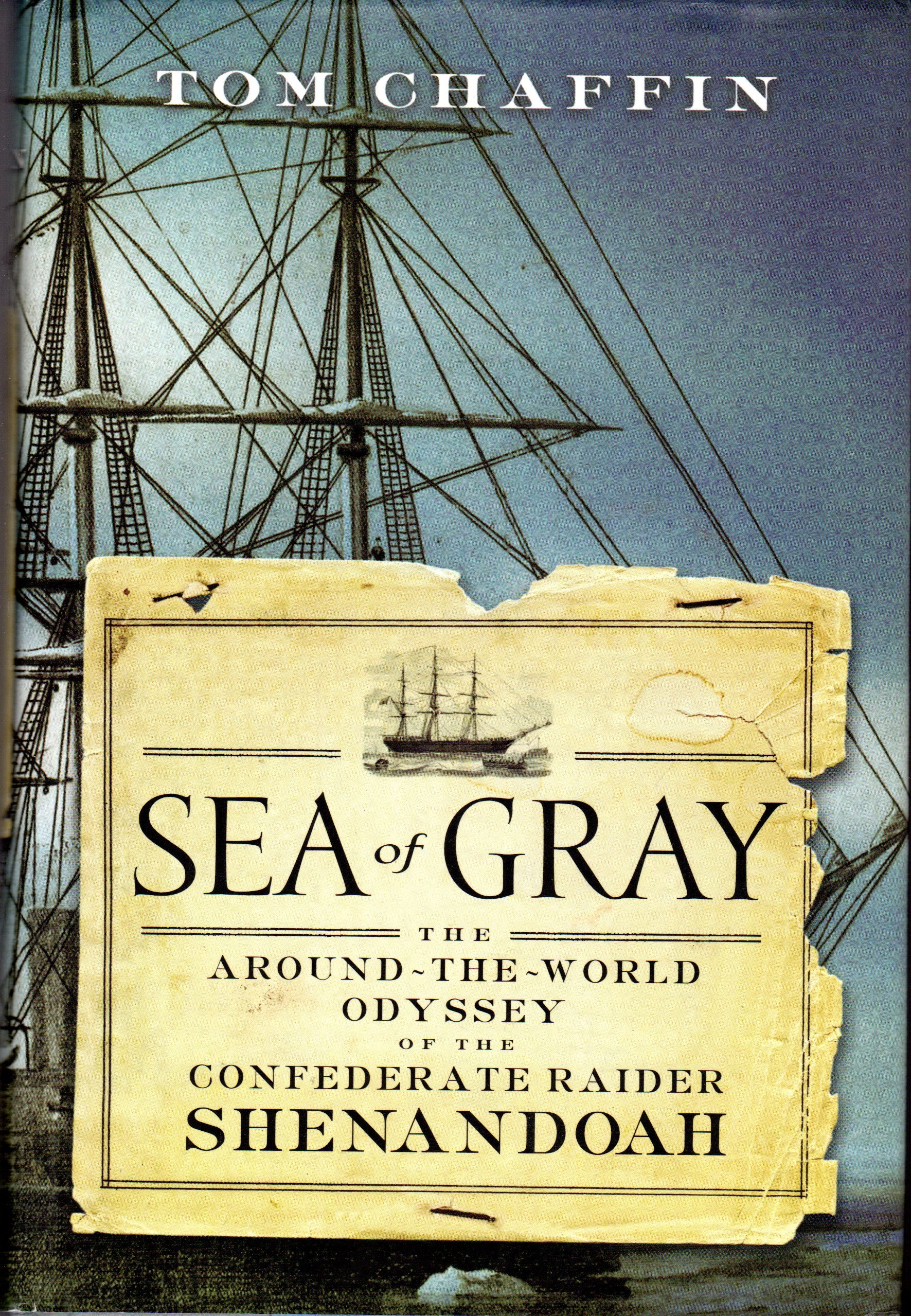
Sea of Gray: The Around-the-World Odyssey of the Confederate Raider Shenandoah
$16.95
by Tom Chaffin



The 58,000-Mile, Around-the-World Cruise of the Confederacy's Last Ship Afloat The sleek, 222-foot, black auxiliary steamer The Sea King left London on October, 8, 1864, ostensibly bound for Bombay. The subterfuge was ended off the shores of Madeira, as the ship was rechristened and outfitted for war. With new gun ports cut to accommodate additional cannon, the CSS Shenandoah commenced the last, most quixotic sea story of the Civil War, the 58,000-mile, around-the-world cruise of the Confederacy’s third most successful merchant raider. Before its voyage was over, thirty- two Union merchant and whaling ships and their cargoes would be sunk. But it was after ship and crew had rounded Africa’s Cape of Good Hope, stopped long enough in Australia to cause a diplomatic crisis, and navigated the ice floes of Siberia’s Sea of Okhotsk, the Bering Sea, and the Arctic Ocean that their journey took its most fearful turn. Four months after the Civil War was over, the Shenandoah ’s Captain Waddell finally learned he was, and had been, fighting without cause or state. In the eyes of the Union, he had gone from being an enemy combatant to a pirate, a hangable offense. Hunted by Union and British men-of-war, his polyglot crew rife with hints of mutiny, and with dwindling supplies, Waddell elected to camouflage the ship, circumnavigate the globe, and attempt to surrender on English soil. Assembled from hundreds of original documents, including intimate shipboard journals kept by Shenandoah officers, Sea of Gray is a masterful narrative of men at sea. Chaffin chronicles the remarkable story of the Shenandoah 's 58,000-mile voyage around the world during the Civil War. Along the way, it sunk 32 Union merchant and whaling ships heavily laden with cargo, including brandy, rum, and whiskey. After the vessel rounded Africa's Cape of Good Hope, it stopped in Australia and then navigated the ice floes of Siberia's Sea of Okhotsk, the Bering Sea, and the Arctic Ocean--much of it through gales, ice fields, subfreezing temperatures, fog, and rain. The ship's crew hoped to destroy the Yankees' western Arctic whaling fleet, but four months after the war ended, the Shenan doah's captain learned that he had been fighting a war "without cause or state." He had gone from being an enemy combatant to a pirate, an offense that could get him hanged. He camouflaged the vessel, circumnavigated the globe, and attempted to surrender in England. Chaffin drew on hundreds of original documents in researching this riveting narrative of one episode of the Civil War. George Cohen Copyright © American Library Association. All rights reserved "Meticulously researched . . . Chaffin, the author of Pathfinder: John Charles Frémont and the Course of American Empire, has drawn from a rich array of primary sources, including shipboard journals, crew memoirs, and newspaper accounts, to tell the story of the raider's 58,000-mile journey . . . A brisk and engaging read."-- Elizabeth D. Hoover, American Heritage Tom Chaffin is the author of Pathfinder: John Charles Frémont and the Course of American Empire . His work has appeared in The New York Times , Harper’s Magazine , Time , and other publications. He lives in Atlanta, Georgia. Excerpted from Sea of Gray by Tom Chaffin. Copyright © 2006 by Tom Chaffin. Published February 2006 by Hill and Wang, a division of Farrar, Straus and Giroux, LLC. All rights reserved. One Of Ice Floes and Arctic Fires I t was just past 1:00 a.m., June 28, 1865, a few tilting spins of the earth beyond the year’s longest day. And in the Bering Strait the hazy summer dawn breaking over the blue-white ice floes crowding its waters revealed a curious tableau: framed by the dark, distant, snow-crowned headlands to the east and west and, at a lower elevation, the two flat- and sheer-sided Diomede Islands tucked between those mainland heights, rose a forest of masts, sails, and rigging. Closer inspection revealed a listing three-masted whaleship. Moored to it by a web of radiating ropes bobbed five smaller vessels, the thirty-five-foot whaleboats that, on better days, the whaleship dispatched to harpoon the bowhead whales that brought white men to these remote climes. And, completing the scene, forming its outer perimeter, nine other whaling vessels swung at anchor in the eerily calm waters of this 37° F cloudless Arctic morning. A day earlier the winds that often slice through this storied icy gut dividing North America and Asia had roiled those waters; swells had blown the Brunswick —the now-listing ship from New Bedford, Massachusetts—against one of the ice floes. During the summer these chunks of ice drift northward from the Pacific to the Arctic through this fifty-mile-wide passage between Siberia’s western and Alaska’s eastern shores. The collision stove a hole below the Brunswick ’ s waterline, breaching the wooden planking and the copper-alloy sheathing of her hull. Afterward the ship’s officers and c